Table of Contents
- The Key Verse: Revelation 3:20
- Who Was Jesus Speaking To?
- The Condition of the Laodicean Church
- What Does the Door Represent?
- The Meaning of the Knock
- The Promise of Fellowship
- A Table of Meaning: What Jesus at the Door Shows Us
- Is This About Salvation?
- When We Ignore the Knock
- Real-Life Application
- The Call to Repentance
- Why This Image Matters Today
- Christ’s Patience and Sovereignty
- The Personal Nature of the Invitation
- Opening the Door Today
- Final Reflection
- FAQs
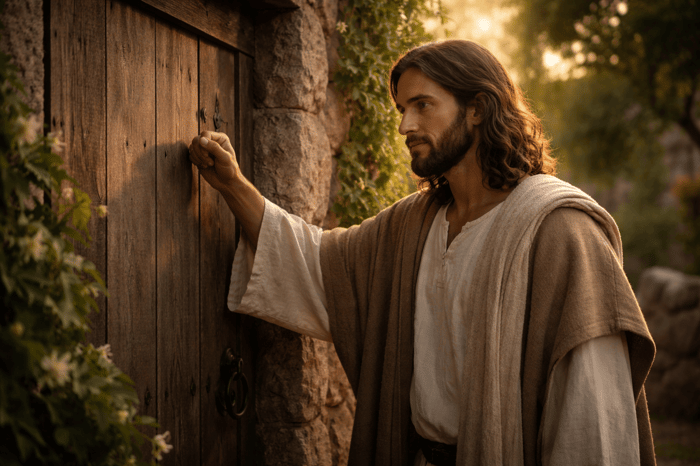
Jesus at the Door is one of the most loved images in the Bible. Many people picture Him standing outside, knocking, waiting to be invited in. The phrase comes from Revelation 3:20 and has shaped sermons, paintings, and personal faith stories for generations. But what does it truly mean when we talk about Jesus at the Door? Is it only about salvation? Or is there something deeper happening in this passage?
To understand this image, we must look at the full message behind it. When we do, we see not just a gentle knock, but a loving call to renewed fellowship, repentance, and restored closeness with Christ.
The Key Verse: Revelation 3:20
The image of Jesus at the Door comes from a letter written to the church in Laodicea. This church had become spiritually lukewarm. They were not openly rejecting Christ, but they were not fully devoted either.
Revelation 3:20
Behold, I stand at the door and knock. If anyone hears my voice and opens the door, I will come in to him and eat with him, and he with me.
In this verse, Jesus says He stands at the door and knocks. If anyone hears His voice and opens the door, He will come in and share a meal with them.
This is not a picture of force. It is a picture of invitation.
Who Was Jesus Speaking To?
Many people use Revelation 3:20 in evangelism, and that can be helpful. Yet the original audience was not unbelievers. It was a church. Jesus was speaking to people who already claimed His name.
Here is what makes this powerful:
- They had grown comfortable.
- They trusted their wealth more than Christ.
- They had become spiritually dull.
- They thought they were fine, but they were not.
Jesus at the Door is a message to believers who have drifted.
The Condition of the Laodicean Church
Earlier in the letter, Jesus describes their spiritual state.
Revelation 3:15–16
“‘I know your works: you are neither cold nor hot. Would that you were either cold or hot! So, because you are lukewarm, and neither hot nor cold, I will spit you out of my mouth.
They were neither hot nor cold. They were lukewarm. This word paints a picture of useless water—neither refreshing nor healing.
Jesus was not rejecting them. He was confronting them. His knock at the door was an act of mercy.
What Does the Door Represent?
The door represents the heart, the center of a person’s life. In Scripture, the heart is where trust, desire, and worship live.
Other verses help us see this clearly:
Proverbs 4:23
Keep your heart with all vigilance,
for from it flow the springs of life.
When we think about Jesus at the Door, we should ask:
- Is He welcome in every part of my life?
- Have I closed certain rooms off?
- Am I spiritually distant?
The image is personal. It is not about church attendance. It is about fellowship.
The Meaning of the Knock
Jesus does not break down the door. He knocks.
That matters.
The knock shows:
- Patience
- Grace
- Respect for human response
- Ongoing pursuit
This connects with other passages that show Christ seeking His people.
Luke 19:10
For the Son of Man came to seek and to save the lost.”
The knock is not weakness. It is love.
The Promise of Fellowship
Jesus says that if anyone opens the door, He will come in and eat with them. In the ancient world, sharing a meal meant deep relationship and peace.
It was not casual.
This echoes what Jesus said to His disciples:
John 14:23
Jesus answered him, “If anyone loves me, he will keep my word, and my Father will love him, and we will come to him and make our home with him.
Jesus at the Door is not simply about getting saved and going to heaven. It is about daily communion with Christ.
A Table of Meaning: What Jesus at the Door Shows Us
| Image in Revelation 3:20 | What It Teaches | Why It Matters |
|---|---|---|
| Jesus standing | He takes initiative | Grace begins with Him |
| The knock | He invites, not forces | Love respects response |
| Hearing His voice | Relationship requires attention | Faith involves listening |
| Opening the door | Repentance and welcome | We respond in trust |
| Sharing a meal | Close fellowship | Christianity is relational |
Is This About Salvation?
There is debate about whether Revelation 3:20 speaks of first-time salvation or restored fellowship. Many scholars believe it speaks mainly to believers who need renewal.
Still, the truth applies in both cases.
Jesus at the Door shows:
- Christ seeks sinners.
- Christ restores believers.
- Christ desires relationship.
Another verse supports this call to return:
James 4:8
Draw near to God, and he will draw near to you. Cleanse your hands, you sinners, and purify your hearts, you double-minded.
Drawing near to God is not a one-time act. It is ongoing.
When We Ignore the Knock
What happens when someone does not open the door?
Revelation does not describe Jesus leaving in anger. Yet the warning before this verse shows consequences for spiritual pride.
The Laodiceans believed they were rich and strong. But Jesus said they were poor and blind.
Revelation 3:17
For you say, “I am rich, I have prospered, and I need nothing,” not realizing that you are wretched, pitiable, poor, blind, and naked.
Ignoring Jesus at the Door leads to:
- Spiritual dryness
- Loss of joy
- False security
- Distance from Christ
Believers today can fall into the same trap.
Real-Life Application
Imagine someone who once loved prayer but now feels distracted. Or someone who once shared their faith but now stays silent. Or someone who once trusted God deeply but now relies only on comfort and success.
Jesus at the Door speaks to these moments.
It asks:
- Have you grown lukewarm?
- Have you drifted without noticing?
- Are you too busy to listen?
The call is gentle, but it is clear.
The Call to Repentance
Just before Revelation 3:20, Jesus gives instruction.
Revelation 3:19
Those whom I love, I reprove and discipline, so be zealous and repent.
He rebukes and disciplines those He loves.
That means the knock is connected to correction. It is not comfort alone. It is loving truth.
Repentance means turning around. It means reopening the door we may have quietly shut.
Why This Image Matters Today
Jesus at the Door continues to speak in a culture that values independence. Many people want Jesus as Savior but resist Him as Lord.
Yet fellowship requires surrender.
Here is a helpful summary:
| Response to the Knock | Outcome |
|---|---|
| Ignore it | Ongoing distance |
| Delay opening | Lingering conviction |
| Open the door | Renewed intimacy |
| Invite Him fully | Deeper transformation |
This is not about emotional hype. It is about steady obedience.
Christ’s Patience and Sovereignty
It is important to remember that Jesus at the Door is the same Jesus who reigns as King. He is not powerless. He is patient.
Scripture reminds us:
2 Peter 3:9
The Lord is not slow to fulfill his promise as some count slowness, but is patient toward you, not wishing that any should perish, but that all should reach repentance.
His patience gives time for repentance.
The knocking of Christ shows mercy before judgment.
The Personal Nature of the Invitation
Notice that Jesus says, “If anyone hears My voice.” The invitation is personal.
It is not addressed only to leaders or pastors. It is for each believer.
Faith is not inherited. It is lived.
Jesus at the Door means:
- Christ knows you personally.
- Christ speaks directly.
- Christ desires closeness.
This connects to the voice imagery found elsewhere.
John 10:27
My sheep hear my voice, and I know them, and they follow me.
Hearing His voice requires attention.
Opening the Door Today
Opening the door does not require dramatic action. It may look like:
- Confessing hidden sin
- Restoring prayer life
- Returning to Scripture
- Choosing obedience in a hard situation
- Surrendering control
The act is simple, but the result is deep.
When we welcome Jesus at the Door, we are not adding Him to our life. We are restoring Him to His rightful place.
Final Reflection
Jesus at the Door is one of the most tender images in Scripture. It reminds us that Christ pursues His people even when they drift. He does not abandon the lukewarm church. He calls it back.
The knock still echoes.
The question is not whether He is willing to come in. The question is whether we are willing to open the door.
FAQs
What does “Jesus at the Door” mean in Revelation 3:20?
The image of Jesus at the Door comes from Christ’s message to the church in Laodicea. It shows Jesus standing outside, knocking, and inviting believers back into close fellowship with Him. This verse is not about force or pressure. It shows grace, patience, and a loving call to respond.
In context, the church had become spiritually lukewarm. They believed they were strong and self-sufficient, yet they had drifted from true dependence on Christ. Jesus was not abandoning them. He was calling them back.
Revelation 3:20
“Behold, I stand at the door and knock. If anyone hears My voice and opens the door, I will come in to him and dine with him, and he with Me.”
The phrase “I stand” shows that Christ is present and active. He is not distant. The knock shows invitation, not force. The promise to “dine” reflects deep fellowship. In the ancient world, sharing a meal meant peace, acceptance, and relationship.
So when we talk about Jesus at the Door, we are speaking about a Savior who lovingly calls His people into restored closeness. The verse reminds believers that Christ desires more than surface faith. He desires communion.
Jesus at the Door is not simply about conversion. It is about ongoing relationship.
Is Jesus at the Door speaking to believers or unbelievers?
In its original setting, Jesus at the Door is spoken to believers. The verse appears in a letter addressed to the church in Laodicea. These were people who identified as followers of Christ, yet their faith had grown weak and complacent. They were not openly rejecting Him, but they were no longer living with passion or dependence.
Jesus begins the message with a direct address:
Revelation 3:14–16
“And to the angel of the church of the Laodiceans write,
‘These things says the Amen, the Faithful and True Witness, the Beginning of the creation of God:
I know your works, that you are neither cold nor hot. I could wish you were cold or hot.
So then, because you are lukewarm, and neither cold nor hot, I will vomit you out of My mouth.’”
This strong language shows that the problem was not unbelief in name, but spiritual indifference. They had become self-satisfied.
Later in the passage, Jesus explains their true condition:
Revelation 3:17
“Because you say, ‘I am rich, have become wealthy, and have need of nothing’—and do not know that you are wretched, miserable, poor, blind, and naked—”
This context makes it clear that Jesus at the Door is a call to renewal for believers who have drifted. It is a warning against pride and spiritual apathy.
That said, the truth of the verse still applies to unbelievers. Christ does call sinners to salvation. Yet in Revelation 3, the primary message is about restoring fellowship with those who already belong to Him.
Jesus at the Door reminds believers that knowing Christ once is not the same as walking closely with Him daily.
Why does Jesus knock instead of forcing the door open?
Jesus knocks because love invites rather than demands. The image of Jesus at the Door shows a Savior who seeks relationship, not control. He could command obedience. He is Lord. Yet He chooses to call, not coerce.
The knock reflects patience and mercy. Scripture reminds us that God does not rush judgment but gives space for repentance.
2 Peter 3:9
“The Lord is not slack concerning His promise, as some count slackness, but is longsuffering toward us, not willing that any should perish but that all should come to repentance.”
This verse helps explain the heart behind the knock. God’s patience is not weakness. It is kindness. He desires repentance, not destruction.
Jesus also describes His relationship with believers in personal terms:
John 10:27
“My sheep hear My voice, and I know them, and they follow Me.”
Notice the pattern: hearing, knowing, following. The knock requires listening. It calls for response. Christ does not force His way into the life of someone who refuses Him. He invites.
Jesus at the Door teaches that God respects human response while still pursuing His people. The knock is firm but gentle. It is persistent but not violent. It is the sound of mercy calling us back into fellowship.
What does opening the door to Jesus look like in daily life?
Opening the door to Jesus is not a dramatic ceremony. It is a posture of the heart. It means welcoming Christ into every area of life instead of keeping certain parts closed off. In the context of Jesus at the Door, it points to repentance, humility, and renewed fellowship.
Scripture gives a clear picture of what this response looks like:
James 4:8
“Draw near to God and He will draw near to you. Cleanse your hands, you sinners; and purify your hearts, you double-minded.”
Drawing near to God requires intentional action. It involves turning from sin and choosing obedience. It also carries a promise—when we move toward Him, He responds with closeness.
Jesus also connects love and obedience:
John 14:23
“Jesus answered and said to him, ‘If anyone loves Me, he will keep My word; and My Father will love him, and We will come to him and make Our home with him.’”
Opening the door means keeping His word. It means allowing His truth to shape decisions, habits, and priorities.
In daily life, this may look like:
Confessing hidden sin
Restoring a neglected prayer life
Returning to regular Scripture reading
Choosing forgiveness over bitterness
Surrendering control of a difficult situation
Jesus at the Door reminds believers that fellowship with Christ is not automatic. It grows through response. Opening the door is choosing relationship over independence and trust over self-sufficiency.
What does it mean when Jesus says He will “eat” with us?
When Jesus says He will “eat” with the one who opens the door, He is speaking about fellowship. In the ancient world, sharing a meal was not casual. It meant friendship, peace, and acceptance. You did not eat with someone unless there was relationship.
In Revelation 3:20, Jesus makes this promise:
Revelation 3:20
“Behold, I stand at the door and knock. If anyone hears My voice and opens the door, I will come in to him and dine with him, and he with Me.”
The phrase “dine with him” points to close communion. It is not rushed. It is not distant. It is shared life.
Jesus often used meals to express grace. He ate with tax collectors and sinners, showing that He came to restore what was lost.
Luke 19:10
“For the Son of Man has come to seek and to save that which was lost.”
Meals in Scripture often symbolize covenant and peace. After His resurrection, Jesus even ate with His disciples to show real fellowship and restored relationship.
Luke 24:30–31
“Now it came to pass, as He sat at the table with them, that He took bread, blessed and broke it, and gave it to them.
Then their eyes were opened and they knew Him; and He vanished from their sight.”
When we speak about Jesus at the Door, the promise of eating together reminds us that Christ does not want distant religion. He desires shared life. He offers communion, not cold formality.
Opening the door leads to a table. And at that table, there is peace, forgiveness, and renewed closeness with Christ.
What happens if someone ignores Jesus at the Door?
Ignoring Jesus at the Door does not mean Christ stops caring. It does mean fellowship is broken. The message to Laodicea shows that spiritual indifference has consequences. When believers become self-sufficient and lukewarm, they lose clarity, joy, and closeness with Christ.
Jesus describes their condition with strong words:
Revelation 3:17–18
“Because you say, ‘I am rich, have become wealthy, and have need of nothing’—and do not know that you are wretched, miserable, poor, blind, and naked—
I counsel you to buy from Me gold refined in the fire, that you may be rich; and white garments, that you may be clothed, that the shame of your nakedness may not be revealed; and anoint your eyes with eye salve, that you may see.”
They believed they were strong, yet they were spiritually blind. Ignoring the knock leads to false confidence. A person may look fine outwardly but feel empty inside.
Still, the warning comes with love:
Revelation 3:19
“As many as I love, I rebuke and chasten. Therefore be zealous and repent.”
This is not rejection. It is discipline rooted in love. When someone ignores Jesus at the Door, Christ corrects in order to restore.
The danger of continued resistance is spiritual hardness. Distance can grow if pride remains unchecked. Yet the invitation remains open. The knock continues.
Jesus at the Door reminds us that Christ desires relationship, but relationship requires response. Ignoring Him brings dryness. Opening the door brings renewal.