Table of Contents
- What Does the Word Messiah Mean?
- What Are Messianic Prophecies?
- The First Messianic Prophecy in the Bible
- Key Messianic Prophecies at a Glance
- Prophecies About the Messiah's Family Line
- Messianic Prophecies About His Birth
- The Messiah Would Be a Prophet Like Moses
- Messianic Prophecies About the Coming King
- The Messiah Would Be a Humble King
- Messianic Prophecies About His Suffering
- Isaiah 53 and the Suffering Servant
- Did Every Messianic Prophecy Work the Same Way?
- Why Were the Prophecies Given?
- How Do Messianic Prophecies Point to the Gospel?
- Why Messianic Prophecies Still Matter
- The Main Message of the Messianic Prophecies
- FAQs
Messianic prophecies are Old Testament passages that reveal the identity, mission, suffering, victory, and future reign of the promised Messiah. Written across many centuries, these passages gave God's people hope that He would send a chosen King and Savior.
Some prophecies about the Messiah give clear predictions about future events. Others establish themes and patterns that reach their fullest meaning in Jesus Christ. Together, they form a connected biblical portrait of the One God promised to send.
Understanding these prophecies helps us follow the Bible's main story. Humanity fell into sin, but God promised a Deliverer who would defeat evil, bear sin, establish righteousness, and restore God's people.
What Does the Word Messiah Mean?
The word Messiah comes from a Hebrew word meaning "anointed one." In the Old Testament, kings, priests, and at times prophets were anointed with oil when set apart for God's work.
The promised Messiah would be greater than every earlier anointed leader. He would be God's chosen King, the suffering Servant, and the Savior of His people.
The Greek word for Messiah is Christ. This means that "Jesus Christ" is not simply a first and last name. It identifies Jesus as the promised Anointed One.
Andrew used both terms when speaking to his brother Simon Peter:
He first found his own brother, Simon, and said to him, "We have found the Messiah!" which is, being interpreted, Christ.
John 1:41 (WEB)
What Are Messianic Prophecies?
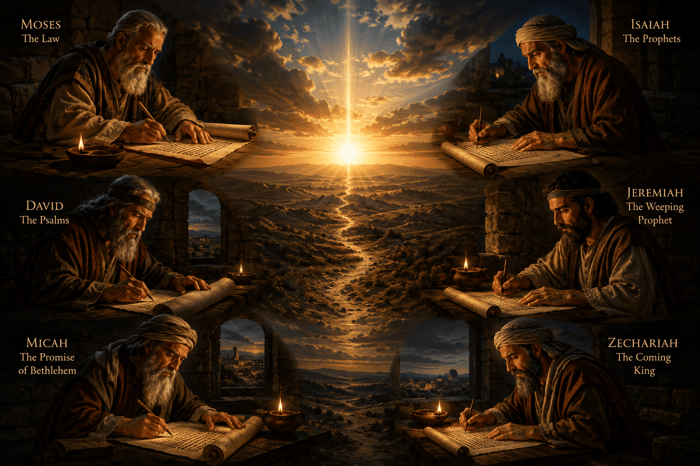
Messianic prophecies are Scriptures that point forward to the person and work of the coming Messiah. They appear throughout the Law, the Psalms, and the Prophets.
These passages cover several main areas:
- The Messiah's family line
- The place and nature of His birth
- His character and ministry
- His authority as King
- His rejection and suffering
- His death for sinners
- His resurrection and victory
- His future kingdom
No single Old Testament passage gives every detail. God revealed the picture over time, adding new truths through different writers and historical events.
Jesus later taught that the Old Testament Scriptures spoke about Him.
He said to them, "These are my words which I spoke to you while I was still with you, that all things must be fulfilled which were written in the law of Moses, the prophets, and the psalms concerning me."
Luke 24:44 (WEB)
The First Messianic Prophecy in the Bible
Many Bible students see Genesis 3:15 as the first Messianic prophecy. It was spoken after Adam and Eve sinned and brought death into the human story.
God told the serpent that a future offspring of the woman would crush his head, though the serpent would wound His heel.
I will put hostility between you and the woman, and between your offspring and her offspring. He will bruise your head, and you will bruise his heel.
Genesis 3:15 (WEB)
This promise begins the Bible's hope of a coming Deliverer. Evil would wound Him, but He would win the final victory.
The rest of Scripture develops this promise. The coming Messiah would defeat Satan, overcome sin, and break the power of death.
Key Messianic Prophecies at a Glance
The following table summarizes several major Messiah predictions and the truths they reveal.
| Old Testament passage | Messianic prediction | Main truth revealed |
|---|---|---|
| Genesis 3:15 | The woman's offspring would defeat the serpent | The Messiah would overcome evil |
| Genesis 12:3 | All nations would be blessed through Abraham | The Messiah's blessing would reach the world |
| Deuteronomy 18:15 | God would raise up a prophet like Moses | The Messiah would speak God's words |
| 2 Samuel 7:12-16 | David's descendant would rule forever | The Messiah would be the eternal King |
| Psalm 2:6-7 | God's Anointed King would rule the nations | The Messiah would possess divine authority |
| Psalm 22 | The righteous sufferer would be mocked and afflicted | The Messiah would suffer rejection |
| Isaiah 7:14 | A virgin would bear a son called Immanuel | The Messiah's birth would be a divine sign |
| Isaiah 53 | God's Servant would suffer for sinners | The Messiah would bear human guilt |
| Micah 5:2 | Israel's ruler would come from Bethlehem | The Messiah's birthplace was foretold |
| Zechariah 9:9 | The King would enter Jerusalem on a donkey | The Messiah would come as a humble King |
These Messianic prophecies are spread across different books and periods of Israel's history. Yet they fit together into one unfolding promise.
Prophecies About the Messiah's Family Line
God gradually narrowed the promised family line through which the Messiah would come.
First, God promised Abraham that all the families of the earth would be blessed through him.
I will bless those who bless you, and I will curse him who treats you with contempt. All the families of the earth will be blessed through you.
Genesis 12:3 (WEB)
The promise was later connected to Abraham's son Isaac, then to Jacob, and then to the tribe of Judah.
Jacob spoke of a future ruler coming from Judah:
The scepter will not depart from Judah, nor the ruler's staff from between his feet, until he comes to whom it belongs. The obedience of the peoples will be to him.
Genesis 49:10 (WEB)
God later promised that the royal line would pass through King David. David's descendant would possess an everlasting throne.
Your house and your kingdom will be made sure forever before you. Your throne will be established forever.
2 Samuel 7:16 (WEB)
These Messiah predictions created clear expectations. The coming King would be connected to Abraham, Judah, and David.
Messianic Prophecies About His Birth
Several Bible prophecies about Jesus describe the Messiah's birth.
Isaiah announced that a virgin would conceive and give birth to a son called Immanuel, meaning "God with us."
Therefore the Lord himself will give you a sign. Behold, the virgin will conceive, and bear a son, and shall call his name Immanuel.
Isaiah 7:14 (WEB)
Micah identified Bethlehem as the place from which Israel's ruler would come.
But you, Bethlehem Ephrathah, being small among the clans of Judah, out of you one will come out to me who is to be ruler in Israel; whose goings out are from ancient times, from everlasting.
Micah 5:2 (WEB)
These Messianic prophecies show that the Messiah's arrival would be rooted in human history. He would be born in a real place and enter the world as a child.
Yet His identity would be greater than that of an ordinary ruler. He would be called Immanuel, and His origins would reach back beyond His human birth.
The Messiah Would Be a Prophet Like Moses
Moses told Israel that God would raise up another prophet like him.
“The Lord your God will raise up for you a prophet like me from among you, from your brothers—it is to him you shall listen—
Deuteronomy 18:15 (ESV)
Moses served as a mediator, delivered God's Word, performed signs, and led God's people out of slavery. The promised Prophet would carry God's authority and speak the truth people were required to hear.
This Messianic prophecy does not mean that the Messiah would be equal to Moses in every way. It points to a greater Prophet who would reveal God and bring a greater deliverance.
Jesus did not merely repeat human wisdom. He spoke with authority, revealed the Father, and called people to obey His words.
Messianic Prophecies About the Coming King
The Old Testament presents the Messiah as God's chosen King. Psalm 2 describes nations opposing the Lord and His Anointed One.
"Yet I have set my King on my holy hill of Zion."
Psalm 2:6 (WEB)
This King would not rule over Israel alone. His authority would extend to the nations.
Isaiah also described a child who would carry the government and rule with justice forever.
For a child is born to us. A son is given to us; and the government will be on his shoulders. His name will be called Wonderful Counselor, Mighty God, Everlasting Father, Prince of Peace.
Isaiah 9:6 (WEB)
Of the increase of his government and of peace there shall be no end, on David's throne and on his kingdom, to establish it and to uphold it with justice and with righteousness from that time on, even forever.
Isaiah 9:7 (WEB)
These Messianic prophecies describe a ruler who is both connected to David and greater than any human king. His kingdom would be marked by peace, justice, and righteousness.
The Messiah Would Be a Humble King
The promised King would possess great authority, but He would not arrive with human pride.
Zechariah described Him entering Jerusalem in humility:
Rejoice greatly, daughter of Zion! Shout, daughter of Jerusalem! Behold, your King comes to you! He is righteous, and having salvation; lowly, and riding on a donkey, even on a colt, the foal of a donkey.
Zechariah 9:9 (WEB)
This is one of the clearest prophecies about the Messiah's public presentation as King. He would bring salvation, yet He would come riding on a humble animal rather than a warhorse.
The prophecy reveals something important about His character. The Messiah would be powerful without being proud and royal without seeking worldly display.
Messianic Prophecies About His Suffering
The Old Testament does not present the Messiah only as a victorious King. It also speaks of a righteous person who would be rejected, mocked, wounded, and killed.
Psalm 22 describes intense suffering and public ridicule.
All who see me mock me;
they make mouths at me; they wag their heads;
“He trusts in the Lord; let him deliver him;
let him rescue him, for he delights in him!”
Psalm 22:7-8 (ESV)
Later in the psalm, the sufferer's clothing is divided.
They divide my garments among them. They cast lots for my clothing.
Psalm 22:18 (WEB)
These details form part of a wider pattern of suffering that the New Testament connects to Jesus.
Isaiah 53 gives the clearest explanation for why the Servant would suffer. He would not suffer for His own sins. He would suffer in the place of others.
Isaiah 53 and the Suffering Servant
Isaiah described a Servant who would be despised and rejected. He would carry grief, bear sin, and bring peace through His wounds.
Surely he has borne our sickness and carried our suffering; yet we considered him plagued, struck by God, and afflicted.
Isaiah 53:4 (WEB)
But he was pierced for our transgressions. He was crushed for our iniquities. The punishment that brought our peace was on him; and by his wounds we are healed.
Isaiah 53:5 (WEB)
This Messianic prophecy is central to the Bible's message of salvation. Humanity's greatest problem is not a lack of education, comfort, or political power. Our deepest problem is sin, which separates us from a holy God.
The Servant would bear the punishment sinners deserve. His suffering would make peace possible between God and those who trust Him.
Did Every Messianic Prophecy Work the Same Way?
Not every prophecy works in the same way. Recognizing this helps us read the Bible with care.
Some Messianic prophecies are direct predictions. Micah 5:2, for example, names Bethlehem as the birthplace of the coming ruler.
Other passages describe patterns that reach a greater fulfillment in Christ. Israel's exodus, the Passover lamb, the priesthood, sacrifices, and the reign of David all prepare readers to understand the Messiah's work.
A third group includes passages that had meaning in their original setting but also pointed beyond that moment. The immediate event was real, yet God's purpose reached its fullest expression in Jesus.
This does not weaken the biblical case. It shows that God's plan was woven into the history, worship, promises, and poetry of the Old Testament.
Why Were the Prophecies Given?
The Messiah predictions served several purposes.
They gave hope to people living under sin, suffering, exile, and foreign rule. They also helped Israel recognize the kind of Savior God intended to send.
The prophecies revealed that the Messiah would be:
- Human, yet greater than any ordinary man
- A descendant of David, yet an eternal King
- Powerful, yet humble
- Rejected, yet chosen by God
- Innocent, yet wounded for sinners
- Killed, yet victorious
- King of Israel, yet Savior for the nations
These truths guard us from creating a Messiah based on human wishes. Scripture defines His identity and mission.
How Do Messianic Prophecies Point to the Gospel?
Messianic prophecies point beyond interesting predictions. They lead to the Gospel.
God promised a Savior because human beings could not rescue themselves from sin. The suffering Servant would carry guilt, receive punishment, and make peace with God possible.
The Messiah would also rise in victory. David wrote that God's Holy One would not be abandoned to the grave.
For you will not leave my soul in Sheol, neither will you allow your holy one to see corruption.
Psalm 16:10 (WEB)
Jesus Christ fulfilled the saving mission these passages revealed. He lived without sin, died for sinners, and rose from the dead.
The right response is repentance and faith. We are not saved by knowing a list of prophecies. We are saved by trusting the promised Savior to whom they point.
Why Messianic Prophecies Still Matter
Messianic prophecies show that the Gospel is part of one united biblical story. God's plan did not begin in the New Testament. He revealed it from the earliest pages of Scripture and developed it across generations.
They also give believers confidence in God's faithfulness. The Lord kept His promise to send the Messiah, and He will keep every promise connected to Christ's future reign.
These prophecies invite readers to examine Jesus through the testimony of Scripture. They reveal Him as the promised Prophet, suffering Servant, Son of David, Savior, and eternal King.
The Main Message of the Messianic Prophecies
Messianic prophecies are God's unfolding promises about the coming Messiah. They describe His family line, birth, character, ministry, suffering, saving death, victory, and kingdom.
Together, the prophecies about the Messiah create a unified portrait. The promised One would defeat evil, bear sin, speak God's truth, and reign in righteousness.
The central purpose of these prophecies is not to satisfy curiosity. They direct us to Jesus Christ and call us to trust Him as the Savior and King God promised to send.
FAQs
What are Messianic prophecies?
Messianic prophecies are Old Testament passages that point to the coming Messiah. They reveal His identity, mission, kingdom, suffering, and ultimate victory. Rather than appearing in one place, these prophecies unfold across many books of the Bible, creating one unified picture of God's promised Savior.
He said to them, "These are my words which I spoke to you while I was still with you, that all things must be fulfilled which were written in the law of Moses, the prophets, and the psalms concerning me."
Luke 24:44 (WEB)
What is the first Messianic prophecy in the Bible?
Many Bible scholars identify Genesis 3:15 as the first Messianic prophecy. After Adam and Eve sinned, God promised that the offspring of the woman would ultimately defeat the serpent, pointing ahead to the Messiah's victory over Satan and sin.
I will put hostility between you and the woman, and between your offspring and her offspring. He will bruise your head, and you will bruise his heel.
Genesis 3:15 (WEB)
Why are there so many prophecies about the Messiah?
God revealed His plan gradually over many centuries. Each prophecy added another piece to the picture so people could recognize the promised Messiah when He came. Together, the prophecies about the Messiah reveal His birth, lineage, character, ministry, suffering, kingship, and eternal reign.
Surely the Lord Yahweh will do nothing, unless he reveals his secret to his servants the prophets.
Amos 3:7 (WEB)
Do all Messianic prophecies predict future events in the same way?
No. Some Messianic prophecies are direct predictions, such as the Messiah being born in Bethlehem. Others are patterns or themes that prepare readers to understand Christ's work, such as the Passover lamb or the sacrificial system. Together they reveal God's consistent plan of redemption.
For the testimony of Jesus is the spirit of prophecy.
Revelation 19:10 (WEB)
Why is Isaiah 53 considered one of the greatest Messianic prophecies?
Isaiah 53 explains that God's Servant would suffer, bear the sins of others, and bring peace through His sacrifice. It reveals not only that the Messiah would suffer, but also why His suffering was necessary.
But he was pierced for our transgressions. He was crushed for our iniquities. The punishment that brought our peace was on him; and by his wounds we are healed.
Isaiah 53:5 (WEB)
How do Messianic Prophecies point to the Gospel?
Messianic Prophecies reveal God's plan to rescue sinners long before Jesus came into the world. They show that humanity's greatest need is forgiveness, and they point to the Messiah who would bear sin, die in the place of guilty people, and bring peace with God.
Jesus fulfilled that mission through His death and resurrection. The Gospel calls every person to repent and trust the promised Savior whom God announced throughout the Old Testament.
Surely he has borne our sickness and carried our suffering; yet we considered him plagued, struck by God, and afflicted.
Isaiah 53:4 (WEB)
He himself bore our sins in his body on the tree, that we, having died to sins, might live to righteousness. You were healed by his wounds.
1 Peter 2:24 (WEB)
Why do Messianic prophecies still matter today?
Messianic prophecies remind believers that God always keeps His promises. They strengthen our confidence in Scripture, deepen our understanding of Jesus Christ, and give us hope that the remaining promises concerning His return and eternal kingdom will also be fulfilled.
For however many are the promises of God, in him is the "Yes." Therefore also through him is the "Amen," to the glory of God through us.
2 Corinthians 1:20 (WEB)