Table of Contents
- Why Are the Old Testament Prophecies About Jesus Important?
- The First Promise of a Coming Deliverer
- The Messiah Would Come Through Abraham's Family
- The Messiah Would Come From the Tribe of Judah
- The Messiah Would Be a Descendant of David
- The Messiah Would Be Born in Bethlehem
- The Messiah Would Be Born of a Virgin
- The Messiah Would Bring Light
- The Messiah Would Be a Divine King
- The Messiah Would Speak God's Words
- The Messiah Would Enter Jerusalem as King
- The Messiah Would Be Rejected
- The Messiah Would Suffer for Sinners
- The Messiah Would Be Silent Before His Accusers
- The Messiah Would Be Betrayed
- The Messiah's Hands and Feet Would Be Pierced
- The Messiah Would Rise From the Dead
- A Summary of Major Messianic Prophecies
- How Should We Understand Fulfilled Prophecy?
- Old Testament Prophecies About Jesus and the Gospel
- Why These Prophecies Still Matter
- FAQs
The Old Testament prophecies about Jesus show that His coming was part of God's plan long before Bethlehem. The prophets described the Messiah's family line, birthplace, mission, suffering, death, resurrection, and future reign.
These prophecies were written across many centuries. Yet they form one clear picture of the promised Savior.
The New Testament presents Jesus as the One who fulfilled these promises. His life did not fit the prophecies by accident. God revealed the Messiah beforehand so people could recognize Him when He came.
Why Are the Old Testament Prophecies About Jesus Important?
The Old Testament prophecies about Jesus matter because they show that the Gospel is rooted in God's promises.
Jesus did not appear without warning. From Genesis through the prophets, God prepared His people for the coming Messiah.
Fulfilled prophecy also shows God's faithfulness. He does what He says He will do, even when centuries pass before the promise is completed.
Jesus explained that the Scriptures pointed to Him.
"You search the Scriptures, because you think that in them you have eternal life; and these are they which testify about me."
John 5:39 (WEB)
The Old Testament does more than provide the background for Jesus. It bears witness to His identity and mission.
The First Promise of a Coming Deliverer
The first prophecy about the Messiah appears soon after sin entered the world.
Adam and Eve disobeyed God, bringing guilt, death, and separation into human life. Yet God immediately promised that evil would not have the final victory.
God spoke these words to the serpent:
"I will put hostility between you and the woman, and between your offspring and her offspring. He will bruise your head, and you will bruise his heel."
Genesis 3:15 (WEB)
This verse is often called the first announcement of the Gospel.
The coming offspring would be wounded, but He would crush the serpent's head. This points forward to Jesus, who suffered on the cross but defeated sin, death, and Satan through His resurrection.
The story of the Old Testament begins with the hope of a promised Deliverer, making this first promise foundational to the Old Testament prophecies about Jesus.
The Messiah Would Come Through Abraham's Family
God later promised Abraham that blessing would come to all nations through his offspring.
"All the nations of the earth will be blessed by your offspring, because you have obeyed my voice."
Genesis 22:18 (WEB)
This promise reached beyond Abraham's immediate descendants.
God's plan was to bring salvation to people from every nation through one promised descendant.
The New Testament identifies Jesus as the fulfillment of this promise.
Now the promises were spoken to Abraham and to his offspring. He doesn't say, "To descendants," as of many, but as of one, "To your offspring," which is Christ.
Galatians 3:16 (WEB)
These Old Testament prophecies about Jesus reveal that the Messiah would not come only for Israel. He would bring God's blessing to the world.
The Messiah Would Come From the Tribe of Judah
Jacob gave a prophecy about Judah before his death.
He spoke of a future ruler whose authority would extend beyond one family or nation.
"The scepter will not depart from Judah, nor the ruler's staff from between his feet, until he comes to whom it belongs. The obedience of the peoples will be to him."
Genesis 49:10 (WEB)
A scepter represents royal authority.
This prophecy showed that the Messiah would come from the tribe of Judah and would receive the obedience of the nations.
Jesus was born into Judah's family line.
The book of Revelation later identifies Him as the Lion of the tribe of Judah, connecting His royal authority with this ancient promise.
The Messiah Would Be a Descendant of David
God narrowed the promise further when He made a covenant with King David.
He promised that David's royal line would lead to an everlasting kingdom.
"Your house and your kingdom will be made sure forever before you. Your throne will be established forever."
2 Samuel 7:16 (WEB)
No ordinary king could fulfill this promise completely.
Every earthly ruler dies. Every human kingdom changes or falls.
The promised Messiah would reign forever.
That is why the New Testament often calls Jesus the Son of David. This title identifies Him as the rightful heir to the promised throne and helps unite the Old Testament prophecies about Jesus around His royal identity.
The angel Gabriel repeated this promise before Jesus was born.
"He will be great and will be called the Son of the Most High. The Lord God will give him the throne of his father, David, and he will reign over the house of Jacob forever. There will be no end to his Kingdom."
Luke 1:32-33 (WEB)
The Messiah Would Be Born in Bethlehem
One of the clearest Old Testament prophecies about Jesus identified the town where the Messiah would be born.
Micah wrote:
"But you, Bethlehem Ephrathah, being small among the clans of Judah, out of you one will come out to me who is to be ruler in Israel. His goings out are from ancient times, from everlasting."
Micah 5:2 (WEB)
Bethlehem was a small town, but it had great meaning in Israel's history.
It was the city of David. The promised King would come from David's town.
Jesus was born in Bethlehem, fulfilling this prophecy.
The words "from ancient times, from everlasting" also point beyond an ordinary human ruler. They suggest that the Messiah's existence did not begin at His birth.
The Messiah Would Be Born of a Virgin
Isaiah gave another remarkable prophecy about the Messiah's birth.
"Therefore the Lord himself will give you a sign. Behold, the virgin will conceive, and bear a son, and shall call his name Immanuel."
Isaiah 7:14 (WEB)
The name Immanuel means "God with us."
The New Testament records that Mary conceived Jesus by the Holy Spirit before she had been with a man.
Jesus' virgin birth was a sign that His coming was God's supernatural work.
He was truly human, born from a woman. Yet He was also the eternal Son of God who came to dwell among His people.
The Messiah Would Bring Light
Isaiah described the coming Messiah as light shining into darkness.
"The people who walked in darkness have seen a great light. Those who lived in the land of the shadow of death, on them the light has shined."
Isaiah 9:2 (WEB)
This prophecy spoke to people living in fear, spiritual darkness, and oppression.
Jesus fulfilled it by bringing God's truth, grace, and salvation.
Matthew quoted this passage when describing the beginning of Jesus' ministry in Galilee.
The Messiah came to reveal God and call sinners out of darkness into life.
The Messiah Would Be a Divine King
Isaiah also described the Messiah with titles that go far beyond those of a normal ruler.
"For to us a child is born. To us a son is given; and the government will be on his shoulders. His name will be called Wonderful Counselor, Mighty God, Everlasting Father, Prince of Peace."
Isaiah 9:6 (WEB)
The promised King would be born as a child, yet He would be called Mighty God.
These Old Testament prophecies about Jesus reveal that the Messiah would be both human and divine.
He would rule with perfect wisdom, power, care, and peace.
Jesus fulfills this description as the eternal Son who took on human flesh and entered the world.
The Messiah Would Speak God's Words
Moses foretold that God would raise up a prophet like him.
“The Lord your God will raise up for you a prophet like me from among you, from your brothers—it is to him you shall listen—
Deuteronomy 18:15 (ESV)
Moses delivered God's Word, led the people, and served as a mediator of the covenant.
Jesus is greater than Moses.
He does not only speak God's truth. He is the Word made flesh.
He reveals the Father perfectly and establishes the new covenant through His own blood.
Those who hear Jesus are called to listen and obey because He speaks with God's authority.
The Messiah Would Enter Jerusalem as King
Zechariah foretold how the Messiah would enter Jerusalem.
"Rejoice greatly, daughter of Zion! Shout, daughter of Jerusalem! Behold, your King comes to you! He is righteous, and having salvation; lowly, and riding on a donkey, even on a colt, the foal of a donkey."
Zechariah 9:9 (WEB)
Jesus fulfilled this prophecy during His triumphal entry.
He entered Jerusalem on a donkey while the crowds welcomed Him as the Son of David.
The scene revealed an important truth about the Messiah.
He was a King, but He came in humility.
He did not enter with the pride of a military conqueror. He came as the righteous King who brought salvation.
The Messiah Would Be Rejected
Isaiah foretold that the Messiah would not be welcomed by everyone.
"He was despised and rejected by men, a man of suffering and acquainted with disease. He was despised as one from whom men hide their face; and we didn't respect him."
Isaiah 53:3 (WEB)
Jesus was rejected by many religious leaders and by much of the nation.
He was mocked, abandoned, and condemned.
This rejection did not prove that He was not the Messiah. It fulfilled what God had already revealed.
The promised Savior would not meet every human expectation. He would come in humility and suffer before entering His glory.
The Messiah Would Suffer for Sinners
Isaiah 53 gives one of the clearest pictures of the Messiah's saving work.
"But he was pierced for our transgressions. He was crushed for our iniquities. The punishment that brought our peace was on him; and by his wounds we are healed."
Isaiah 53:5 (WEB)
The Messiah would suffer because of the sins of others.
He would bear the punishment sinners deserved.
Jesus fulfilled this prophecy on the cross. He was pierced, wounded, and put to death, though He had committed no sin.
His suffering was not a meaningless tragedy. It was a sacrifice.
The cross stands at the center of fulfilled prophecy because the Messiah came to save His people from sin.
The Messiah Would Be Silent Before His Accusers
Isaiah also described the Messiah's response to unjust suffering.
"He was oppressed, yet when he was afflicted he didn't open his mouth. As a lamb that is led to the slaughter, and as a sheep that before its shearers is silent, so he didn't open his mouth."
Isaiah 53:7 (WEB)
Jesus stood before His accusers without defending Himself in the way people expected.
He willingly submitted to the Father's plan.
He was not powerless. He chose to lay down His life.
This fulfilled prophecy shows that the cross was not an accident. Jesus knowingly gave Himself as the Lamb of God.
The Messiah Would Be Betrayed
Zechariah foretold a price of thirty pieces of silver.
"So they weighed for my wages thirty pieces of silver."
Zechariah 11:12 (WEB)
Judas later betrayed Jesus for thirty pieces of silver.
Even the details surrounding the betrayal were known in advance.
This does not remove Judas's guilt. It shows that human sin could not overthrow God's plan.
God used even the betrayal of Jesus to bring about the salvation He had promised.
The Messiah's Hands and Feet Would Be Pierced
Psalm 22 gives a striking picture of suffering that closely matches crucifixion.
"For dogs have surrounded me. A company of evildoers have enclosed me. They have pierced my hands and feet."
Psalm 22:16 (WEB)
The psalm also describes mockery and the dividing of garments.
Jesus experienced these things at the cross.
Although Psalm 22 expresses deep suffering, it ends with hope and victory. The Messiah's pain would lead to the proclamation of God's rule among the nations.
The Messiah Would Rise From the Dead
The Old Testament did not only predict the Messiah's death. It also pointed toward His resurrection.
David wrote:
"For you will not leave my soul in Sheol, neither will you allow your holy one to see corruption."
Psalm 16:10 (WEB)
David died, and his body experienced decay.
The apostles explained that this prophecy ultimately referred to Jesus.
He died and was buried, but His body did not remain in the grave.
Jesus rose on the third day, defeating death and confirming that He is the promised Messiah foretold throughout the Old Testament prophecies about Jesus.
A Summary of Major Messianic Prophecies
| Prophecy | Old Testament Passage | Fulfillment in Jesus |
|---|---|---|
| Offspring of the woman defeats evil | Genesis 3:15 | Jesus defeats sin and Satan |
| Blessing comes through Abraham's offspring | Genesis 22:18 | Salvation comes through Christ |
| Ruler comes from Judah | Genesis 49:10 | Jesus comes from Judah |
| Eternal King comes from David | 2 Samuel 7:16 | Jesus inherits David's throne |
| Born of a virgin | Isaiah 7:14 | Jesus is born to Mary |
| Born in Bethlehem | Micah 5:2 | Jesus is born in Bethlehem |
| Enters Jerusalem on a donkey | Zechariah 9:9 | Jesus' triumphal entry |
| Betrayed for thirty pieces of silver | Zechariah 11:12 | Judas betrays Jesus |
| Suffers for sinners | Isaiah 53:5 | Jesus dies on the cross |
| Rises without seeing corruption | Psalm 16:10 | Jesus rises from the dead |
These prophecies form a united picture.
They show the Messiah's identity, mission, suffering, and victory.
How Should We Understand Fulfilled Prophecy?
The Old Testament prophecies about Jesus should not be treated as random predictions pulled from unrelated passages.
They belong to the larger story of Scripture.
God created humanity, people sinned, and the world fell under death and judgment. God then promised a Deliverer and gradually revealed more about Him.
The promises became clearer through Abraham, Judah, David, the Psalms, and the prophets.
Jesus stands at the center of that story.
He is the promised offspring, King, Servant, sacrifice, and risen Lord.
Old Testament Prophecies About Jesus and the Gospel
The Old Testament prophecies about Jesus lead directly to the Gospel.
Humanity's deepest problem is sin. We cannot restore ourselves to God or erase our guilt through good works.
God promised a Savior who would bear sin in our place.
Jesus fulfilled that promise through His death and resurrection.
He is the Messiah who was rejected, pierced, buried, and raised to life.
The proper response is not only to admire fulfilled prophecy. It is to believe the message those prophecies reveal.
Jesus is the promised Savior.
Those who repent and trust Him receive forgiveness, peace with God, and eternal life.
Why These Prophecies Still Matter
The Old Testament prophecies about Jesus remind us that God is faithful across generations.
He kept His promise to send the Messiah.
That gives believers confidence that He will also fulfill His remaining promises.
Jesus will return.
His kingdom will be fully revealed.
Justice will be established, evil will be judged, and God's people will live under the rule of the promised King.
The Messiah who fulfilled the prophecies of His first coming will also fulfill every promise connected to His return.
FAQs
What are the Old Testament prophecies about Jesus?
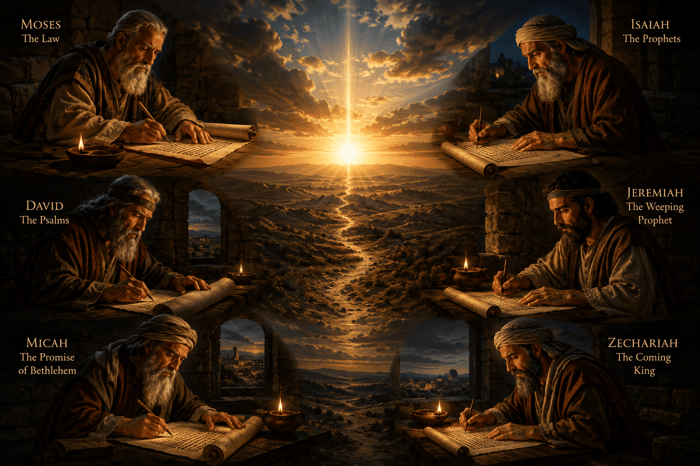
The Old Testament prophecies about Jesus are promises and predictions God gave through Moses, David, Isaiah, Micah, Zechariah, and other prophets about the coming Messiah. They describe His birth, family line, ministry, suffering, death, resurrection, and eternal reign. Christians believe Jesus fulfilled these prophecies, proving He is the promised Christ.
"Beginning from Moses and from all the prophets, he explained to them in all the Scriptures the things concerning himself."
Luke 24:27 (WEB)
How many Old Testament prophecies did Jesus fulfill?
The Bible contains many Messianic prophecies that Jesus fulfilled during His first coming. These include His birth in Bethlehem, His descent from David, His triumphal entry into Jerusalem, His suffering for sinners, His betrayal, and His resurrection. Together, these fulfilled prophecies provide strong evidence that Jesus is the promised Messiah.
"He first found his own brother, Simon, and said to him, 'We have found the Messiah!' which is, being interpreted, Christ."
John 1:41 (WEB)
Why did God give prophecies about Jesus centuries before He was born?
God revealed the Messiah long before His coming so people would recognize Him when He arrived. Each prophecy added another piece to the picture, showing God's faithfulness and demonstrating that Jesus fulfilled His eternal plan rather than appearing unexpectedly.
"Remember the former things of old, for I am God, and there is no other. I am God, and there is none like me; declaring the end from the beginning, and from ancient times things that are not yet done."
Isaiah 46:9-10 (WEB)
Which Old Testament prophecy most clearly points to Jesus' death?
Isaiah 53 is one of the clearest prophecies about the Messiah's suffering. It describes Him bearing the sins of others, being pierced for transgressions, and bringing peace through His sacrifice. Christians understand this passage as a direct prophecy of Jesus' death on the cross.
"But he was pierced for our transgressions. He was crushed for our iniquities. The punishment that brought our peace was on him; and by his wounds we are healed."
Isaiah 53:5 (WEB)
Do the Old Testament prophecies about Jesus also speak about His second coming?
Yes. Some prophecies describe the Messiah's suffering, while others describe His future reign as King. Jesus fulfilled many prophecies during His first coming and will fulfill the remaining kingdom prophecies when He returns to judge the world and establish His everlasting kingdom.
"Behold, he is coming with the clouds, and every eye will see him, including those who pierced him. All the tribes of the earth will mourn over him. Even so, Amen."
Revelation 1:7 (WEB)
Why are the Old Testament prophecies about Jesus important for salvation?
The Old Testament prophecies about Jesus reveal that God planned salvation long before Jesus was born. Humanity's greatest problem is sin, and God promised to send a Messiah who would bear our punishment and bring us back to Himself. Jesus fulfilled those promises through His death and resurrection. When we repent and trust Him, we receive the forgiveness and eternal life that God promised from the beginning.
"But these are written that you may believe that Jesus is the Christ, the Son of God, and that believing you may have life in his name."
John 20:31 (WEB)
How should Christians respond to fulfilled prophecy?
Fulfilled prophecy should strengthen our faith in God's Word and increase our confidence that He always keeps His promises. Just as God faithfully fulfilled His promises about the Messiah's first coming, believers can trust Him to fulfill every promise concerning Christ's return and His eternal kingdom.
"For however many are the promises of God, in him is the 'Yes.' Therefore also through him is the 'Amen,' to the glory of God through us."
2 Corinthians 1:20 (WEB)