
Table of Contents
- What Does Rabbi Mean?
- Rabbi Meaning in the Bible
- Why Was Jesus Called Rabbi?
- How Jesus Was Different From Other Rabbis
- Jesus the Teacher Called Disciples to Follow Him
- Jesus Accepted the Title Teacher
- Why Did Jesus Warn Against Loving the Title Rabbi?
- What Did Jesus Teach as Rabbi?
- Rabbi, Rabboni, and Teacher
- Why the Rabbi Meaning Matters for Christians Today
- Is It Enough to Call Jesus Rabbi?
- How Jesus the Teacher Leads Us to the Gospel
- Following Jesus as Teacher and Lord
- FAQs
The Rabbi meaning in the Bible helps us understand why people often approached Jesus as a teacher. The word showed respect, but it also pointed to the authority people saw in His words, His understanding of Scripture, and His power to explain God's truth.
Jesus was more than a human teacher. He is the Son of God, the promised Christ, and the Lord. Yet the title Rabbi shows how He met people in daily life, opened the Scriptures, answered hard questions, and called His followers to obey God.
To understand why Jesus was called Rabbi, we need to look at what the word meant, who used it, and how Jesus fulfilled the role of teacher in a way no one else could.
What Does Rabbi Mean?
The word Rabbi comes from a Hebrew and Aramaic term connected to the idea of "my master" or "my teacher." In the time of Jesus, it was used as a respectful title for a Jewish teacher who knew the Scriptures and guided others in understanding God's law.
The biblical meaning of Rabbi is not limited to a modern job title. In the Gospels, the word often shows that someone recognized Jesus as a teacher with spiritual authority.
John explains the term when two disciples first speak to Jesus:
They said to him, "Rabbi" (which is to say, being interpreted, Teacher), "where are you staying?"
John 1:38 (WEB)
This verse gives the clearest answer to the question, what does Rabbi mean? It means "Teacher." Still, when the title is used for Jesus, it carries more weight because of who He is and how He taught.
Rabbi Meaning in the Bible
The Rabbi meaning becomes clearer when we see how the title appears in the Gospels. It was used by disciples, seekers, religious leaders, and people who had questions for Jesus.
Nicodemus, a Pharisee and ruler of the Jews, came to Jesus at night and addressed Him with respect:
The same came to him by night, and said to him, "Rabbi, we know that you are a teacher come from God, for no one can do these signs that you do, unless God is with him."
John 3:2 (WEB)
Nicodemus saw that Jesus was not an ordinary teacher. His miracles showed that God was at work through Him. Even before Nicodemus understood Jesus fully, he knew that Jesus had come from God.
Other people also called Jesus Rabbi:
When they had found him on the other side of the sea, they asked him, "Rabbi, when did you come here?"
John 6:25 (WEB)
His disciples asked him, "Rabbi, who sinned, this man or his parents, that he was born blind?"
John 9:2 (WEB)
Then the disciples asked him, "Rabbi, the Jews were just trying to stone you, and are you going there again?"
John 11:8 (WEB)
These verses show that Rabbi in the Bible was a living title used in real conversations. People came to Jesus for answers, direction, and truth.
Why Was Jesus Called Rabbi?
The Rabbi meaning helps answer why Jesus was called Rabbi: He taught people about God with unmatched wisdom and authority. He explained Scripture, corrected false ideas, told parables, answered questions, and trained disciples.
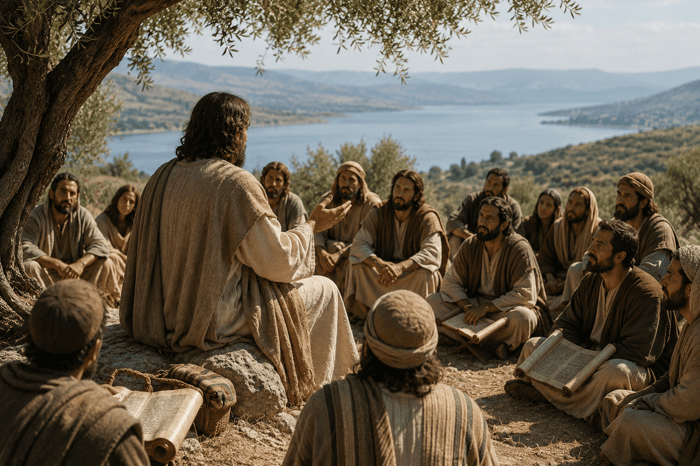
He also taught in synagogues, homes, fields, boats, and public places. His classroom could be anywhere, and His students included fishermen, tax collectors, religious leaders, women, children, the poor, and the powerful.
When Jesus taught in Capernaum, people noticed that His teaching was different:
They went into Capernaum, and immediately on the Sabbath day he entered into the synagogue and taught. They were astonished at his teaching, for he taught them as having authority, and not as the scribes.
Mark 1:21-22 (WEB)
This is a key part of the Rabbi meaning when applied to Jesus. Other teachers often supported their views by quoting earlier authorities. Jesus spoke with authority that came from within Himself.
He did not merely explain God's Word. He is the eternal Word who came in the flesh. His teaching was true because He came from the Father and perfectly revealed Him.
How Jesus Was Different From Other Rabbis
The Rabbi meaning includes the work of a Jewish teacher, but Jesus was not simply one teacher among many.
| Feature | Other Jewish Teachers | Jesus |
|---|---|---|
| Knowledge of Scripture | Studied and explained the law | Fulfilled the law and revealed its true purpose |
| Source of authority | Often appealed to earlier teachers | Spoke with authority from the Father |
| Choice of students | Students often chose a teacher | Jesus called His own disciples |
| Teaching method | Used discussion and interpretation | Used parables, questions, commands, miracles, and personal example |
| Final identity | Human teacher | Son of God, Messiah, Lord, and Savior |
Jesus taught God's truth without error. He also showed the truth through His life. He loved sinners, confronted hypocrisy, served the weak, obeyed the Father, and gave His life for the world.
This is why the Rabbi title of Jesus is important, but not complete by itself. Calling Him Teacher is right. Stopping there is not enough.
Jesus the Teacher Called Disciples to Follow Him
The Rabbi meaning also involves the relationship between a teacher and his students. A rabbi normally had students, and Jesus had disciples. Yet His call went beyond learning facts. He called people to follow Him with their whole lives.
He said to Simon Peter and Andrew:
He said to them, "Come after me, and I will make you fishers for men."
Matthew 4:19 (WEB)
Jesus did not only say, "Listen to my lessons." He said, "Come after me." His disciples were to watch Him, trust Him, obey Him, and become like Him.
Jesus later explained that discipleship includes learning from the teacher:
A disciple is not above his teacher, but everyone when he is fully trained will be like his teacher.
Luke 6:40 (WEB)
The goal of Christian learning is not mere information. It is transformation. A true disciple of Jesus grows to reflect His character, love, humility, obedience, and truth.
Jesus Accepted the Title Teacher
The Rabbi meaning was valid when the disciples used the title correctly, and Jesus did not reject it. On the night before His crucifixion, He told them that they were right to call Him Teacher and Lord.
You call me, "Teacher" and "Lord." You say so correctly, for so I am. If I then, the Lord and the Teacher, have washed your feet, you also ought to wash one another's feet.
John 13:13-14 (WEB)
This passage brings together two truths. Jesus is the Teacher, and Jesus is the Lord. His authority did not make Him proud or distant. He used His position to serve.
The Rabbi meaning reaches its fullest picture in Jesus when authority and humility meet. He had the right to command, yet He washed His disciples' feet. He taught them not only with words but also through His actions.
Why Did Jesus Warn Against Loving the Title Rabbi?
Jesus also warned religious leaders about seeking titles for pride and status. He was not teaching that the word itself was sinful. He was exposing the desire to be honored above others.
But don't you be called "Rabbi," for one is your teacher, the Christ, and all of you are brothers. Call no man on the earth your father, for one is your Father, he who is in heaven. Neither be called masters, for one is your master, the Christ.
Matthew 23:8-10 (WEB)
The warning does not cancel the Rabbi meaning or make teaching wrong. The problem was not teaching. The problem was wanting praise, control, and a higher place than others.
Jesus taught that all believers stand under His authority. Christian teachers may serve the church, but they are not the final source of truth. Christ is the true Master, and Scripture must test every teaching.
What Did Jesus Teach as Rabbi?
Jesus taught about every part of life under God's rule. His teaching was not limited to religious ceremonies.
He taught about:
- The kingdom of God
- Love for God and neighbor
- Repentance and faith
- Prayer and forgiveness
- Marriage and purity
- Money and generosity
- Humility and service
- Judgment and eternal life
- His own identity and mission
Jesus brought people back to the heart of God's commands. He showed that sin is not only outward behavior. It also grows in the heart through hatred, lust, pride, greed, and unbelief.
At the same time, He welcomed sinners who came to Him in faith. He offered mercy without lowering God's standard of holiness.
Rabbi, Rabboni, and Teacher
The Rabbi meaning is also seen through related forms of the title used in the Gospels. Rabboni is a stronger or more personal form that can mean "my teacher" or "my master."
After Jesus rose from the dead, Mary Magdalene recognized Him and cried out:
Jesus said to her, "Mary." She turned and said to him, "Rabboni!" which is to say, "Teacher!"
John 20:16 (WEB)
This moment adds deep feeling to the Jewish teacher meaning. Mary was not speaking to a distant scholar. She was speaking to the risen Jesus, whom she loved and followed.
Her use of Rabboni shows respect, devotion, and personal connection. The Teacher who had been crucified was alive.
Why the Rabbi Meaning Matters for Christians Today
The Rabbi meaning matters because Christians are still disciples of Jesus. He continues to teach His people through Scripture and by the work of the Holy Spirit.
We do not sit beside the Sea of Galilee as the first disciples did. Yet we hear Christ's words in the Bible. We learn His commands, see His character, and follow His example.
Calling Jesus Teacher should shape the way we live.
First, we should listen to Him. Many voices compete for our attention, but Jesus speaks the words of eternal life.
Second, we should obey Him. A student who praises a teacher but ignores every lesson is not acting like a true disciple.
Third, we should become more like Him. His teaching is meant to renew our minds and change our conduct.
Fourth, we should help others learn His words without making ourselves the center. Christian teaching should point people to Christ, not to personal fame.
Is It Enough to Call Jesus Rabbi?
The Rabbi meaning describes Jesus truthfully, but it is not enough to see Him only as a wise teacher.
Some people admire the Sermon on the Mount, the Golden Rule, or Jesus' compassion while rejecting His claims about Himself. The Gospels do not allow us to separate His moral teaching from His identity.
Jesus taught that He came from the Father, had authority to forgive sins, would judge the world, would give His life as a ransom, and would rise again. A person cannot accept Him as an honest teacher while dismissing these claims.
The disciples grew in their understanding. They first called Him Rabbi, but they came to confess Him as the Christ and the Son of God.
Peter said:
Simon Peter answered, "You are the Christ, the Son of the living God."
Matthew 16:16 (WEB)
This confession goes beyond the Rabbi title of Jesus. He is the promised Savior and divine Son.
How Jesus the Teacher Leads Us to the Gospel
Jesus did not only teach people how to live better. He came to save sinners who could not rescue themselves.
His teaching exposes our need. We have not loved God with all our heart. We have not loved our neighbors as ourselves. We have sinned in thought, word, desire, and action.
The Teacher then did what no other rabbi could do. He took the punishment for sin on the cross and rose from the dead.
Jesus said:
For the Son of Man came to seek and to save that which was lost.
Luke 19:10 (WEB)
The right response is not only to admire His wisdom. It is to repent, believe in Him, and follow Him as Lord.
This is the deepest lesson connected to the Rabbi meaning. Jesus teaches the way of salvation because He is the way. He speaks the truth because He is the truth. He gives eternal life because life is found in Him.
Following Jesus as Teacher and Lord
Jesus called His disciples to hear His words and put them into practice. That call still stands.
A person who follows Jesus should read Scripture, pray for understanding, obey what Christ commands, and remain teachable. Growth takes time, but the direction of a disciple's life should be toward greater faith and obedience.
The title Rabbi helps us see Jesus as the perfect Teacher. Yet the full witness of Scripture calls us to bow before Him as Lord, trust Him as Savior, and follow Him as the risen Christ.
The Rabbi meaning is therefore both simple and rich. Rabbi means Teacher, but Jesus is no ordinary teacher. He teaches with divine authority, lives out every truth He gives, saves those who trust Him, and forms His disciples to become more like Him.
FAQs
What does Rabbi mean in the Bible?
The word Rabbi means "Teacher" or "my teacher." It was a respectful title used for Jewish teachers who instructed others in God's Word. In the Gospels, the title recognizes Jesus as a teacher with authority, although He was far more than an ordinary rabbi.
They said to him, "Rabbi" (which is to say, being interpreted, Teacher), "where are you staying?"
John 1:38 (WEB)
Why was Jesus called Rabbi?
Jesus was called Rabbi because He taught God's truth with wisdom and authority. He explained the Scriptures, answered difficult questions, trained disciples, and revealed God's will. Unlike other teachers, Jesus taught with divine authority because He came from the Father.
They were astonished at his teaching, for he taught them as having authority, and not as the scribes.
Mark 1:22 (WEB)
Was Jesus officially a rabbi?
The Bible never says Jesus completed the formal religious training expected of many Jewish rabbis. Instead, people recognized Him as Rabbi because of His teaching, His knowledge of Scripture, and His authority. His title came from who He was rather than from a religious institution.
The same came to him by night, and said to him, "Rabbi, we know that you are a teacher come from God, for no one can do these signs that you do, unless God is with him."
John 3:2 (WEB)
What is the difference between Rabbi and Lord?
Rabbi emphasizes Jesus as Teacher, while Lord points to His authority and divine rule. During His earthly ministry, many people first knew Him as Rabbi, but His disciples came to understand that He is also the promised Messiah, the Son of God, and Lord over all.
You call me, "Teacher" and "Lord." You say so correctly, for so I am.
John 13:13 (WEB)
Why did Jesus warn people not to seek the title Rabbi?
Jesus was not condemning teaching itself. He was warning against pride and the desire for honor. Religious leaders often loved impressive titles and public recognition. Jesus taught that His followers should pursue humility because He alone is the ultimate Teacher.
But don't you be called "Rabbi," for one is your teacher, the Christ, and all of you are brothers.
Matthew 23:8 (WEB)
What can Christians learn from Jesus as Rabbi?
Jesus shows that true teaching is more than sharing information. He taught the truth, lived the truth, and called His followers to obey God's Word. Christians continue to learn from Him through the Scriptures and seek to become more like Him each day.
A disciple is not above his teacher, but everyone when he is fully trained will be like his teacher.
Luke 6:40 (WEB)
Is understanding the Rabbi meaning important for salvation?
Yes. Understanding the Rabbi meaning helps us see that Jesus is the perfect Teacher, but the Gospel calls us to do more than admire His teaching. Jesus taught that every person is a sinner who needs forgiveness. He then accomplished what no other rabbi could by dying on the cross for our sins and rising again. Saving faith is not simply agreeing with His lessons—it is trusting Him as the crucified and risen Savior who gives eternal life.
For the Son of Man came to seek and to save that which was lost.
Luke 19:10 (WEB)
For God so loved the world, that he gave his one and only Son, that whoever believes in him should not perish, but have eternal life.
John 3:16 (WEB)
Is Jesus still our Rabbi today?
Although Jesus has ascended into heaven, He continues to teach His followers through His Word and by the Holy Spirit. Every believer is called to remain His disciple by learning His commands, trusting His promises, and putting His teaching into practice.
Go, and make disciples of all nations, baptizing them in the name of the Father and of the Son and of the Holy Spirit, teaching them to observe all things that I commanded you.
Matthew 28:19-20 (WEB)