Table of Contents
- The First Appearance of Melchizedek
- A Priest Before the Law
- Melchizedek in the Book of Hebrews
- Why Abram’s Tithe Matters
- A Priest and a King Together
- Is Melchizedek a Theophany?
- The Theology of Melchizedek
- Practical Lessons from Melchizedek
- Melchizedek and the Bread and Wine
- The Eternal Priest We Need
- Why Melchizedek Still Matters
- FAQs
Melchizedek is one of the most mysterious figures in Scripture. Though he appears only briefly in the Old Testament, his role carries deep meaning. He stands at a turning point in redemptive history, linking the promises made to Abraham with the greater priesthood fulfilled in Christ.
His story is short, yet his impact is lasting. When we study him, we see more than an ancient king. We see a shadow pointing forward to Jesus, our eternal High Priest.
The First Appearance of Melchizedek
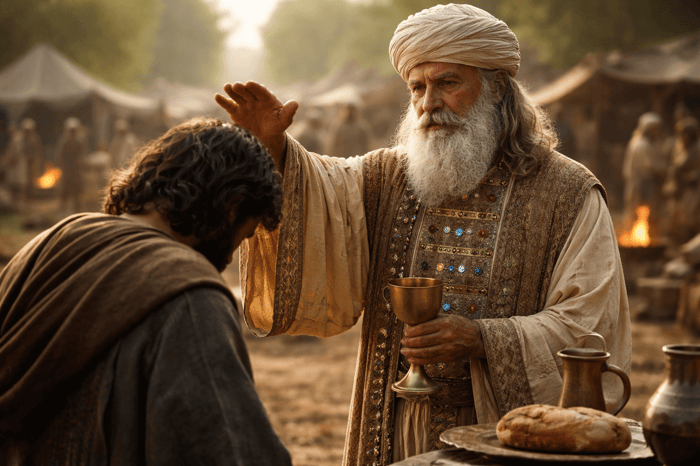
He first appears in the book of Genesis. After Abram rescues Lot from enemy kings, he is met by this mysterious priest-king.
Genesis 14:18–20
Then Melchizedek king of Salem brought out bread and wine. He was priest of God Most High, and he blessed Abram, saying,
“Blessed be Abram by God Most High,
Creator of heaven and earth.
And praise be to God Most High,
who delivered your enemies into your hand.”
Then Abram gave him a tenth of everything.
The passage tells us three important facts:
- He was king of Salem.
- He was priest of God Most High.
- He blessed Abram.
The name means “king of righteousness.” Salem is often understood to be early Jerusalem and means “peace.” So he is both king of righteousness and king of peace. That alone should catch our attention.
He brings bread and wine to Abram. This detail feels simple, yet later readers cannot help but see echoes of communion. While Genesis does not explain the symbolism, Scripture later unfolds deeper meaning.
Abram responds by giving him a tenth of everything. This act shows honor and submission. Abram, the one who received God’s promise, recognizes spiritual authority in this priest-king.
A Priest Before the Law
One of the most striking truths about Melchizedek is that he appears long before the Levitical priesthood.
The Law of Moses had not yet been given. The tribe of Levi did not yet exist. Yet here stands a priest of “God Most High.”
This shows that God’s work was never limited to one nation or one priestly line. Even before Israel was formed, God had a priest who served Him.
Psalm 110 later speaks of a coming king who would be like this priest-king.
Psalm 110:4
The Lord has sworn
and will not change his mind:
“You are a priest forever,
in the order of Melchizedek.”
This verse is powerful. It speaks of an eternal priesthood, not one based on family lineage, but on divine appointment.
David wrote this psalm centuries after Genesis. The Spirit inspired him to connect the coming Messiah with this priest-king. That link prepares the way for the New Testament.
Melchizedek in the Book of Hebrews
The fullest explanation of this priest-king comes in Hebrews. The writer builds a careful argument that Jesus’ priesthood is greater than the Levitical system.
Hebrews 5:6
And he says in another place,
“You are a priest forever,
in the order of Melchizedek.
Hebrews 7:1–3
This Melchizedek was king of Salem and priest of God Most High. He met Abraham returning from the defeat of the kings and blessed him, and Abraham gave him a tenth of everything. First, the name Melchizedek means “king of righteousness”; then also, “king of Salem” means “king of peace.” Without father or mother, without genealogy, without beginning of days or end of life, resembling the Son of God, he remains a priest forever.
Hebrews highlights several key truths:
- He was both king and priest.
- His genealogy is not recorded.
- He is described as having no beginning or end in the text.
- He resembles the Son of God.
The writer does not claim he was literally eternal. Instead, he notes that Scripture gives no record of his birth or death. That silence becomes part of the symbolism.
In contrast, Levitical priests served for a time and then died. Their ministry passed on to others. But Jesus holds His priesthood forever.
Hebrews 7:23–25
Now there have been many of those priests, since death prevented them from continuing in office; but because Jesus lives forever, he has a permanent priesthood. Therefore he is able to save completely those who come to God through him, because he always lives to intercede for them.
Here the comparison becomes clear. The priesthood of Jesus does not depend on ancestry. It rests on the power of an endless life.
Melchizedek becomes a picture, a pattern that points forward.
Why Abram’s Tithe Matters
Hebrews also points to Abram’s act of giving a tenth.
Hebrews 7:4–10
Just think how great he was: Even the patriarch Abraham gave him a tenth of the plunder! Now the law requires the descendants of Levi who become priests to collect a tenth from the people—that is, from their fellow Israelites—even though they also are descended from Abraham. This man, however, did not trace his descent from Levi, yet he collected a tenth from Abraham and blessed him who had the promises. And without doubt the lesser is blessed by the greater. In the one case, the tenth is collected by people who die; but in the other case, by him who is declared to be living. One might even say that Levi, who collects the tenth, paid the tenth through Abraham, because when Melchizedek met Abraham, Levi was still in the body of his ancestor.
The argument is simple yet profound. If Abram gave a tithe to this priest-king, then he is greater than Abram. And since Levi came from Abram’s line, the Levitical priesthood is symbolically subordinate to him.
This strengthens the claim that Christ’s priesthood surpasses the old covenant system.
The logic may seem technical, but the message is pastoral. Believers can trust that Jesus’ priesthood is better. It is secure. It is complete.
A Priest and a King Together
Under the Law of Moses, the roles of king and priest were separate.
- Kings came from the tribe of Judah.
- Priests came from the tribe of Levi.
If a king tried to act as priest, it brought judgment. The offices were divided to guard holiness.
Yet Melchizedek held both roles. He ruled and ministered. He governed and interceded.
This unity finds fulfillment in Jesus. He is the Lion of Judah and the Great High Priest.
Hebrews 7:17
For it is declared:
“You are a priest forever,
in the order of Melchizedek.
Christ does not need to offer sacrifices daily. He offered Himself once for all.
When believers think about Melchizedek, they are meant to look past him to Jesus.
Is Melchizedek a Theophany?
Some have wondered whether he was a pre-incarnate appearance of Christ. The language in Hebrews is strong. He is described as “without father or mother” and “without beginning of days.”
Yet the text says he “resembles” the Son of God. That word suggests comparison, not identity.
Most scholars understand Melchizedek as a real historical king whose life, as recorded in Scripture, intentionally points beyond itself.
The Bible often works this way. God arranges events and people so they foreshadow Christ.
Consider these examples:
| Old Testament Figure | Points to Christ In |
|---|---|
| Adam | Headship of humanity (Romans 5) |
| Passover Lamb | Sacrificial death |
| David | Kingship |
| Melchizedek | Eternal priesthood |
Melchizedek fits within this pattern of redemptive design.
The Theology of Melchizedek
When we gather the threads together, several theological themes emerge.
1. God’s Plan Is Unified
The story in Genesis is not random. It connects to Psalms and then to Hebrews. This shows that Scripture is one unfolding story.
2. Priesthood Is About Access
Priests represent people before God. They offer sacrifices and intercede. The Levitical system provided temporary access. The priesthood patterned after Melchizedek finds its fulfillment in Christ’s permanent access.
Hebrews 4:14–16
Therefore, since we have a great high priest who has ascended into heaven, Jesus the Son of God, let us hold firmly to the faith we profess. For we do not have a high priest who is unable to empathize with our weaknesses, but we have one who has been tempted in every way, just as we are—yet he did not sin. Let us then approach God’s throne of grace with confidence, so that we may receive mercy and find grace to help us in our time of need.
Because Jesus is our High Priest, believers can approach the throne of grace with confidence.
3. Righteousness and Peace Belong Together
The name Melchizedek teaches this. Righteousness comes first. Peace follows. This order matters.
True peace with God does not ignore sin. It comes through righteousness granted by Christ.
Romans 5:1
Therefore, since we have been justified through faith, we have peace with God through our Lord Jesus Christ,
Justification leads to peace. The pattern remains.
Practical Lessons from Melchizedek
Though he appears briefly, his story encourages believers in real ways.
We Can Trust God’s Greater Plan
Abram may not have understood the full meaning of that meeting. Yet God was weaving history toward Christ. Often believers see only small moments, but God is building something larger.
Jesus’ Priesthood Is Secure
Because it does not depend on lineage or temporary service, Christ’s priesthood cannot fail. He lives forever to intercede.
Worship Includes Honor
Abram gave a tenth. He responded to blessing with gratitude. While the New Testament teaches freedom from legalistic tithe rules, the principle of honoring God remains.
Consider these reflections:
- Do we recognize Christ’s authority?
- Do we approach Him with confidence?
- Do we respond to grace with worship?
Melchizedek helps frame those questions.
Melchizedek and the Bread and Wine
The detail of bread and wine in Genesis has stirred much reflection.
Genesis 14:18
Then Melchizedek king of Salem brought out bread and wine. He was priest of God Most High,
While the text does not state symbolic meaning, the pairing later appears in the Lord’s Supper.
Jesus took bread and wine and gave them new covenant meaning.
This does not mean he instituted communion. Yet Scripture often plants seeds early that bloom later.
The Bible invites readers to see patterns that deepen faith.
The Eternal Priest We Need
The Levitical system required repeated sacrifices. Sin required constant atonement. Priests were imperfect and mortal.
But Christ, after the order of Melchizedek, offered one perfect sacrifice.
Hebrews 7:27
Unlike the other high priests, he does not need to offer sacrifices day after day, first for his own sins, and then for the sins of the people. He sacrificed for their sins once for all when he offered himself.
This verse anchors hope. Salvation rests not on repeated effort but on a finished work.
When believers struggle with guilt or fear, the doctrine behind this priest-king becomes deeply personal. Jesus intercedes. His work stands complete.
Why Melchizedek Still Matters
Some may wonder why such a brief figure deserves attention.
The answer is simple: he magnifies Christ.
Without this priest-king, the argument in Hebrews would lose depth. The Spirit uses this ancient ruler to explain the superiority of Jesus.
His presence in Scripture reminds readers that:
- God prepares the way long before fulfillment.
- Christ’s priesthood is eternal.
- Righteousness leads to peace.
- Access to God rests on divine appointment, not human lineage.
He may seem hidden in Genesis, but he shines in the light of the Gospel.
The story of Melchizedek is not about mystery for its own sake. It is about clarity. It teaches that Jesus stands as both righteous King and eternal Priest. He rules with peace and intercedes with mercy.
And because He lives forever, those who trust Him are secure.
FAQs
Who was Melchizedek in the Bible?
Melchizedek was a king of Salem and a priest of God Most High who met Abram after a battle and blessed him.
Genesis 14:18–20
“And Melchizedek king of Salem brought out bread and wine. (He was priest of God Most High.) And he blessed him and said, ‘Blessed be Abram by God Most High, Possessor of heaven and earth; and blessed be God Most High, who has delivered your enemies into your hand!’ And Abram gave him a tenth of everything.”
What does the name Melchizedek mean?
His name means “king of righteousness,” and he was also called king of Salem, meaning “peace.” These titles point to themes later fulfilled in Christ.
Hebrews 7:2
“To him Abraham apportioned a tenth part of everything. He is first, by translation of his name, king of righteousness, and then he is also king of Salem, that is, king of peace.”
Why is Melchizedek important in the book of Hebrews?
Hebrews uses his priesthood to show that Jesus’ priesthood is greater than the Levitical system and based on an eternal order.
Hebrews 7:11–17
“Now if perfection had been attainable through the Levitical priesthood (for under it the people received the law), what further need would there have been for another priest to arise after the order of Melchizedek, rather than one named after the order of Aaron?
For when there is a change in the priesthood, there is necessarily a change in the law as well.
For the one of whom these things are spoken belonged to another tribe, from which no one has ever served at the altar.
For it is evident that our Lord was descended from Judah, and in connection with that tribe Moses said nothing about priests.
This becomes even more evident when another priest arises in the likeness of Melchizedek,
who has become a priest, not on the basis of a legal requirement concerning bodily descent, but by the power of an indestructible life.
For it is witnessed of him, ‘You are a priest forever, after the order of Melchizedek.’”
Was Melchizedek Jesus appearing before His birth?
Some have wondered this because of how Hebrews describes him. However, Scripture says he “resembles” the Son of God, which suggests a pattern or foreshadowing rather than identity.
Hebrews 7:3
“He is without father or mother or genealogy, having neither beginning of days nor end of life, but resembling the Son of God he continues a priest forever.”
Why did Abram give Melchizedek a tenth?
Abram gave him a tenth of the spoils as an act of honor and recognition of spiritual authority.
Hebrews 7:4
“See how great this man was to whom Abraham the patriarch gave a tenth of the spoils!”
How does Melchizedek point to Jesus?
He served as both king and priest, roles that are united perfectly in Christ. His priesthood is described as lasting, which points to Jesus’ eternal ministry.
Psalm 110:4
“The LORD has sworn and will not change his mind, ‘You are a priest forever after the order of Melchizedek.’”