Table of Contents
- Why the Geography of the Bible Matters
- The First Place: The Beginning of the World
- Key Regions in the Geography of the Bible
- Important Cities in the Geography of the Bible
- Places from the Life of Jesus
- Rivers and Natural Features
- The Spread of the Gospel Across Regions
- How Geography Reveals Spiritual Truth
- How to Study the Geography of the Bible
- The Geography of the Bible Points to God’s Plan
- Final Thoughts on the Geography of the Bible
- FAQs
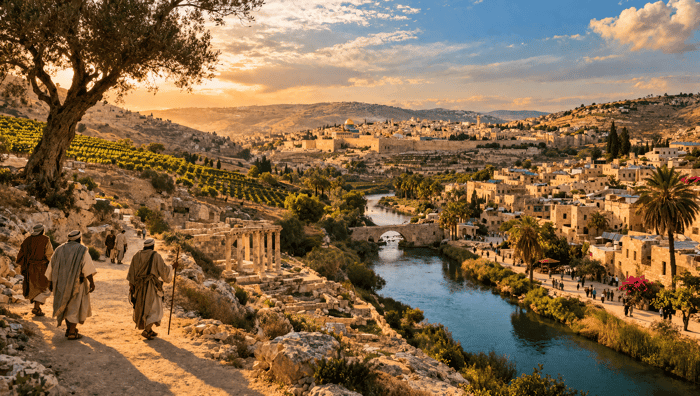
The Geography of the Bible helps us see that Scripture is not just a collection of ideas. It is a record of real events that happened in real places. Cities, rivers, deserts, and nations all play a role in how God reveals Himself. When you understand the setting of Scripture, the stories become clearer, and the message becomes stronger.
From the Garden of Eden to Jerusalem, the land itself tells part of the story. God works through places to teach, guide, and redeem His people. These places show how location shapes meaning, movement, and mission.
“The earth is the Lord's and the fullness thereof,
the world and those who dwell therein,” — Psalm 24:1 (ESV)
Why the Geography of the Bible Matters
Many readers focus only on people and events. But place matters just as much. The land provides context for everything that happens.
When you study biblical locations, you begin to:
- Understand why events happened where they did
- See patterns in God’s work across regions
- Connect Old and New Testament locations
- Recognize the reality of biblical history
Key Benefits of Studying Biblical Geography
| Benefit | What It Helps You See | Example |
|---|---|---|
| Context | Why events unfold a certain way | Jericho’s walls and battle strategy |
| Meaning | Deeper spiritual lessons | Wilderness as testing |
| Connection | Links between events | Egypt to Exodus |
| Confidence | Scripture is rooted in real places | Jerusalem as a central location |
“Your word is a lamp to my feet, and a light for my path.” — Psalm 119:105
The First Place: The Beginning of the World
The story begins with creation. The Garden of Eden is the first place mentioned in Scripture.
- It represents perfect fellowship with God
- It shows where sin first entered the world
- It marks the starting point of redemption
10 Interesting Facts About the Garden of Eden
“And the Lord God planted a garden in Eden, in the east, and there he put the man whom he had formed.” — Genesis 2:8 (ESV)
Key Regions in the Geography of the Bible
Different regions shape different parts of the story. Each place carries meaning beyond its location.
Egypt: Bondage and Deliverance
Egypt represents both refuge and slavery.
- Joseph rose to power there
- Israel lived and multiplied there
- God delivered His people from there
10 Interesting Facts About Egypt in the Bible
“I have surely seen the affliction of my people who are in Egypt… and I have come down to deliver them.” — Exodus 3:7-8
Nineveh: Repentance and Mercy
Nineveh shows God’s mercy toward those who turn to Him.
10 Interesting Facts About Nineveh in the Bible
“The people of Nineveh believed God.” — Jonah 3:5
Sodom and Gomorrah: Judgment and Warning
These cities reveal the seriousness of sin and the justice of God.
10 Interesting Facts About Sodom and Gomorrah in the Bible
Important Cities in the Geography of the Bible
Cities often serve as centers of culture, power, and spiritual influence.
Jerusalem: The Heart of the Story
Jerusalem stands at the center of Scripture’s story.
- The temple was built there
- Jesus was crucified there
- The early church began there
20 Interesting Facts About Jerusalem in the Bible
“For out of Zion shall go forth the law,
and the word of the Lord from Jerusalem.” — Isaiah 2:3 (ESV)
Bethlehem: The Birthplace of Jesus
Bethlehem is where Jesus was born, fulfilling prophecy.
20 Interesting Facts About Bethlehem in the Bible
“But you, Bethlehem… out of you will come one who is to be ruler in Israel.” — Micah 5:2
Jericho: Faith and Obedience
Jericho shows how God works through obedience.
10 Interesting Facts About Jericho in the Bible
Damascus: Transformation
Damascus is where Saul became Paul.
20 Interesting Facts About Damascus in the Bible
Places from the Life of Jesus
The Geography of the Bible becomes very personal in the life of Jesus. His ministry was tied closely to specific places.
Galilee: Ministry and Teaching
Many of Jesus’ teachings and miracles happened in Galilee.
10 Interesting Facts About Galilee in the Bible
Cana: The First Miracle
Jesus turned water into wine in Cana.
10 Interesting Facts About Cana in the Bible
“This beginning of his signs Jesus did in Cana of Galilee.” — John 2:11
Bethany: Friendship and Faith
Bethany was a place of rest and relationship for Jesus.
10 Interesting Facts About Bethany in the Bible
Golgotha: Sacrifice and Salvation
Golgotha is where Jesus was crucified.
10 Interesting Facts About Golgotha
“They came to a place called Golgotha… where they crucified him.” — Matthew 27:33-35
Rivers and Natural Features
Scripture also includes rivers and landscapes that shape events.
The Jordan River: Transition and New Life
- Israel crossed it into the Promised Land
- Jesus was baptized in it
10 Interesting Facts About the Jordan River in the Bible
“Jesus… was baptized by John in the Jordan.” — Mark 1:9
The Spread of the Gospel Across Regions
The Geography of the Bible expands in the New Testament as the gospel spreads.
Corinth and Ephesus: Church Growth
These cities became centers of early Christianity.
10 Interesting Facts About Corinth in the Bible
10 Interesting Facts About Ephesus in the Bible
Samaria: Breaking Barriers
Samaria shows how the gospel reaches all people.
Samaria in the Bible: History, Significance, and Lessons
“You will be my witnesses in Jerusalem, in all Judea and Samaria, and to the uttermost parts of the earth.” — Acts 1:8
How Geography Reveals Spiritual Truth
Biblical geography is not just about maps. It teaches spiritual lessons.
Common Patterns
| Place Type | Spiritual Meaning |
|---|---|
| Wilderness | Testing and dependence |
| Cities | Influence and culture |
| Rivers | Change and transition |
| Mountains | Meeting with God |
How to Study the Geography of the Bible
You can grow in understanding by taking simple steps.
Practical Steps
- Read articles about key places
- Follow journeys on a map
- Connect places to events
- Look for patterns in Scripture
The Geography of the Bible Points to God’s Plan
Every place in Scripture is part of a larger story. From Eden to Jerusalem, God is working out His plan.
This shows that God’s work is not abstract. It happens in real places, among real people, across real history.
“For we walk by faith, not by sight.” — 2 Corinthians 5:7
Final Thoughts on the Geography of the Bible
God’s Word helps you see Scripture as a living, connected story. It brings clarity, depth, and confidence.
When you understand where things happened, you better understand why they happened. And when you see how everything connects, you begin to see God’s plan more clearly.
“Jesus Christ is the same yesterday, today, and forever.” — Hebrews 13:8
FAQs
Why is the geography of the Bible important?
The geography of the Bible helps us understand where events happened and why those places mattered. God worked in real locations, and those settings shaped how people lived, traveled, and worshiped.
The land that I will show you. — Genesis 12:1 (WEB)
What are the most important locations in the Bible?
Some of the most important places include Jerusalem, Bethlehem, Galilee, Egypt, and the Jordan River. Each place connects to key moments in God’s plan, from the patriarchs to the life of Jesus.
Jerusalem, Jerusalem, who kills the prophets and stones those who are sent to her! — Matthew 23:37 (WEB)
How does geography help us understand Bible stories?
Knowing the geography of the Bible helps explain travel distances, cultural regions, and natural features like deserts and rivers. This adds depth to stories and shows how people depended on God in real conditions.
He led them also by a straight way, that they might go to a city to live in. — Psalm 107:7 (WEB)
Where did most Bible events take place?
Most Bible events happened in the Middle East, especially in Israel, Egypt, and nearby regions. These lands formed the setting for both the Old and New Testaments.
Blessed be Egypt my people, Assyria the work of my hands, and Israel my inheritance. — Isaiah 19:25 (WEB)
What is the significance of the Jordan River?
The Jordan River marks many important events, including Israel's entry into the Promised Land and the baptism of Jesus. It represents transition, obedience, and new beginnings.
Now when all the people were baptized, Jesus also had been baptized, and was praying. The sky was opened. — Luke 3:21 (WEB)
Is the Garden of Eden a real place?
The Bible describes Eden as a real place with rivers and land boundaries, though its exact location today is unknown. It shows where humanity first walked with God before sin entered the world.
Yahweh God planted a garden eastward, in Eden, and there he put the man whom he had formed. — Genesis 2:8 (WEB)
How does geography connect to God’s plan of salvation?
God chose specific places to carry out His plan, from Abraham’s journey to the cross in Jerusalem. These locations show that salvation happened in real history, not just ideas.
For God so loved the world, that he gave his one and only Son, that whoever believes in him should not perish, but have eternal life. — John 3:16 (WEB)
Why did Jesus minister in places like Galilee and Judea?
Jesus taught and performed miracles in these regions because they were full of people from different backgrounds. His message reached both Jews and Gentiles through these locations.
Jesus went about in all Galilee, teaching in their synagogues, preaching the Good News of the Kingdom. — Matthew 4:23 (WEB)
What can we learn from studying Bible places today?
Studying Bible places helps us see God’s work in real history and strengthens our faith. It reminds us that His promises were fulfilled in real time and space.
These things happened to them by way of example, and they were written for our admonition. — 1 Corinthians 10:11 (WEB)
How should believers respond to what the Bible reveals about these places?
Believers should respond with faith, trusting that God’s work in history points to His work in their lives today. The same God who worked in these places still calls people to follow Him.
Jesus Christ is the same yesterday, today, and forever. — Hebrews 13:8 (WEB)