Table of Contents
- Did Jesus Ever Claim to Be God in Clear Words?
- Jesus Claimed to Be One With the Father
- Jesus Claimed God's Authority to Forgive Sins
- Jesus Claimed Authority Over the Sabbath
- Jesus Said That Seeing Him Reveals the Father
- Jesus Accepted Worship
- Jesus Identified Himself as the Divine Son of Man
- Why Didn't Jesus Say the Exact Words "I Am God"?
- Did Jesus Claim to Have the Power to Give Eternal Life?
- Why the Deity of Jesus Matters for Salvation
- How Should We Respond to the Claims of Jesus?
- Did Jesus Ever Claim to Be God? The Biblical Answer
- FAQs
Did Jesus ever claim to be God? Jesus never spoke the exact modern sentence, "I am God." Yet He made statements that His Jewish listeners understood as claims to divine identity, authority, honor, and power.
Jesus claimed to exist before Abraham. He said He was one with the Father. He accepted worship, forgave sins, claimed authority over the Sabbath, and said that seeing Him was seeing the Father.
The claims of Jesus leave us with an important choice. If we ask, "Did Jesus ever claim to be God?" we must examine His own words instead of our assumptions. We cannot treat Him as only a wise teacher while ignoring what He said about Himself. We must decide whether His words are true.
Did Jesus Ever Claim to Be God in Clear Words?
Some people argue that Jesus never claimed to be God because the Gospels do not record Him saying the exact phrase, "I am God." But that standard places a modern wording requirement on an ancient Jewish setting.
Jesus spoke to people who knew the Old Testament. He used names, images, and forms of authority that belonged to God. His listeners often understood what He meant, even when they rejected Him.
In John 8, Jesus was speaking with religious leaders about Abraham. They questioned how Jesus could speak as though He had known Abraham. Jesus answered:
"Most certainly, I tell you, before Abraham came into existence, I AM."
John 8:58 (WEB)
Jesus did not merely say, "I existed before Abraham." He used the words "I AM." This language points back to God's revelation of His name to Moses and helps answer the question, "Did Jesus ever claim to be God?"
God said to Moses, "I AM WHO I AM," and he said, "You shall tell the children of Israel this: 'I AM has sent me to you.'"
Exodus 3:14 (WEB)
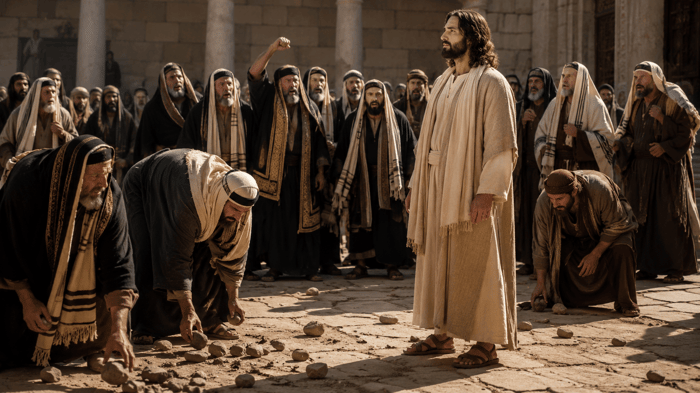
The people listening to Jesus did not respond as though He had made an ordinary statement about age. They picked up stones to throw at Him.
Their reaction shows that they believed Jesus had spoken blasphemy by taking divine language for Himself. Jesus did not correct them by saying, "You misunderstood me. I am only a prophet." Instead, He left the temple because His appointed time had not yet come.
Jesus Claimed to Be One With the Father
Another clear answer to the question, did Jesus ever claim to be God, appears in John 10. Jesus spoke about giving eternal life to His sheep and keeping them safe forever.
"I and the Father are one."
John 10:30 (WEB)
Jesus did not say that He and the Father were the same Person. The Father and the Son are distinct. Yet Jesus claimed a unity with the Father that went far beyond two people agreeing about a mission.
The religious leaders again picked up stones. Jesus asked why they wanted to stone Him. They answered:
The Jews answered him, "We don't stone you for a good work, but for blasphemy: because you, being a man, make yourself God."
John 10:33 (WEB)
This response is important. The people standing before Jesus believed He was making Himself equal with God.
Jesus did not deny His divine identity. He continued explaining that He was the Son whom the Father had sent into the world. He also said that the Father was in Him and He was in the Father.
The question is not whether His opponents agreed with Jesus. They did not. The point is that they understood the kind of claim He was making. Their response provides another biblical answer to the question, "Did Jesus ever claim to be God?"
Jesus Claimed God's Authority to Forgive Sins
Only God can forgive sins committed against God. A prophet may announce that God has forgiven someone, but Jesus did more than announce forgiveness. He forgave sins by His own authority.
When some men brought a paralyzed man to Jesus, He first addressed the man's deeper need.
Jesus, seeing their faith, said to the paralytic, "Son, cheer up! Your sins are forgiven you."
Matthew 9:2 (WEB)
The scribes believed Jesus had spoken blasphemy. Jesus knew their thoughts and asked which was easier: to forgive sins or to tell the man to rise and walk.
He then healed the man to show that He had authority on earth to forgive sins.
This was one of the claims of Jesus that revealed His deity. He was not acting like a religious teacher who could only point people toward God's forgiveness. He spoke as the One who had the right to grant it.
| Claim of Jesus | What It Reveals |
|---|---|
| "Before Abraham came into existence, I AM" | His eternal existence and divine identity |
| "I and the Father are one" | His unique unity with the Father |
| "Your sins are forgiven" | His authority to forgive sins |
| "The Son of Man is Lord of the Sabbath" | His authority over a law established by God |
| "He who has seen me has seen the Father" | His perfect revelation of the Father |
| "All authority has been given to me" | His rule over heaven and earth |
Jesus Claimed Authority Over the Sabbath
The Sabbath was not a human tradition. God established it and commanded Israel to keep it. Yet Jesus declared that He had authority over the Sabbath.
"For the Son of Man is Lord of the Sabbath."
Matthew 12:8 (WEB)
A mere teacher could explain how to obey the Sabbath. Jesus said He was its Lord.
This claim placed Him above the interpretations of the religious leaders and showed that He possessed divine authority over God's command. The Sabbath belonged to Him because He shared in the authority of the God who established it.
This does not mean Jesus rejected God's law. He showed its true purpose. The Sabbath was meant to serve people and point them toward rest in God, not to become a tool of pride or control. His authority over the Sabbath is another reason many Christians answer yes when asked, "Did Jesus ever claim to be God?"
Jesus Said That Seeing Him Reveals the Father
Philip once asked Jesus to show the disciples the Father. Jesus answered with a statement that no ordinary prophet could make.
Jesus said to him, "Have I been with you such a long time, and do you not know me, Philip? He who has seen me has seen the Father. How do you say, 'Show us the Father?'"
John 14:9 (WEB)
Jesus was not saying that He was the Father. The Son speaks to the Father and is sent by the Father. Yet Jesus is the perfect revelation of God's nature and character.
To see the compassion of Jesus is to see the compassion of God. To hear the truth of Jesus is to hear God's truth. To witness the holiness, justice, mercy, and love of Jesus is to see what the Father is like.
No prophet could truthfully say, "He who has seen me has seen the Father." Jesus could say it because He is the eternal Son who came to reveal God.
Jesus Accepted Worship
Faithful servants of God refused worship. Angels also refused worship because worship belongs to God alone.
After Jesus rose from the dead, His disciples worshiped Him.
When they saw him, they bowed down to him, but some doubted.
Matthew 28:17 (WEB)
Jesus did not rebuke them. He accepted their worship and then declared that all authority in heaven and on earth had been given to Him.
Thomas also worshiped Jesus after seeing the risen Lord.
Thomas answered him, "My Lord and my God!"
John 20:28 (WEB)
Jesus did not tell Thomas that his words were wrong. Instead, He said Thomas believed because he had seen Him. Jesus then blessed those who would believe without seeing.
If Jesus were only a created messenger, accepting worship and being called God would have been sinful. But Jesus accepted Thomas's confession because it was true.
Jesus Identified Himself as the Divine Son of Man
During His trial, the high priest asked Jesus whether He was the Christ, the Son of the Blessed. Jesus answered by pointing to Daniel's vision of a heavenly ruler.
Jesus said, "I am. You will see the Son of Man sitting at the right hand of Power and coming with the clouds of the sky."
Mark 14:62 (WEB)
In Daniel 7, the Son of Man comes with the clouds and receives an everlasting kingdom. All peoples and nations serve Him.
Dominion was given him, and glory, and a kingdom, that all the peoples, nations, and languages should serve him. His dominion is an everlasting dominion, which will not pass away, and his kingdom that which will not be destroyed.
Daniel 7:14 (WEB)
Coming with the clouds was connected with divine authority. Jesus claimed that He would sit at God's right hand and return as the glorious ruler and judge.
The high priest tore his clothing and accused Jesus of blasphemy. Once again, those listening understood that Jesus was making more than a claim to be a human king.
Why Didn't Jesus Say the Exact Words "I Am God"?
When someone asks, did Jesus ever claim to be God, the question often assumes that only one sentence would count as proof. But people reveal their identity through more than one form of speech.
Jesus made His identity known through:
- Divine names and titles
- Authority to forgive sins
- Authority over the Sabbath
- Power to give eternal life
- Unity with the Father
- Acceptance of worship
- Authority to judge the world
- Claims of eternal existence
- Power over death
- His resurrection from the dead
Jesus spoke in ways that fit His first-century Jewish setting. His claims were clear enough that His opponents repeatedly accused Him of blasphemy and sought to kill Him.
The issue was not that they failed to understand Him. The issue was that many refused to believe Him.
Did Jesus Claim to Have the Power to Give Eternal Life?
Jesus did not merely teach people how to find life. He claimed to be the source of life.
Jesus said to her, "I am the resurrection and the life. He who believes in me will still live, even if he dies."
John 11:25 (WEB)
A prophet might pray for God to raise the dead. Jesus said, "I am the resurrection and the life."
He also claimed the authority to raise His people on the last day. These are not the words of a teacher who believed He was one guide among many. They are the words of the divine Son who holds power over life and death.
The Jesus deity question cannot be separated from His promises. If Jesus is not God, He cannot give eternal life to everyone who trusts Him. But if He is God the Son, His promise is secure.
Why the Deity of Jesus Matters for Salvation
The question, did Jesus ever claim to be God, is not only part of a religious debate. It is tied to the Gospel.
Every person has sinned against a holy God. Our good works cannot erase our guilt or restore our broken relationship with Him. We need a Savior who can bear sin's judgment and defeat death.
Jesus became truly human so He could represent us and die in our place. He is truly God, so His sacrifice has complete worth and His power to save has no limit.
But God commends his own love toward us, in that while we were yet sinners, Christ died for us.
Romans 5:8 (WEB)
Jesus died on the cross for sinners and rose from the dead. His resurrection proved that death had been defeated and that His sacrifice was accepted.
Salvation is not earned by religious effort. God calls us to repent of sin and trust in Jesus Christ.
Because if you will confess with your mouth that Jesus is Lord, and believe in your heart that God raised him from the dead, you will be saved.
Romans 10:9 (WEB)
Calling Jesus "Lord" is more than treating Him as a life coach. It means trusting Him as the risen King, submitting to His authority, and depending on His death and resurrection for salvation.
How Should We Respond to the Claims of Jesus?
Jesus does not leave room for a neutral response. He claimed divine identity and authority. He also called people to follow Him.
Consider these questions:
- Do I believe Jesus spoke the truth about Himself?
- Do I trust His death as the payment for my sin?
- Do I believe that God raised Him from the dead?
- Have I surrendered my life to Jesus as Lord?
- Am I following His words or only admiring His teachings?
Some people in the Gospels responded to Jesus with anger. Others walked away. Some bowed before Him and confessed that He was Lord.
The same choice remains today.
Did Jesus Ever Claim to Be God? The Biblical Answer
So, did Jesus ever claim to be God? Yes. He claimed eternal existence, equality with the Father, authority to forgive sins, rule over the Sabbath, power to give life, and the right to receive worship.
Jesus claimed to be God through statements and actions that His Jewish audience understood. Some accused Him of blasphemy because they rejected His claim. Others worshiped Him because they believed it.
The strongest confirmation came through His resurrection. Jesus died, was buried, and rose from the dead. He is not only a teacher from the past. He is the living Lord.
Each person must decide how to respond. If the answer to "Did Jesus ever claim to be God?" is yes, then His call to repent and believe cannot be ignored. The right response is to repent, believe the Gospel, confess Jesus as Lord, and follow Him in faith.
FAQs
Did Jesus ever claim to be God directly?
Jesus never recorded the exact English words, "I am God." Instead, He made statements that His Jewish audience understood as claims to deity. He called Himself "I AM," claimed unity with the Father, forgave sins, accepted worship, and declared authority that belongs only to God.
"Most certainly, I tell you, before Abraham came into existence, I AM."
John 8:58 (WEB)
Why did the Jewish leaders accuse Jesus of blasphemy?
The religious leaders believed Jesus was making Himself equal with God. That is why they repeatedly tried to stone Him and later sought His execution. They understood His claims, even though they rejected them.
The Jews answered him, "We don't stone you for a good work, but for blasphemy: because you, being a man, make yourself God."
John 10:33 (WEB)
Did Jesus accept worship?
Yes. Unlike angels and faithful servants of God, Jesus accepted worship without correcting those who worshiped Him. After His resurrection, Thomas confessed Jesus as both Lord and God, and Jesus accepted that confession.
Thomas answered him, "My Lord and my God!"
John 20:28 (WEB)
Why is Jesus' claim to be God important?
If Jesus is truly God, then His words carry absolute authority. His sacrifice on the cross has infinite value, and His promise of eternal life can be trusted. If His claims were false, Christianity would have no foundation.
"I and the Father are one."
John 10:30 (WEB)
Did Jesus' miracles prove He is God?
Jesus' miracles alone did not automatically prove His deity, because prophets also performed miracles by God's power. What makes Jesus unique is that His miracles confirmed His own claims to divine authority, including forgiving sins, raising the dead, and giving eternal life.
Jesus, seeing their faith, said to the paralytic, "Son, cheer up! Your sins are forgiven you."
Matthew 9:2 (WEB)
Why didn't Jesus simply say, "I am God"?
Jesus spoke within a first-century Jewish culture that understood the Old Testament. Rather than using a modern phrase, He revealed His identity through divine names, titles, actions, and authority. His audience clearly understood what He meant, which explains why they accused Him of blasphemy.
God said to Moses, "I AM WHO I AM," and he said, "You shall tell the children of Israel this: 'I AM has sent me to you.'"
Exodus 3:14 (WEB)
How does the question "Did Jesus ever claim to be God?" relate to salvation?
This question is at the heart of the Gospel. Only someone who is truly God could fully satisfy God's justice and conquer death. Jesus became fully human to die in our place, and because He is fully God, His sacrifice is sufficient for every sinner who believes in Him. The proper response is not merely to acknowledge His claims, but to repent, trust in His death and resurrection, and confess Him as Lord.
But God commends his own love toward us, in that while we were yet sinners, Christ died for us.
Romans 5:8 (WEB)
Because if you will confess with your mouth that Jesus is Lord, and believe in your heart that God raised him from the dead, you will be saved.
Romans 10:9 (WEB)
What is the strongest evidence that Jesus' claims were true?
The resurrection is the ultimate confirmation of everything Jesus said about Himself. By rising from the dead, He demonstrated His authority over sin and death and proved that His claims were true.
He is not here, for he has risen, just like he said. Come, see the place where the Lord was lying.
Matthew 28:6 (WEB)