
Table of Contents
- 1. Adam’s Name Means “Man” or “From the Ground”
- 2. Eve Was Created as a True Partner
- 3. Eden Was a Real Place With Real Features
- 4. Adam and Eve Were Naked Without Shame
- 5. The Serpent Was Crafty, Not Forceful
- 6. Eve Saw the Fruit as Desirable
- 7. Adam Was With Eve During the Choice
- 8. Shame Appeared After Disobedience
- 9. God Sought Them Even After Sin
- 10. Hope Was Promised From the Start
- Key Themes in the Story
- Strengths and Challenges of the Adam and Eve Account
- Why This Story Still Matters
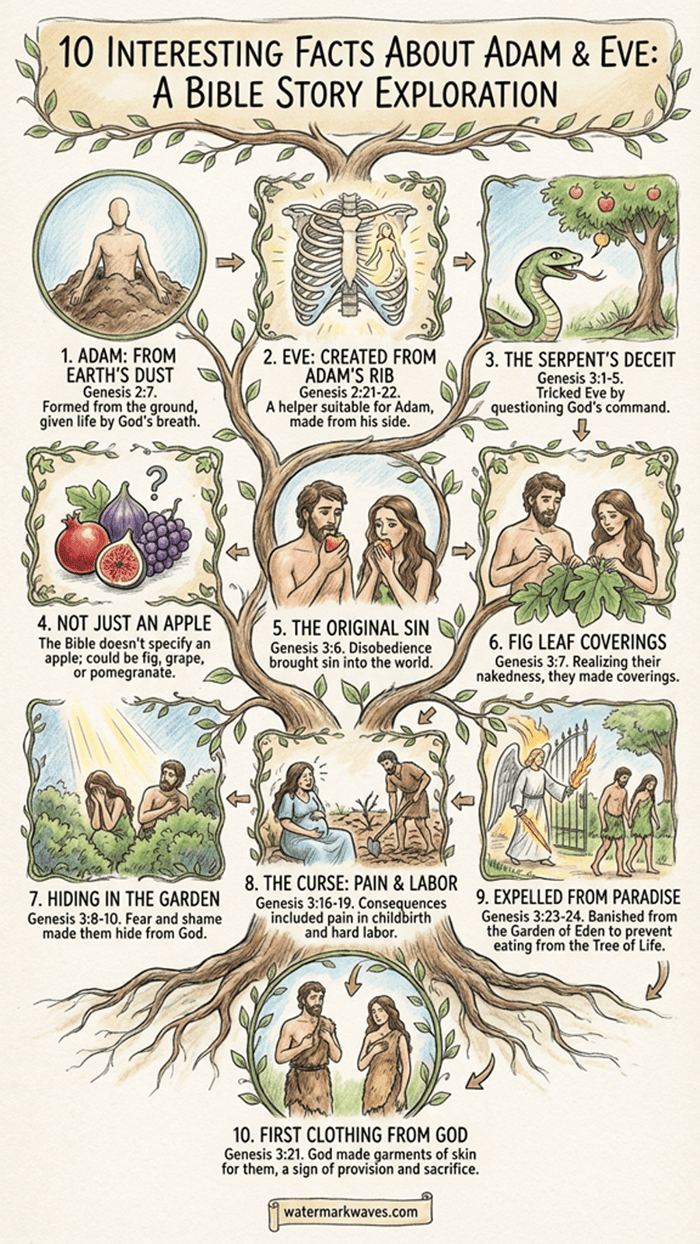
- Infographic
The story of Adam and Eve stands at the very beginning of the Bible. It shapes how many people understand creation, choice, sin, and hope. Found in Genesis, this account is simple on the surface but rich with meaning.
Below are ten interesting facts that help explain why this story still matters today.
1. Adam’s Name Means “Man” or “From the Ground”
The name Adam comes from the Hebrew word adamah, which means ground or soil. This connects Adam directly to the earth he was formed from. This detail reminds readers that humans are created beings who depend on God for life.
“Then the Lord God formed the man of dust from the ground and breathed into his nostrils the breath of life.”
— Genesis 2:7
2. Eve Was Created as a True Partner
Eve was formed from Adam’s side, not his head or feet. This shows closeness and shared purpose. The story presents companionship as part of God’s good design.
“Then the Lord God made a woman from the rib he had taken out of the man.”
— Genesis 2:22
3. Eden Was a Real Place With Real Features
The Garden of Eden is described with rivers and regions. This makes it more than a vague idea. The Bible treats Eden as a place prepared by God, not a random setting.
“A river watering the garden flowed from Eden; from there it was separated into four headwaters.”
— Genesis 2:10
4. Adam and Eve Were Naked Without Shame
Before sin entered the world, there was no fear or guilt. This shows complete trust, peace, and openness.
“Adam and his wife were both naked, and they felt no shame.”
— Genesis 2:25
5. The Serpent Was Crafty, Not Forceful
The serpent did not force Eve to eat the fruit. It questioned God’s words. Temptation often starts with doubt, not pressure.
“Did God really say, ‘You must not eat from any tree in the garden’?”
— Genesis 3:1
6. Eve Saw the Fruit as Desirable
The fruit appealed to the eyes, the appetite, and the mind. This shows how temptation works on many levels at once.
“When the woman saw that the fruit of the tree was good for food and pleasing to the eye, and also desirable for gaining wisdom…”
— Genesis 3:6
7. Adam Was With Eve During the Choice
The text suggests Adam was present, not absent. This places responsibility on both, not just one.
“She also gave some to her husband, who was with her, and he ate it.”
— Genesis 3:6
8. Shame Appeared After Disobedience
Once they sinned, their view of themselves changed. Fear and hiding replaced peace.
“Then the eyes of both of them were opened, and they realized they were naked.”
— Genesis 3:7
9. God Sought Them Even After Sin
God came looking for Adam and Eve instead of abandoning them. This shows God’s desire for relationship, even after failure.
“But the Lord God called to the man, ‘Where are you?’”
— Genesis 3:9
10. Hope Was Promised From the Start
God spoke of a future victory over evil. Many see this as the first promise of redemption.
“He will crush your head, and you will strike his heel.”
— Genesis 3:15
Key Themes in the Story
| Theme | Meaning | Impact on Faith |
|---|---|---|
| Creation | Humans made by God | Gives life purpose |
| Choice | Free will is real | Actions matter |
| Sin | Disobedience breaks trust | Explains brokenness |
| Grace | God seeks sinners | Offers hope |
Strengths and Challenges of the Adam and Eve Account
| Aspect | Strengths | Challenges |
|---|---|---|
| Simplicity | Easy to remember | Often misunderstood |
| Symbolism | Deep meaning | Can be debated |
| Theology | Explains sin | Raises questions |
| Hope | Promise of rescue | Requires faith |
Why This Story Still Matters
The story of Adam and Eve explains why the world is both beautiful and broken. It teaches that choices have consequences, yet God’s mercy remains present. Many people see their own struggles reflected in this early story.
“For as in Adam all die, so in Christ all will be made alive.”
— 1 Corinthians 15:22
Infographic