Table of Contents
Jonah in the Bible is more than a story about a great fish. It is a powerful account of God’s mercy, human resistance, and the wideness of divine compassion. Many people remember Jonah for running away. Yet the book shows far more than one prophet’s fear. It reveals a God who pursues both sinners and servants.
The story is short—only four chapters—but it speaks with deep truth. Jonah struggled with obedience. He wrestled with anger. He learned that God’s mercy reaches farther than personal comfort. When we study Jonah in the Bible, we see our own hearts reflected in his.
The Call of God and the Flight of a Prophet
Jonah was a prophet during the reign of King Jeroboam II of Israel. Scripture first mentions him outside the book that bears his name.
2 Kings 14:25 (WEB)
He restored the border of Israel from the entrance of Hamath to the sea of the Arabah, according to Yahweh, the God of Israel’s word, which he spoke by his servant Jonah the son of Amittai, the prophet, who was from Gath Hepher.
God later called Jonah to preach against Nineveh, the capital of Assyria. Nineveh was known for violence and cruelty. Instead of going east to Nineveh, Jonah boarded a ship heading west to Tarshish. He did not misunderstand God’s command. He simply did not want to obey.
Jonah 1:1–2 (WEB)
Now Yahweh’s word came to Jonah the son of Amittai, saying, “Arise, go to Nineveh, that great city, and preach against it, for their wickedness has come up before me.”
Jonah 1:3 (WEB)
But Jonah rose up to flee to Tarshish from the presence of Yahweh. He went down to Joppa, and found a ship going to Tarshish; so he paid its fare, and went down into it, to go with them to Tarshish from the presence of Yahweh.
Jonah’s flight was not just a change of direction. It was a rejection of God’s mission. He went “down” to Joppa, “down” into the ship, and later “down” into the sea. The downward movement shows the spiritual path of disobedience.
Lessons from Jonah’s Flight
- God’s call may stretch us beyond comfort.
- Disobedience often begins with fear or pride.
- Running from God never brings peace.
- God remains present even when we resist Him.
Jonah in the Bible teaches that believers can know God and still struggle with obedience.
The Storm and the Sovereignty of God
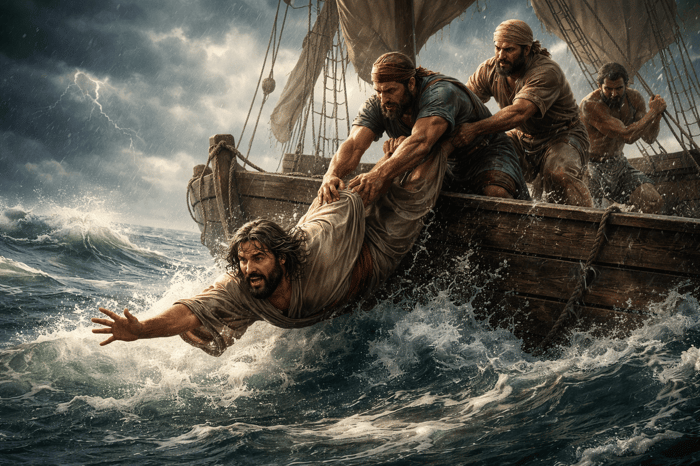
As Jonah sailed away, the Lord sent a violent storm. The sailors feared for their lives. They cried out to their own gods, but Jonah slept below deck.
Jonah 1:4 (WEB)
But Yahweh sent out a great wind on the sea, and there was a mighty storm on the sea, so that the ship was likely to break up.
The captain woke Jonah and urged him to pray. The sailors cast lots to discover the cause of the storm. The lot fell on Jonah. He admitted that he was fleeing from the Lord, the God of heaven.
Jonah 1:9 (WEB)
He said to them, “I am a Hebrew, and I fear Yahweh, the God of heaven, who has made the sea and the dry land.”
Jonah told the sailors to throw him into the sea. At first they resisted. They rowed harder. But the storm grew worse. Finally, they cast Jonah overboard, and the sea became calm.
Jonah 1:15–16 (WEB)
So they took up Jonah and threw him into the sea; and the sea ceased its raging. Then the men feared Yahweh exceedingly; and they offered a sacrifice to Yahweh and made vows.
The pagan sailors feared the Lord and offered sacrifices. Even in Jonah’s disobedience, God used the situation to reveal Himself to others.
What This Section Shows
| Event | What It Reveals About God | What It Reveals About Jonah |
|---|---|---|
| The storm | God rules over nature | Jonah cannot escape God |
| The lot falling on Jonah | God directs events | Jonah must face truth |
| The sea calming | God shows mercy | Jonah’s choice had impact |
| Sailors worshiping | God reaches nations | Jonah resists what sailors accept |
Jonah in the Bible reminds us that God’s plans will stand, even when His servants falter.
The Great Fish and the Prayer of Repentance
After Jonah was thrown into the sea, God appointed a great fish to swallow him.
Jonah 1:17 (WEB)
Yahweh prepared a huge fish to swallow up Jonah, and Jonah was in the belly of the fish three days and three nights.
Jonah spent three days and three nights inside the fish. This moment often captures attention, yet it serves a deeper purpose. It was not judgment alone; it was rescue.
Inside the fish, Jonah prayed.
Jonah 2:1–2 (WEB)
Then Jonah prayed to Yahweh, his God, out of the fish’s belly. He said,
“I called because of my affliction to Yahweh.
He answered me.
Out of the belly of Sheol I cried.
You heard my voice.
Jonah’s prayer echoes many Psalms. He acknowledged that salvation belongs to the Lord.
Jonah 2:9 (WEB)
But I will sacrifice to you with the voice of thanksgiving.
I will pay that which I have vowed.
Salvation belongs to Yahweh.”
God commanded the fish to release Jonah onto dry land. The prophet who ran now had a second chance.
Theological Truths from the Fish
- God disciplines but also restores.
- No place is beyond God’s reach.
- Repentance begins with honest prayer.
- Salvation belongs to the Lord alone.
Jesus later referred to Jonah’s three days in the fish as a sign pointing to His own death and resurrection.
Matthew 12:40 (WEB)
For as Jonah was three days and three nights in the belly of the huge fish, so will the Son of Man be three days and three nights in the heart of the earth.
Jonah in the Bible does not only look backward. It points forward to Christ.
The Preaching in Nineveh
God repeated His command to Jonah.
Jonah 3:1–2 (WEB)
Yahweh’s word came to Jonah the second time, saying, “Arise, go to Nineveh, that great city, and preach to it the message that I give you.”
This time, Jonah obeyed. He entered Nineveh and proclaimed judgment.
Jonah 3:4 (WEB)
Jonah began to enter into the city a day’s journey, and he cried out, and said, “In forty days, Nineveh will be overthrown!”
The response was unexpected. The people believed God. From the greatest to the least, they fasted and put on sackcloth. Even the king humbled himself.
Jonah 3:5–6 (WEB)
The people of Nineveh believed God; and they proclaimed a fast and put on sackcloth, from their greatest even to their least. The news reached the king of Nineveh, and he arose from his throne, took off his royal robe, covered himself with sackcloth, and sat in ashes.
When God saw their repentance, He relented from the disaster He had threatened.
Jonah 3:10 (WEB)
God saw their works, that they turned from their evil way. God relented of the disaster which he said he would do to them, and he didn’t do it.
This is one of the most remarkable revivals in Scripture. A city known for cruelty turned to God.
What We Learn from Nineveh
- God’s mercy extends to all nations.
- Repentance can begin with a simple message.
- God responds to genuine humility.
- No one is beyond hope.
Jonah in the Bible shows that God’s heart for the nations was not a New Testament idea. It was present long before.
Jonah’s Anger and God’s Compassion
Instead of rejoicing, Jonah became angry.
Jonah 4:1–2 (WEB)
But it displeased Jonah exceedingly, and he was angry. He prayed to Yahweh, and said, “Please, Yahweh, wasn’t this what I said when I was still in my own country? Therefore I hurried to flee to Tarshish, for I knew that you are a gracious God and merciful, slow to anger, and abundant in loving kindness, and you relent of doing harm.
Jonah admitted why he ran in the first place. He knew God was gracious and compassionate. He did not want mercy shown to his enemies.
Jonah went outside the city and waited, hoping judgment would still fall. God appointed a plant to provide shade. Jonah was glad for the plant. Then God appointed a worm to destroy it. Jonah became upset again.
Jonah 4:6–7 (WEB)
Yahweh God prepared a vine and made it to come up over Jonah, that it might be a shade over his head to deliver him from his discomfort. So Jonah was exceedingly glad because of the vine. But God prepared a worm at dawn the next day, and it chewed on the vine so that it withered.
God used the plant to teach Jonah about compassion.
Jonah 4:10–11 (WEB)
Yahweh said, “You have been concerned for the vine, for which you have not labored, neither made it grow; which came up in a night and perished in a night. Shouldn’t I be concerned for Nineveh, that great city, in which are more than one hundred twenty thousand persons who can’t discern between their right hand and their left hand, and also many animals?”
The book ends with a question. God contrasts Jonah’s concern for a plant with His concern for thousands of people. The story closes without telling us Jonah’s final response.
A Comparison of Hearts
| Jonah’s Focus | God’s Focus |
|---|---|
| Personal comfort | Eternal souls |
| National pride | Global mercy |
| Anger over grace | Joy over repentance |
| Temporary shade | Lasting compassion |
Jonah in the Bible challenges readers to examine their own hearts. Do we celebrate mercy for others, even when it costs us comfort?
Christ and the Greater Jonah
Jesus described Himself as greater than Jonah.
Matthew 12:41 (WEB)
The men of Nineveh will stand up in the judgment with this generation and will condemn it, for they repented at the preaching of Jonah; and behold, someone greater than Jonah is here.
Jonah preached reluctantly. Jesus came willingly. Jonah fled from sinners. Jesus ate with sinners. Jonah was angry at mercy. Jesus embodied mercy.
The sign of Jonah—three days and nights—points to the resurrection. Where Jonah emerged from a fish to preach judgment and grace, Christ rose from the grave to bring salvation to all who believe.
Practical Applications for Today
The story speaks clearly to modern believers.
When We Resist God’s Call
- Ask whether fear is guiding choices.
- Remember that obedience leads to peace.
- Trust that God’s mission is good.
When We Face Discipline
- See correction as love.
- Turn quickly in prayer.
- Hold fast to the truth that salvation belongs to the Lord.
When Others Receive Mercy
- Celebrate grace, even for enemies.
- Pray for a heart shaped like God’s.
- Remember your own need for forgiveness.
Jonah in the Bible is not a children’s tale. It is a mirror. It shows that believers can know doctrine and still struggle with pride. It shows that God’s compassion is wider than national borders. It shows that mercy triumphs over judgment.
Key Themes in Jonah
- Sovereignty of God – He controls storms, fish, plants, and nations.
- Human Responsibility – Jonah made real choices.
- Repentance – Nineveh responded in humility.
- Grace – God delights in mercy.
- Mission – God’s concern includes all peoples.
Each theme runs through Scripture as a whole.
Why Jonah in the Bible Still Matters
Many people feel like Jonah at some point. They sense God leading them somewhere difficult. They wrestle with resentment. They struggle with obedience. The book does not hide these tensions. It presents them with honesty.
Yet above Jonah’s weakness stands God’s faithfulness. God pursued Jonah on the sea. He heard Jonah in the depths. He used Jonah in Nineveh. He corrected Jonah outside the city.
The final question God asked Jonah still echoes: Should He not have concern for a great city? That question invites readers to align their hearts with His.
Jonah in the Bible reveals a God who is patient with His servants and compassionate toward the lost. It calls believers to trust His wisdom, share His message, and reflect His mercy.
FAQs
Why did Jonah run away from God?
Jonah did not flee because he doubted God’s power. He fled because he knew God’s character. He feared that Nineveh would repent and receive mercy.
Jonah 4:2 (WEB)
He prayed to Yahweh, and said, “Please, Yahweh, wasn’t this what I said when I was still in my own country? Therefore I hurried to flee to Tarshish; for I knew that you are a gracious God, and merciful, slow to anger, and abundant in loving kindness, and repent of the evil.”
Was the great fish meant to punish Jonah?
The great fish was not only an act of discipline but also an act of rescue. God preserved Jonah’s life and gave him space to repent.
Jonah 1:17 (WEB)
Yahweh prepared a huge fish to swallow up Jonah, and Jonah was in the belly of the fish three days and three nights.
What does Jonah’s prayer teach us about repentance?
Jonah’s prayer shows that repentance begins with acknowledging God’s sovereignty and confessing that salvation belongs to Him.
Jonah 2:9 (WEB)
But I will sacrifice to you with the voice of thanksgiving. I will pay that which I have vowed. Salvation belongs to Yahweh.
Why did the people of Nineveh respond so quickly?
The people of Nineveh believed God’s warning and humbled themselves. Their response shows that even hardened cities can turn when confronted with truth.
Jonah 3:5 (WEB)
The people of Nineveh believed God; and they proclaimed a fast, and put on sackcloth, from their greatest even to their least.
What does Jonah’s anger reveal about the human heart?
Jonah’s anger exposes how easily believers can value comfort over compassion. It reminds us that we often struggle to celebrate grace for others.
Jonah 4:1–2 (WEB)
But it displeased Jonah exceedingly, and he was angry. He prayed to Yahweh, and said, “Please, Yahweh, wasn’t this what I said when I was still in my own country? Therefore I hurried to flee to Tarshish; for I knew that you are a gracious God, and merciful, slow to anger, and abundant in loving kindness, and repent of the evil.”
How does Jonah point to Jesus?
Jesus identified Jonah’s three days in the fish as a sign of His own death and resurrection, showing that the story ultimately points to Christ.
Matthew 12:40 (WEB)
For as Jonah was three days and three nights in the belly of the huge fish, so will the Son of Man be three days and three nights in the heart of the earth.