
Table of Contents
Job in the Bible stands as one of the most powerful portraits of faith under pressure. His story is not simple. It does not offer easy answers. Yet it gives deep truth about suffering, trust, and the character of God. When believers wrestle with pain, loss, or silence from heaven, they often turn to Job in the Bible because his life mirrors their own questions.
The book of Job invites readers into a hard conversation. Why do the righteous suffer? Does faith depend on blessing? Can trust survive when life falls apart? These are not abstract ideas. They are real struggles that many Christians face. The life of Job in the Bible shows that faith can endure even when understanding fails.
Who Was Job?
Job is introduced as a righteous man. He feared God and turned away from evil. He was wealthy, respected, and blessed with a large family.
Job 1:1 (WEB)
There was a man in the land of Uz, whose name was Job. That man was blameless and upright, and one who feared God, and turned away from evil.
Scripture makes it clear that Job’s suffering was not punishment for hidden sin. From the start, the reader is told that he was upright. This matters. Many people assume that hardship always comes from wrongdoing. Job in the Bible challenges that idea.
He lived in the land of Uz, likely during the time of the patriarchs. The book does not focus on Israel’s law or temple. Instead, it centers on universal themes: suffering, justice, and faith.
Key Facts About Job
- He was described as blameless and upright.
- He had great wealth and many children.
- He regularly offered sacrifices for his family.
- He became a symbol of endurance in later Scripture.
James 5:11 (WEB)
Behold, we call them blessed who endured. You have heard of the perseverance of Job and have seen the Lord in the outcome, and how the Lord is full of compassion and mercy.
James points back to Job as an example of perseverance. That shows that the message of Job in the Bible carries forward into the New Testament.
The Heavenly Scene We Do Not See
One of the most striking parts of the book is the opening scene in heaven. Satan challenges Job’s faith. He argues that Job only serves God because he is blessed.
Job 1:9–11 (WEB)
Then Satan answered Yahweh, and said, “Does Job fear God for nothing? Haven’t you made a hedge around him, and around his house, and around all that he has, on every side? You have blessed the work of his hands, and his substance is increased in the land. But stretch out your hand now, and touch all that he has, and he will renounce you to your face.”
This moment reveals something important. The story is not just about Job. It is about the worth of God. Is God worthy of worship apart from gifts and comfort?
God allows Satan to test Job, but He sets limits. Job loses his wealth. He loses his children. Later, he loses his health.
Job 1:21 (WEB)
He said, “Naked I came out of my mother’s womb, and naked will I return there. Yahweh gave, and Yahweh has taken away. Blessed be Yahweh’s name.”
Job’s response is remarkable. He grieves, yet he worships. He acknowledges that everything comes from God’s hand. Job in the Bible teaches that worship is not rooted in circumstance but in who God is.
When Suffering Feels Personal
After losing his possessions and children, Job is struck with painful sores. His wife urges him to curse God and die.
Job 2:9–10 (WEB)
Then his wife said to him, “Do you still maintain your integrity? Renounce God, and die.”
But he said to her, “You speak as one of the foolish women would speak. What? Shall we receive good at the hand of God, and shall we not receive evil?”
In all this Job didn’t sin with his lips.
Job refuses. He does not deny his pain. He does not pretend that loss does not hurt. But he holds to the truth that God is still sovereign.
Many believers relate to this stage of Job in the Bible. There are seasons when suffering feels relentless. Illness, loss, broken relationships, and uncertainty press in from every side. In those moments, faith can feel fragile.
Yet the story shows that honest grief is not rebellion. Job laments. He cries out. He questions. Still, he does not abandon God.
The Friends and Their Arguments
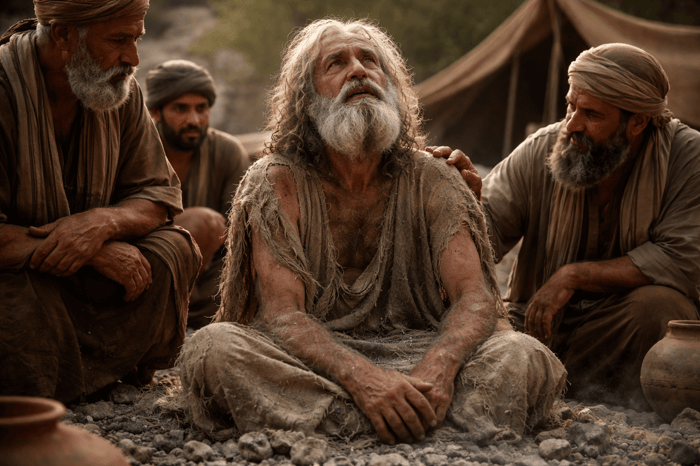
Job’s three friends arrive to comfort him. At first, they sit in silence. That was wise.
Job 2:13 (WEB)
So they sat down with him on the ground seven days and seven nights, and no one spoke a word to him, for they saw that his grief was very great.
But then they begin to speak. They insist that suffering must be tied to sin. In their view, Job must have done something wrong.
Their theology sounds logical. God is just. Therefore, pain must mean guilt. Yet their conclusion is flawed. They apply a general truth in a rigid way.
What Job’s Friends Get Wrong
- They assume they know the reason for suffering.
- They speak for God without full knowledge.
- They value explanation over compassion.
- They reduce complex pain to simple formulas.
Job defends his integrity. He does not claim to be perfect. But he knows he has not committed secret sins that deserve such disaster.
The debate fills most of the book. It shows how hard it is to interpret suffering. It also warns believers not to rush to judgment when others hurt.
Job’s Honest Lament
One reason Job in the Bible resonates so deeply is his honesty. He does not hide his anguish.
Job 3:1–3 (WEB)
After this Job opened his mouth, and cursed the day of his birth. Job answered:
“Let the day perish in which I was born,
the night which said, ‘There is a boy conceived.’
He curses the day of his birth. He wishes he had never lived. These words may shock readers. Yet they are preserved in Scripture. God allows lament to be recorded.
Job asks hard questions:
- Why do the wicked prosper?
- Why does God seem silent?
- Why is there no clear answer?
At times, he speaks boldly. He even desires to bring his case before God.
Job 13:3 (WEB)
“Surely I would speak to the Almighty.
I desire to reason with God.
This boldness is not unbelief. It is the cry of a man who believes God is real and just. Job in the Bible shows that faith can wrestle without walking away.
A Glimpse of Hope
In the middle of despair, Job speaks words of hope that echo through history.
Job 19:25–27 (WEB)
But as for me, I know that my Redeemer lives.
In the end, he will stand upon the earth.
After my skin is destroyed,
then I will see God in my flesh,
whom I, even I, will see on my side.
My eyes will see, and not as a stranger.
“My heart is consumed within me.
These verses point to a Redeemer. Christians often see in them a shadow of Christ. Even without full knowledge of the gospel, Job expresses confidence that his story will not end in dust.
This hope does not erase his suffering. But it anchors him. Job in the Bible teaches that hope can coexist with sorrow.
God Speaks from the Whirlwind
After many chapters of debate, God answers. He does not explain the heavenly conversation. He does not outline the reason for each loss. Instead, He reveals His power and wisdom.
Job 38:1–4 (WEB)
Then Yahweh answered Job out of the whirlwind,
“Who is this who darkens counsel
by words without knowledge?
Brace yourself like a man,
for I will question you, then you answer me!
“Where were you when I laid the foundations of the earth?
Declare, if you have understanding.
God asks questions about creation. Where was Job when the foundations of the earth were laid? Can he command the morning? Can he control the sea?
The point is not to shame Job. It is to remind him of God’s greatness. Human understanding is limited. Divine wisdom is not.
What God’s Response Teaches
- God is sovereign over creation.
- His purposes are higher than human plans.
- Not all suffering will be explained.
- Trust rests in who God is, not in full answers.
Job responds with humility.
Job 42:1–6 (WEB)
Then Job answered Yahweh:
“I know that you can do all things,
and that no purpose of yours can be restrained.
You asked, ‘Who is this who hides counsel without knowledge?’
therefore I have uttered that which I didn’t understand,
things too wonderful for me, which I didn’t know.
You said, ‘Listen, now, and I will speak;
I will question you, and you will answer me.’
I had heard of you by the hearing of the ear,
but now my eye sees you.
Therefore I abhor myself,
and repent in dust and ashes.”
He admits that he spoke of things too wonderful for him. He does not receive a detailed explanation. Instead, he gains a deeper vision of God.
Restoration and Grace
At the end of the book, God restores Job’s fortunes. He gives him more children and greater wealth than before.
Job 42:10 (WEB)
Yahweh restored Job’s prosperity when he prayed for his friends. Yahweh gave Job twice as much as he had before.
Restoration does not erase the graves of his first children. It does not rewrite history. But it shows that suffering does not have the final word.
Job in the Bible reminds believers that God’s purposes move toward redemption. Even when pain lasts long, it is not ultimate.
Theological Lessons from Job in the Bible
The story offers rich teaching for Christian life.
1. Suffering Is Not Always Punishment
Job’s righteousness is clear from the start. Hardship does not equal guilt.
2. God Is Worthy Apart from Blessing
The central question in heaven was whether Job would serve God without gifts. His endurance shows that true faith values God Himself.
3. Honest Lament Is Part of Faith
Job’s cries are preserved in Scripture. God does not silence grief. He meets it.
4. God’s Wisdom Surpasses Ours
The whirlwind speech shifts focus from explanation to revelation. God’s character becomes the answer.
5. Hope Points Forward
Job’s longing for a Redeemer finds its fulfillment in Christ. The book prepares hearts for the gospel.
Why Job in the Bible Still Matters
Modern believers face many forms of suffering: illness, loss, injustice, doubt. The story of Job in the Bible speaks into each one.
It teaches that faith is not built on comfort. It grows through trust. It also warns against shallow answers. When someone suffers, presence matters more than explanation.
The book ends not with neat logic but with worship. Job sees God more clearly. That vision changes him.
When readers study Job in the Bible, they learn that pain does not cancel God’s goodness. Silence does not mean absence. And unanswered questions do not cancel trust.
The life of Job in the Bible calls believers to a deeper faith—one rooted not in gifts but in the Giver. It invites them to worship through tears and to rest in a wisdom greater than their own.
FAQs
Was Job a real person in the Bible?
Yes, Scripture treats Job as a real historical person. The prophet Ezekiel and the apostle James both mention him alongside other known figures. This shows that Job in the Bible is not presented as a myth but as a faithful man who endured real suffering.
Ezekiel 14:14 (WEB)
Even if these three men, Noah, Daniel, and Job, were in it, they would deliver only their own souls by their righteousness,” says the Lord Yahweh.
James 5:11 (WEB)
Behold, we call them blessed who endured. You have heard of the perseverance of Job and have seen the Lord’s outcome, how the Lord is full of compassion and mercy.
Why did God allow Job to suffer?
God allowed Job’s suffering to reveal deeper truths about faith and His sovereignty. The heavenly scene shows that the testing was not random. It addressed whether Job would love God for who He is, not just for blessings.
Job 1:8–12 (WEB)
Yahweh said to Satan, “Have you considered my servant, Job? For there is no one like him in the earth, a blameless and an upright man, one who fears God and turns away from evil.”
Then Satan answered Yahweh, and said, “Does Job fear God for nothing?
Haven’t you made a hedge around him, and around his house, and around all that he has, on every side? You have blessed the work of his hands, and his substance is increased in the land.
But stretch out your hand now, and touch all that he has, and he will renounce you to your face.”
Yahweh said to Satan, “Behold, all that he has is in your power. Only on himself don’t stretch out your hand.” So Satan went out from the presence of Yahweh.
Did Job ever sin during his trials?
Job did not sin in the way his friends accused him. However, he did speak words that reflected limited understanding. In the end, he humbled himself before God and acknowledged his smallness compared to divine wisdom.
Job 1:22 (WEB)
In all this, Job didn’t sin, nor charge God with wrongdoing.
Job 42:3–6 (WEB)
You asked, “Who is this who hides counsel without knowledge?” Therefore I have uttered that which I didn’t understand, things too wonderful for me, which I didn’t know.
You said, “Listen, now, and I will speak; I will question you, and you will answer me.”
I had heard of you by the hearing of the ear, but now my eye sees you.
Therefore I abhor myself, and repent in dust and ashes.
What did Job mean when he said, “I know that my Redeemer lives”?
This statement expresses hope beyond suffering. Many Christians see it as a glimpse of future resurrection and redemption. Even before Christ’s coming, Job trusted that God would vindicate him.
Job 19:25–27 (WEB)
But as for me, I know that my Redeemer lives. In the end, he will stand upon the earth.
After my skin is destroyed, then in my flesh shall I see God,
whom I, even I, will see, on my side. My eyes will see, and not as a stranger. My heart is consumed within me.
What can believers learn from Job’s friends?
Job’s friends teach an important lesson about compassion. They began well by sitting in silence. But they erred when they assumed they understood God’s reasons. Their story reminds believers to comfort first and explain later.
Job 2:11–13 (WEB)
Now when Job’s three friends heard of all this evil that had come on him, they each came from his own place: Eliphaz the Temanite, Bildad the Shuhite, and Zophar the Naamathite; and they made an appointment together to come to sympathize with him and to comfort him.
When they lifted up their eyes at a distance and didn’t recognize him, they raised their voices and wept. Each one tore his robe and sprinkled dust on his head toward the sky.
So they sat down with him on the ground seven days and seven nights, and no one spoke a word to him, for they saw that his grief was very great.
How does the story of Job point to Jesus?
Job suffered though he was described as upright. He longed for a mediator between himself and God. That longing finds fulfillment in Christ, who intercedes for believers and brings ultimate restoration.
Job 9:32–33 (WEB)
For he is not a man, as I am, that I should answer him, that we should come together in judgment.
There is no umpire between us, that might lay his hand on us both.
1 Timothy 2:5 (WEB)
For there is one God and one mediator between God and men, the man Christ Jesus.