
Table of Contents
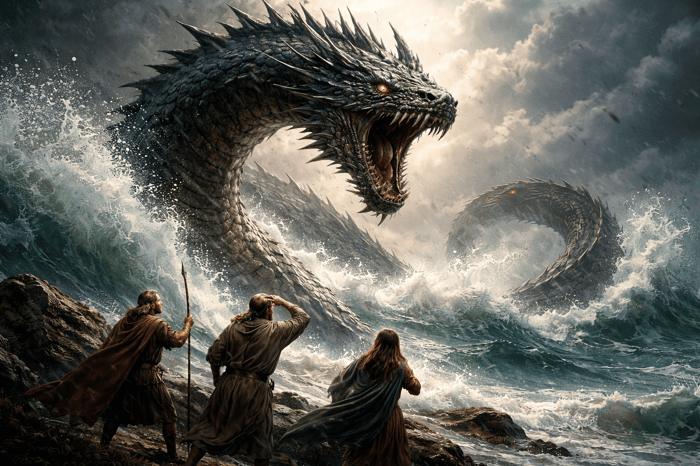
Leviathan in the Bible is one of the most mysterious and powerful images found in Scripture. From the book of Job to the Psalms and Isaiah, this creature appears as a symbol of chaos, strength, and untamed power. Yet each time Leviathan is mentioned, one truth stands above the rest: God rules over it.
Many readers wonder if Leviathan in the Bible is a real creature, a symbol, or both. Scripture does not answer every detail. What it does show clearly is that no force, no matter how wild, stands outside of God’s authority.
Where Is Leviathan Mentioned in Scripture?
Leviathan appears in several Old Testament passages. Each one adds depth to our understanding.
Job 41
The longest description comes in Job. After Job questions God’s justice, the Lord responds by pointing to His creation. Leviathan becomes a living example of power beyond human control.
“Can you draw out Leviathan with a fishhook
or press down his tongue with a cord?
Can you put a rope in his nose
or pierce his jaw with a hook?
Will he make many pleas to you?
Will he speak to you soft words?
Will he make a covenant with you
to take him for your servant forever?
Will you play with him as with a bird,
or will you put him on a leash for your girls? – Job 41:1–5
In this chapter, Leviathan is described with armored scales, fierce strength, and a fearsome presence. The message is clear: if Job cannot tame Leviathan, how can he question the Creator who made it?
This passage shows that Leviathan in the Bible serves as a teaching tool. It reminds us that God’s wisdom is greater than ours.
Psalm 74:14
In Psalm 74, Leviathan appears in a different way. Here, the psalmist speaks of God crushing Leviathan as part of His mighty acts.
You crushed the heads of Leviathan;
you gave him as food for the creatures of the wilderness. – Psalm 74:14
The language sounds poetic and symbolic. Leviathan seems to represent forces that oppose God and threaten His people. Yet God defeats it without struggle.
Psalm 104:26
Psalm 104 gives another perspective. This time Leviathan is part of the sea that God formed.
There go the ships,
and Leviathan, which you formed to play in it. – Psalm 104:26
Here Leviathan is not an enemy but a creature that plays in the ocean under God’s care. This verse shows balance. The same powerful creature is still under divine control.
Isaiah 27:1
In Isaiah, Leviathan appears in prophetic language.
In that day the Lord with his hard and great and strong sword will punish Leviathan the fleeing serpent, Leviathan the twisting serpent, and he will slay the dragon that is in the sea. – Isaiah 27:1
The prophet speaks of a day when God will punish Leviathan, described as a twisting serpent. Many scholars see this as a symbol of evil kingdoms or even Satan. Regardless of interpretation, the outcome is certain: God wins.
Is Leviathan a Real Creature?
Some believe Leviathan in the Bible refers to a real animal. Possibilities include:
- A large crocodile
- An extinct sea creature
- A poetic picture of a sea dragon
Others view Leviathan as symbolic language drawn from ancient Near Eastern imagery. Sea monsters often represented chaos in that culture.
The Bible does not require us to choose one explanation with certainty. What matters most is the message.
| Viewpoint | Strengths | Challenges |
|---|---|---|
| Literal Creature | Fits Job’s detailed description | Some features seem exaggerated |
| Symbolic Figure | Matches poetic language in Psalms and Isaiah | Job’s description sounds physical |
| Both Literal & Symbolic | Honors physical detail and theological meaning | Leaves some mystery |
The purpose of Leviathan in the Bible is not to satisfy curiosity about ancient zoology. It is to point to God’s unmatched authority.
Leviathan as a Symbol of Chaos
Throughout Scripture, the sea often represents danger and disorder. Storms threaten lives. Floodwaters destroy land. In ancient thinking, deep waters symbolized forces beyond control.
Leviathan in the Bible embodies that idea. It stands for chaos that humans cannot tame.
Yet notice something important. Leviathan never threatens God. It may terrify people, but it does not frighten the Creator.
This truth carries comfort. The things that overwhelm us do not overwhelm Him.
What Leviathan Teaches About God
Leviathan is not the hero of the story. God is.
In Job, Leviathan shows that God’s wisdom is beyond human judgment. In the Psalms, Leviathan highlights God’s victory. In Isaiah, Leviathan reminds us that evil has an expiration date.
Here are several lessons believers can draw:
- God rules over creation, even its wildest parts
- Chaos is not outside His control
- Evil will not last forever
- Human strength is limited, but God’s power is not
When we read about Leviathan in the Bible, we are meant to look past the creature and see the Creator.
Relating Leviathan to Our Lives
Most of us will never face a sea monster. But we all face chaos.
Sometimes Leviathan looks like:
- A sudden illness
- A broken relationship
- Financial pressure
- Fear about the future
These forces feel large. They seem untouchable. We cannot fix them on our own.
That is where the message becomes personal.
Leviathan in the Bible reminds us that what feels untamable to us is still under God’s command.
When Job heard God describe Leviathan, he stopped demanding answers. He realized that if God governs creatures he cannot control, then God can also govern his suffering.
God’s Sovereignty Over Evil
Isaiah 27 points toward final judgment. Leviathan is defeated. Evil does not have the last word.
This connects with the larger biblical story. From Genesis to Revelation, God confronts chaos and brings order.
Consider the pattern:
| Biblical Moment | Chaos Present | God’s Response |
|---|---|---|
| Creation | Formless waters | God speaks order |
| Flood | Judgment waters | God preserves a remnant |
| Exodus | Red Sea | God parts the waters |
| Isaiah | Leviathan | God destroys it |
| Revelation | Final evil | God brings new creation |
The message remains steady. Chaos rises. God reigns.
Why Leviathan Still Matters
Modern readers may feel distant from ancient imagery. Yet Leviathan in the Bible still speaks today.
It reminds us:
- We are not as powerful as we think
- The world contains forces beyond our control
- God is not intimidated by those forces
Faith does not deny the presence of chaos. It trusts the One who rules over it.
When storms hit life, we may feel small. That feeling is not meant to drive us to despair. It is meant to drive us to dependence.
A Word of Caution About Speculation
Leviathan has captured the imagination of many people. Some attempt to connect it with myths, dragons, or modern conspiracy ideas. Scripture does not encourage this direction.
The Bible presents Leviathan for a clear purpose: to reveal God’s greatness.
It is wise to avoid reading more into the text than what is written.
Final Reflection
Leviathan in the Bible stands as one of Scripture’s most vivid images of power and mystery. Whether literal, symbolic, or both, its message remains firm.
God rules.
The creature that no human can tame bows to Him. The chaos that shakes nations answers to Him. The evil that twists through history will be judged by Him.
If Leviathan cannot escape God’s authority, neither can the storms in your life.
That truth brings both humility and hope.
FAQs
What is Leviathan in the Bible?
Leviathan in the Bible is described as a powerful sea creature that no human can control. In Job, it is portrayed as fierce and untamable. In the Psalms and Isaiah, it also represents chaos and forces that oppose God.
“Can you draw out Leviathan with a fish hook,
or press down his tongue with a cord?
Can you put a rope into his nose,
or pierce his jaw through with a hook?
Will he make many petitions to you,
or will he speak soft words to you?
Will he make a covenant with you,
that you should take him for a servant forever?
Will you play with him as with a bird?
Or will you bind him for your girls?
Will traders barter for him?
Will they part him among the merchants?
Can you fill his skin with barbed irons,
or his head with fish spears?
Lay your hand on him.
Remember the battle, and do so no more.
Behold, the hope of him is in vain.
Won’t one be cast down even at the sight of him?
None is so fierce that he dare stir him up.
Who then is he who can stand before me?
Who has first given to me, that I should repay him?
Everything under the heavens is mine.
“I will not keep silence concerning his limbs,
nor his mighty strength, nor his goodly frame.
Who can strip off his outer garment?
Who will come within his jaws?
Who can open the doors of his face?
Around his teeth is terror.
Strong scales are his pride,
shut up together with a close seal.
One is so near to another,
that no air can come between them.
They are joined to one another.
They stick together, so that they can’t be pulled apart.
His sneezing flashes out light.
His eyes are like the eyelids of the morning.
Out of his mouth go burning torches.
Sparks of fire leap out.
Out of his nostrils a smoke goes,
as of a boiling pot over a fire of reeds.
His breath kindles coals.
A flame goes out of his mouth.
There is strength in his neck.
Terror dances before him.
The flakes of his flesh are joined together.
They are firm on him.
They can’t be moved.
His heart is as firm as a stone,
yes, firm as the lower millstone.
When he raises himself up, the mighty are afraid.
They retreat before his thrashing.
If one attacks him with the sword, it can’t prevail;
nor the spear, the dart, nor the pointed shaft.
He counts iron as straw,
and bronze as rotten wood.
The arrow can’t make him flee.
Sling stones are like chaff to him.
Clubs are counted as stubble.
He laughs at the rushing of the javelin.
His undersides are like sharp potsherds,
leaving a trail in the mud like a threshing sledge.
He makes the deep to boil like a pot.
He makes the sea like a pot of ointment.
He makes a path shine after him.
One would think the deep had white hair.
On earth there is not his equal,
that is made without fear.
He sees everything that is high.
He is king over all the sons of pride.” – Job 41:1–34
Is Leviathan a real animal or a symbol?
Some readers believe Leviathan was a real sea creature, possibly similar to a crocodile or an extinct marine animal. Others see it as symbolic language that represents chaos or evil. The Bible does not clearly define it one way or the other, but it consistently shows that God rules over it.
“You crushed the heads of Leviathan;
you gave him as food for the creatures of the wilderness.”
— Psalm 74:14 (ESV)
Why does God mention Leviathan to Job?
God uses Leviathan to remind Job of human limits. Job could not tame such a creature, yet God created and controls it. The message is that God’s wisdom and power are greater than human understanding.
“No one is so fierce that he dares to stir him up.
Who then is he who can stand before me?
Who has first given to me, that I should repay him?
Whatever is under the whole heaven is mine.”
— Job 41:10–11 (ESV)
What does Leviathan symbolize in prophecy?
In Isaiah, Leviathan is described as a twisting serpent that God will punish. Many understand this as symbolic of evil powers or rebellious nations. The focus is not the creature itself but God’s final victory.
“In that day the Lord with his hard and great and strong sword
will punish Leviathan the fleeing serpent,
Leviathan the twisting serpent,
and he will slay the dragon that is in the sea.”
— Isaiah 27:1 (ESV)
How does Leviathan show God’s sovereignty?
Each time Leviathan in the Bible appears, God is shown as greater. Whether the creature plays in the sea or stands as a symbol of chaos, it remains under divine authority. This highlights God’s control over creation and history.
“There go the ships,
and Leviathan, which you formed to play in it.”
— Psalm 104:26 (ESV)
What does Leviathan mean for believers today?
Leviathan reminds believers that chaos and evil do not have the last word. What feels overwhelming to us is still under God’s command. The image calls us to trust His strength rather than our own.
“In that day the Lord with his hard and great and strong sword
will punish Leviathan the fleeing serpent,
Leviathan the twisting serpent,
and he will slay the dragon that is in the sea.”
— Isaiah 27:1 (ESV)