Table of Contents
- What Is Subordinationism?
- Does "The Father Is Greater Than I" Teach Subordinationism?
- Jesus Willingly Took the Form of a Servant
- The Son's Obedience Does Not Make Him Less Divine
- The Son Is Fully God
- The Father Sends the Son
- Jesus Praying to the Father Does Not Make Him Less Than God
- Jesus Shares the Father's Glory
- Jesus Receives the Same Honor as the Father
- "The Head of Christ Is God"
- What Does "Son Subordinate to Father" Mean?
- Jesus' Submission Continues to Display Divine Order
- Subordinationism Is Different From Arianism
- The Father and Son Are Distinct Without Unequal Deity
- Why Subordinationism Matters for the Gospel
- The Humble Son Is Exalted
- A Better Way to Understand the Father and Son
- Why Subordinationism Is a Serious Misunderstanding
- FAQs
Subordinationism teaches that the Son is lower than the Father in His divine nature, rank, or being. This view often begins with Bible passages where Jesus obeys the Father, prays to the Father, or says that the Father is greater than He is. Those verses are important, but they must be read alongside everything else Scripture says about Jesus.
The Bible does show the Son submitting to the Father in His mission. Jesus was sent by the Father, obeyed the Father, and humbled Himself to accomplish our salvation.
Yet Scripture also teaches that the Son is fully divine. His willing submission does not make Him a lesser God. The key is understanding the difference between who Jesus is and the role He willingly took in carrying out the Father's saving plan.
What Is Subordinationism?
Subordinationism can refer to the belief that the Son is inferior to the Father in His divine being or nature.
In simple terms, it answers the question "Is Jesus less than the Father?" by saying yes—not merely in His role, but in what He is.
That creates a serious problem.
Scripture distinguishes the Father from the Son and describes the Son obeying the Father. But it also speaks of Jesus in ways that cannot be reduced to a lesser divine being.
John begins his Gospel:
In the beginning was the Word, and the Word was with God, and the Word was God.
John 1:1 (WEB)
The Word is "with God," so the Son is personally distinct from the Father.
Yet the Word also "was God."
Both truths matter.
Does "The Father Is Greater Than I" Teach Subordinationism?
One of the most important passages in this discussion comes from Jesus Himself.
Jesus told His disciples:
You heard how I told you, "I go away, and I come to you." If you loved me, you would have rejoiced because I said "I am going to my Father;" for the Father is greater than I.
John 14:28 (WEB)
At first glance, this seems straightforward. If the Father is greater than Jesus, doesn't that mean Jesus is inferior to the Father?
Context matters.
Jesus speaks these words shortly before His crucifixion. The eternal Son has become human and taken the position of a servant. He is carrying out the mission for which the Father sent Him.
John's Gospel has already said that the Word was God.
It has also recorded Jesus saying:
I and the Father are one.
John 10:30 (WEB)
John 14:28 therefore cannot mean that Jesus is a lesser kind of deity without creating a conflict with the rest of John's Gospel.
Jesus' humble position in His earthly mission does not erase His divine identity.
Jesus Willingly Took the Form of a Servant
Philippians 2 helps explain this distinction.
Paul begins by describing Christ's position before His humiliation:
Who, existing in the form of God, didn't consider equality with God a thing to be grasped.
Philippians 2:6 (WEB)
Jesus does not begin as a mere human being who later becomes exalted.
He exists "in the form of God."
Then something remarkable happens:
But emptied himself, taking the form of a servant, being made in the likeness of men.
Philippians 2:7 (WEB)
The Son willingly takes the form of a servant.
His humility is not evidence that He lacks deity. His humility is remarkable precisely because of who He is.
The One who shares divine glory takes the position of a servant.
The Son's Obedience Does Not Make Him Less Divine
Jesus obeyed the Father throughout His earthly life.
He said:
For I have come down from heaven, not to do my own will, but the will of him who sent me.
John 6:38 (WEB)
This is genuine submission.
The Son does the Father's will.
But submission and inferiority of nature are not the same thing.
A person can willingly submit to another person's authority for a purpose without becoming less human or possessing less human nature.
With God, we must be even more careful because the relationship between the Father and Son is unique.
The Son's obedience tells us about His mission. It does not require us to conclude that He possesses a lesser divine nature.
The Son Is Fully God
Any explanation of the subordinationism Trinity question must account for the Bible's strong statements about Christ's deity.
Paul writes:
For in him all the fullness of the Deity dwells bodily.
Colossians 2:9 (WEB)
Notice that Paul says all the fullness.
Jesus does not possess a lower level of deity.
He does not have part of what the Father has.
The fullness of deity dwells in Christ.
This creates an important distinction:
| Biblical Teaching | What It Means |
|---|---|
| The Father sends the Son | The Persons have distinct roles |
| The Son obeys the Father | Jesus willingly fulfills the Father's will |
| The Son becomes a servant | Christ humbles Himself in His saving mission |
| The Father and Son are distinct | Jesus is not the Father |
| The Son possesses the fullness of deity | Jesus is not inferior in divine nature |
| The Son is called God | Scripture identifies Him as fully divine |
The Bible does not require us to choose between Jesus' deity and His obedience.
It teaches both.
The Father Sends the Son
The Bible often describes the Father sending the Son.
Jesus says:
For the Father himself loves you, because you have loved me, and have believed that I came from God.
John 16:27 (WEB)
The Son comes from the Father and carries out the Father's mission.
This pattern is especially important in the Gospel.
The Father sends.
The Son comes.
The Son obeys.
The Son gives His life.
None of this requires the Son to be a lesser divine being.
Instead, it reveals loving order and personal distinction between the Father and Son.
Jesus Praying to the Father Does Not Make Him Less Than God
Another question often arises: If Jesus is God, why does He pray to the Father?
Jesus' prayers show that the Father and Son are distinct Persons.
They also show the reality of Jesus' humanity.
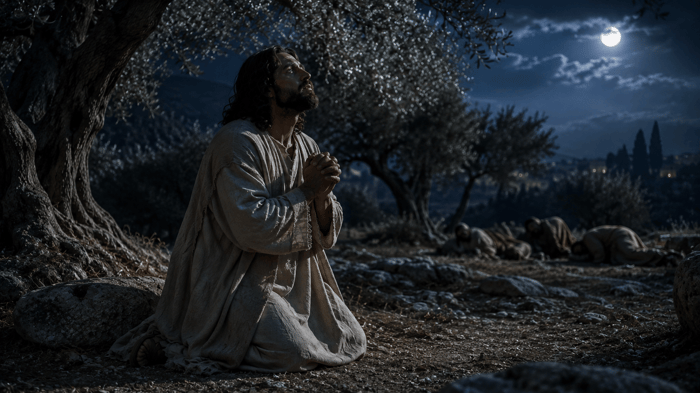
Before His crucifixion, Jesus prayed:
He went forward a little, fell on his face, and prayed, saying, "My Father, if it is possible, let this cup pass away from me; nevertheless, not what I desire, but what you desire."
Matthew 26:39 (WEB)
Jesus truly submits to the Father's will.
His obedience is not an illusion.
But His prayer does not prove that He is less divine. The eternal Son became truly human and lived in perfect obedience to the Father.
Jesus does what sinful humanity has failed to do.
Jesus Shares the Father's Glory
Jesus' prayer in John 17 gives another important piece of the picture.
Shortly before His death, Jesus says:
Now, Father, glorify me with your own self with the glory which I had with you before the world existed.
John 17:5 (WEB)
This statement reaches beyond Jesus' earthly life.
The Son speaks of glory He had with the Father before the world existed.
Jesus is not asking to become divine.
He speaks of glory that was already His before creation.
This makes it difficult to treat the Son as a lesser being who stands below the Father in divine nature.
The Son shares divine glory from before the creation of the world.
Jesus Receives the Same Honor as the Father
Jesus makes another striking statement in John 5.
He explains that the Father has entrusted judgment to the Son:
That all may honor the Son, even as they honor the Father. He who doesn't honor the Son doesn't honor the Father who sent him.
John 5:23 (WEB)
Jesus does not tell people to give Him a lower level of honor.
He says they should honor the Son even as they honor the Father.
This does not erase the distinction between Father and Son.
But it does challenge any form of Subordinationism that makes the Son less worthy of divine honor.
To dishonor the Son is to dishonor the Father who sent Him.
"The Head of Christ Is God"
Another passage sometimes enters the discussion.
Paul writes:
But I would have you know that the head of every man is Christ, and the head of the woman is man, and the head of Christ is God.
1 Corinthians 11:3 (WEB)
Paul describes an order of relationships.
"The head of Christ is God" shows a real relationship between Christ and the Father.
But the verse does not say that Christ possesses less deity.
Elsewhere, the same Paul says that the fullness of deity dwells bodily in Christ.
We should therefore avoid making this verse say more than Paul says.
Order does not automatically mean inferiority of nature.
What Does "Son Subordinate to Father" Mean?
The phrase Son subordinate to Father needs careful definition.
If it means that Jesus willingly obeyed the Father and carried out the mission the Father gave Him, Scripture clearly supports it.
If it means that Jesus is less divine, possesses a lower divine nature, or is a lesser kind of God, Scripture does not support it.
The distinction can be summarized this way:
- Submission in role: The Son willingly carries out the Father's will.
- Inferiority in nature: The Son possesses less deity than the Father.
The first appears throughout Scripture.
The second conflicts with passages that call Jesus God and describe Him as possessing the fullness of deity.
This distinction helps prevent us from confusing what Jesus does with who Jesus is.
Jesus' Submission Continues to Display Divine Order
Paul describes Christ's final victory in 1 Corinthians 15.
After speaking about all things being subjected to Christ, Paul says:
When all things have been subjected to him, then the Son will also himself be subjected to him who subjected all things to him, that God may be all in all.
1 Corinthians 15:28 (WEB)
This verse shows that the language of submission is not limited to Jesus' earthly ministry.
Yet it still does not say that the Son becomes less divine.
Paul has already described Christ exercising universal rule and defeating every enemy, including death.
The passage concerns the ordered completion of God's saving purpose.
Submission does not require inferiority of divine nature.
Subordinationism Is Different From Arianism
Subordinationism and Arianism can overlap, but they are not identical questions.
Arianism teaches that the Son is created and therefore does not possess the same divine nature as the Father.
Subordinationism focuses more directly on whether the Son is lower than the Father in being, status, or divine nature.
That distinction helps preserve a unique search intent.
The central question here is not mainly "Was Jesus created?"
It is:
Does the Son's submission to the Father mean He is less divine than the Father?
Scripture's answer is no.
The Father and Son Are Distinct Without Unequal Deity
The Bible gives us truths that must remain together.
We should not flatten them into one idea.
Scripture teaches:
- The Father is not the Son.
- The Son is sent by the Father.
- The Son obeys the Father.
- The Son became a servant.
- The Son prays to the Father.
- The Son shares glory with the Father.
- The Son receives divine honor.
- The fullness of deity dwells in the Son.
If we emphasize equality while ignoring distinction, we distort the biblical picture.
If we emphasize submission until Jesus becomes less divine, we also distort it.
Biblical Trinitarian teaching preserves both distinction and full deity.
Why Subordinationism Matters for the Gospel
Subordinationism matters because the identity of Jesus matters for salvation.
The Gospel tells us that the Son willingly humbled Himself for sinners.
Paul says:
He humbled himself, becoming obedient to death, yes, the death of the cross.
Philippians 2:8 (WEB)
Jesus' obedience leads Him to the cross.
Human beings have rebelled against God. We have failed to love Him, obey Him, and live according to His will.
Jesus does what we have failed to do.
The eternal Son becomes human, obeys the Father perfectly, bears the cost of sin, dies, and rises again.
His submission is therefore not proof that He is a lesser God.
It is part of the wonder of the Gospel.
The One who shares divine glory willingly takes the place of a servant to save sinners.
The Humble Son Is Exalted
Jesus' path of obedience does not end at the cross.
Paul continues:
Therefore God also highly exalted him, and gave to him the name which is above every name.
Philippians 2:9 (WEB)
Christ's humiliation is followed by exaltation.
The One who humbled Himself is openly honored as Lord.
This pattern helps us understand why the Bible can speak so strongly about both Jesus' submission and His divine glory.
The two truths are not enemies.
The Son's willing obedience reveals His love, humility, and commitment to the Father's saving purpose.
A Better Way to Understand the Father and Son
Instead of assuming that submission must mean lesser deity, we can follow the Bible's categories.
We can say:
- The Father and Son are distinct Persons.
- The Son is fully divine.
- The Son shares divine glory with the Father.
- The Son willingly became human.
- The Father sent the Son.
- The Son obeyed the Father.
- The Son's obedience does not remove His deity.
- Jesus is worthy of the same divine honor given to the Father.
This allows Scripture to define the relationship rather than forcing human ideas of rank onto God.
Why Subordinationism Is a Serious Misunderstanding
Subordinationism becomes a serious error when the Son's willing submission is turned into evidence that He possesses a lower divine nature than the Father.
The Bible gives us no reason to deny Jesus' obedience. His submission to the Father is real and central to His saving mission.
But Scripture also gives us no reason to make Him a lesser God.
The Word was God. The fullness of deity dwells in Christ. The Son shared glory with the Father before the world existed, and He is worthy of divine honor.
Jesus' humility does not diminish His deity.
The Son who obeyed the Father even to death on the cross is the eternal, fully divine Son who willingly humbled Himself for our salvation.
FAQs
What is Subordinationism?
Subordinationism is the belief that the Son is inferior to the Father in His divine being or nature. The article distinguishes this from Jesus' willing submission to the Father in His saving mission. Scripture presents the Son as personally distinct from the Father while also identifying Him as God.
In the beginning was the Word, and the Word was with God, and the Word was God.
John 1:1 (WEB)
Does "the Father is greater than I" mean Jesus is less divine than the Father?
No. The article explains John 14:28 in the context of Jesus' earthly mission. The eternal Son became human and took the position of a servant. His humble role does not erase the divine identity that John's Gospel also gives Him.
You heard how I told you, "I go away, and I come to you." If you loved me, you would have rejoiced because I said "I am going to my Father;" for the Father is greater than I.
John 14:28 (WEB)
Does Jesus' obedience to the Father make Him a lesser God?
No. Jesus genuinely obeyed the Father, but the article distinguishes submission in role from inferiority in divine nature. The Son willingly came to carry out the Father's will, and His obedience does not mean He possesses less deity.
For I have come down from heaven, not to do my own will, but the will of him who sent me.
John 6:38 (WEB)
How does Philippians 2 help explain Jesus' submission to the Father?
Philippians 2 shows that Christ existed in the form of God and then willingly took the form of a servant. His humility is not evidence that He lacks deity. It shows the depth of His willing self-humbling in becoming human and carrying out His saving mission.
But emptied himself, taking the form of a servant, being made in the likeness of men.
Philippians 2:7 (WEB)
Why doesn't Jesus praying to the Father prove that He is less divine?
Jesus' prayers show that the Father and Son are distinct Persons and that Jesus truly became human. In Gethsemane, the Son genuinely submits to the Father's will. The article explains that this obedience does not mean His divine nature is inferior.
He went forward a little, fell on his face, and prayed, saying, "My Father, if it is possible, let this cup pass away from me; nevertheless, not what I desire, but what you desire."
Matthew 26:39 (WEB)
Does the Son share the Father's divine glory?
Yes. Jesus speaks of the glory He had with the Father before the world existed. The article uses this passage to show that Jesus was not asking to become divine but spoke of glory that was already His before creation.
Now, Father, glorify me with your own self with the glory which I had with you before the world existed.
John 17:5 (WEB)
What does it mean to say the Son is subordinate to the Father?
If the phrase means that Jesus willingly obeys the Father and carries out the Father's will, the article shows that Scripture supports it. If it means that Jesus has less deity or a lower divine nature, Scripture does not support it. Paul says that all the fullness of deity dwells in Christ.
For in him all the fullness of the Deity dwells bodily.
Colossians 2:9 (WEB)
Why does Subordinationism matter for understanding the Gospel?
Subordinationism matters because it can turn Jesus' willing obedience into evidence that He is a lesser God. The Gospel shows something different: humanity has rebelled against God, and the eternal, fully divine Son willingly became human and obeyed the Father even to death on the cross for sinners. His submission reveals the humility of the Savior and points us to faith in Jesus Christ, not to a lesser divine being.
He humbled himself, becoming obedient to death, yes, the death of the cross.
Philippians 2:8 (WEB)