Table of Contents
- What Is Modalism?
- Why Modalism Does Not Fit the Bible
- Jesus' Baptism Shows Three Distinct Persons
- Jesus Promised Another Helper
- The Father Sends the Son
- The Son Loves the Father
- The Holy Spirit Is Not Just Another Mode
- Why "Father Son Holy Spirit Modes" Is Misleading
- Why Modalism Is Called a Heresy
- Modalism and the Gospel
- The Trinity Is Not Three Gods
- A Better Way to Speak About the Trinity
- Why This Matters for Knowing God
- FAQs
Modalism is the belief that God is one Person who appears in different forms or modes. In this view, God may act as the Father at one time, the Son at another time, and the Holy Spirit at another time. The problem is that the Bible does not describe the Father, Son, and Holy Spirit as temporary roles played by one divine Person.
Scripture teaches that there is only one God. Yet it also shows that the Father, Son, and Holy Spirit are personally distinct from one another.
That distinction matters. The Father sends the Son. The Son speaks to the Father. The Father and Son send the Holy Spirit. These relationships cannot be explained well by saying that God is simply changing from one mode into another.
What Is Modalism?
Modalism teaches that there is one God and one divine Person who reveals Himself in three different ways.
It may be described like this:
- God is sometimes the Father.
- God later appears as the Son.
- God later works as the Holy Spirit.
- Father, Son, and Holy Spirit are different manifestations of the same Person.
This idea tries to protect the biblical truth that there is only one God. However, it does so by removing the real personal distinctions Scripture gives us between the Father, Son, and Holy Spirit.
The Bible clearly teaches that God is one.
Hear, Israel: Yahweh is our God. Yahweh is one.
Deuteronomy 6:4 (WEB)
Christians do not believe in three gods. But biblical monotheism does not require us to say that the Father, Son, and Holy Spirit are one Person.
The Bible presents one God who eternally exists as Father, Son, and Holy Spirit.
Why Modalism Does Not Fit the Bible
The main difficulty with Modalism is simple: Scripture shows the Father, Son, and Holy Spirit relating to one another at the same time.
They do not appear only one after another.
They speak, send, love, glorify, and testify in ways that show real personal relationship.
Jesus Speaks to the Father
Jesus did not speak as though He were talking to another version of Himself. He spoke to His Father as a distinct Person.
Before raising Lazarus, Jesus prayed:
Jesus lifted up his eyes and said, "Father, I thank you that you listened to me."
John 11:41 (WEB)
Jesus also prayed to the Father before His crucifixion.
Now, Father, glorify me with your own self with the glory which I had with you before the world existed.
John 17:5 (WEB)
This verse creates a serious problem for the idea of one God three modes.
Jesus speaks of glory that He had with the Father before the world existed. The Son was not merely a temporary form God took at Bethlehem. The Son had fellowship with the Father before creation.
Jesus' Baptism Shows Three Distinct Persons
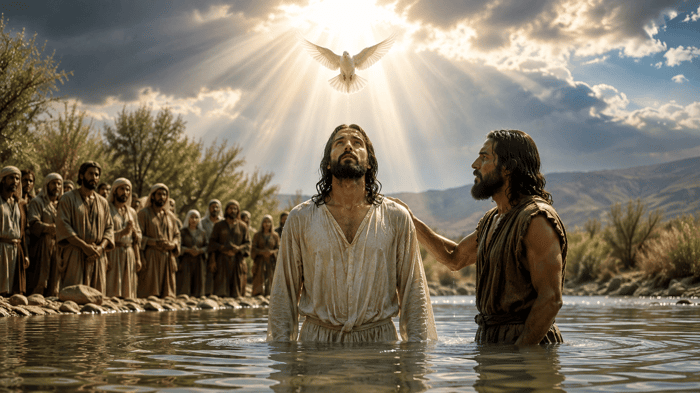
One of the clearest passages against Modalism is the baptism of Jesus.
Jesus is standing in the water. The Holy Spirit descends upon Him. The Father's voice speaks from heaven.
Behold, a voice out of the heavens said, "This is my beloved Son, with whom I am well pleased."
Matthew 3:17 (WEB)
The previous verse says:
Jesus, when he was baptized, went up directly from the water: and behold, the heavens were opened to him. He saw the Spirit of God descending as a dove, and coming on him.
Matthew 3:16 (WEB)
All three are present together.
The Son is baptized.
The Spirit descends.
The Father speaks.
This does not look like the Father changing into the Son and then changing into the Holy Spirit.
It shows the Father, Son, and Holy Spirit acting in relation to one another.
| Biblical Event | Father | Son | Holy Spirit |
|---|---|---|---|
| Jesus' baptism | Speaks from heaven | Is baptized | Descends upon Jesus |
| Jesus' prayer | Hears and receives the Son's prayer | Prays | Works in God's saving mission |
| Sending the Spirit | Sends the Spirit | Asks the Father and sends the Spirit | Comes to believers |
| Salvation | Plans and sends | Accomplishes redemption | Applies God's work to believers |
Jesus Promised Another Helper
Jesus gave another important statement about the Trinity shortly before His death.
I will pray to the Father, and he will give you another Counselor, that he may be with you forever.
John 14:16 (WEB)
Notice the relationships.
Jesus says I will ask the Father, and He will give another Counselor.
There are three distinct personal subjects in the sentence.
The Son asks.
The Father gives.
The Holy Spirit comes.
If the Father, Son, and Holy Spirit were only different modes of one Person, Jesus' words would become difficult to understand.
He would, in effect, be asking Himself to send another form of Himself.
Instead, Jesus speaks naturally of real relationships within the one God.
The Father Sends the Son
The Bible also teaches that the Father sent the Son into the world.
We have seen and testify that the Father has sent the Son as the Savior of the world.
1 John 4:14 (WEB)
Sending requires distinction between the one who sends and the one who is sent.
The Father is not the Son.
The Son is not the Father.
Yet both share the divine identity.
This is why modalism explained only as "God showing Himself in different ways" falls short of the biblical evidence. Scripture does not merely show different appearances of God. It shows personal relationships within God.
The Son Loves the Father
Jesus speaks about His relationship with the Father in personal terms.
But that the world may know that I love the Father, and as the Father commanded me, even so I do.
John 14:31 (WEB)
Love requires relationship.
Jesus says, "I love the Father."
This is not a picture of one Person loving one of His own temporary roles. It reveals communion between the Son and the Father.
Jesus also spoke of the Father's love for Him.
For the Father loves the Son, and shows him all things that he himself does.
John 5:20 (WEB)
These passages show something deeper than outward manifestations. They reveal genuine relationship between the Father and the Son.
The Holy Spirit Is Not Just Another Mode
A modalism Trinity explanation often struggles most with the Holy Spirit.
Some people think of the Spirit as God's power, presence, or influence. Scripture speaks of the Spirit in much more personal ways.
Jesus said:
But when the Counselor has come, whom I will send to you from the Father, the Spirit of truth, who proceeds from the Father, he will testify about me.
John 15:26 (WEB)
Again, all three are present in one statement.
Jesus sends.
The Spirit comes.
The Spirit proceeds from the Father.
The Spirit testifies about Jesus.
The Holy Spirit is not Jesus changing into another form. The Spirit testifies about Christ and is sent in relation to both the Father and the Son.
Why "Father Son Holy Spirit Modes" Is Misleading
The language of Father Son Holy Spirit modes can sound simple, which is one reason this misunderstanding continues.
People sometimes compare God to water.
Water can be liquid, ice, or steam. Since all three are water, the illustration may seem useful.
But it creates a serious problem.
Water normally changes from one state into another. That suggests God switches from Father to Son to Holy Spirit.
Scripture does not teach this.
The Father does not stop being the Father when the Son comes into the world. The Son does not become the Holy Spirit after returning to heaven. The Holy Spirit is not simply another state of Jesus.
The Father, Son, and Holy Spirit exist and act in relation to one another.
Why Modalism Is Called a Heresy
The phrase modalism heresy refers to the fact that the teaching contradicts the biblical distinction between the Father, Son, and Holy Spirit.
The concern is not merely about using the wrong theological label.
The teaching changes how we understand God.
If the Father and Son are not truly distinct, then many parts of the Gospel become difficult to explain.
The Father sends the Son.
For God didn't send his Son into the world to judge the world, but that the world should be saved through him.
John 3:17 (WEB)
The Son offers Himself in obedience to the Father.
The Holy Spirit then comes to dwell in believers and glorify Christ.
Jesus said:
He will glorify me, for he will take from what is mine, and will declare it to you.
John 16:14 (WEB)
These are not meaningless distinctions. They are part of how Scripture describes God's work of salvation.
Modalism and the Gospel
The doctrine of the Trinity helps us understand the Gospel more clearly.
Human beings have sinned against God and cannot repair that broken relationship through their own effort.
God Himself acts to save.
The Father sends the Son. The Son becomes truly human, dies for sinners, and rises again. The Holy Spirit gives life and brings believers into the saving work of Christ.
Paul describes this work of God:
But when the fullness of the time came, God sent out his Son, born to a woman, born under the law, that he might redeem those who were under the law, that we might receive the adoption of children.
Galatians 4:4-5 (WEB)
Then Paul continues:
And because you are children, God sent out the Spirit of his Son into your hearts, crying, "Abba, Father!"
Galatians 4:6 (WEB)
The Father sends the Son for redemption. Then God sends the Spirit into the hearts of believers.
Salvation is deeply Trinitarian.
The distinction between Father, Son, and Holy Spirit helps us see the beauty of God's saving work rather than confusing it.
The Trinity Is Not Three Gods
Rejecting Modalism does not mean believing in three gods.
Scripture is clear that there is only one God.
Paul writes:
Yet to us there is one God, the Father, of whom are all things, and we for him; and one Lord, Jesus Christ, through whom are all things, and we live through him.
1 Corinthians 8:6 (WEB)
The Christian confession holds two biblical truths together.
There is one God.
The Father, Son, and Holy Spirit are personally distinct.
We should not solve one truth by denying the other.
Modalism protects God's oneness by denying personal distinction. Tritheism would protect personal distinction by dividing God into three gods.
Neither reflects the full biblical picture.
A Better Way to Speak About the Trinity
Christians should be careful when describing God.
Instead of saying God "changes forms," it is better to use language that follows Scripture.
We can say:
- There is one God.
- The Father is God.
- The Son is God.
- The Holy Spirit is God.
- The Father is not the Son.
- The Son is not the Holy Spirit.
- The Holy Spirit is not the Father.
- The Father, Son, and Holy Spirit are not three gods.
We may not fully understand how God can be one in being and three in Person, but mystery is different from contradiction.
God is not one Person and three Persons.
He is one God who eternally exists as three distinct Persons.
Why This Matters for Knowing God
Modalism may seem like a technical theological mistake, but it changes how we read many passages of Scripture.
When Jesus prays, He truly speaks to the Father.
When the Father sends the Son, there is a real relationship between them.
When the Spirit glorifies Christ, He acts personally in God's work.
The Bible invites us to know God as He has revealed Himself rather than reducing Him to an illustration that feels easier to understand.
The Father loves the Son. The Son obeys the Father. The Spirit glorifies the Son. Yet Scripture never divides God into three separate beings.
That is why Modalism does not give an adequate picture of the biblical Trinity.
God is not one Person switching between Father, Son, and Holy Spirit modes. He is one God, eternally existing as Father, Son, and Holy Spirit.
FAQs
What is Modalism?
Modalism is the belief that God is one divine Person who reveals Himself in different modes, such as the Father, Son, and Holy Spirit. The article explains that this does not fit Scripture because the Father, Son, and Holy Spirit relate to one another as distinct Persons.
I will pray to the Father, and he will give you another Counselor, that he may be with you forever.
John 14:16 (WEB)
Why does Modalism not fit the Bible?
Modalism does not fit the Bible because Scripture shows the Father, Son, and Holy Spirit acting in relation to one another at the same time. Jesus speaks to the Father, the Father sends the Son, and the Holy Spirit is sent to testify about Christ.
But when the Counselor has come, whom I will send to you from the Father, the Spirit of truth, who proceeds from the Father, he will testify about me.
John 15:26 (WEB)
How does Jesus' baptism show that Modalism is wrong?
At Jesus' baptism, the Son is in the water, the Holy Spirit descends upon Him, and the Father speaks from heaven. The three are present together rather than appearing one after another as different modes of one Person.
Jesus, when he was baptized, went up directly from the water: and behold, the heavens were opened to him. He saw the Spirit of God descending as a dove, and coming on him.
Matthew 3:16 (WEB)
Does Jesus praying to the Father contradict Modalism?
Jesus' prayers show a real relationship between the Son and the Father. Jesus even speaks of the glory He had with the Father before the world existed, showing that the Son was not merely a temporary form God took when Jesus was born.
Now, Father, glorify me with your own self with the glory which I had with you before the world existed.
John 17:5 (WEB)
Is the Holy Spirit another mode of Jesus?
No. Jesus describes the Holy Spirit as the Counselor whom He sends from the Father. The Spirit comes, proceeds from the Father, and testifies about Jesus. These actions show personal distinction rather than Jesus changing into another form.
But when the Counselor has come, whom I will send to you from the Father, the Spirit of truth, who proceeds from the Father, he will testify about me.
John 15:26 (WEB)
Why can the water analogy lead to Modalism?
Water can exist as liquid, ice, or steam, but it normally changes from one state into another. Used as a picture of God, this can suggest that God switches between Father, Son, and Holy Spirit. Scripture instead shows the Father, Son, and Holy Spirit existing and acting in relation to one another.
Behold, a voice out of the heavens said, "This is my beloved Son, with whom I am well pleased."
Matthew 3:17 (WEB)
Does rejecting Modalism mean Christians believe in three gods?
No. Scripture teaches that there is one God while also revealing personal distinction between the Father, Son, and Holy Spirit. Christians should not protect God's oneness by denying those distinctions, nor divide God into three separate gods.
Yet to us there is one God, the Father, of whom are all things, and we for him; and one Lord, Jesus Christ, through whom are all things, and we live through him.
1 Corinthians 8:6 (WEB)
Why does Modalism matter for understanding the Gospel?
Modalism matters because the Gospel reveals God's saving work through real relationships between the Father, Son, and Holy Spirit. Humanity cannot repair its broken relationship with God through its own effort. The Father sends the Son to redeem sinners, and God sends the Spirit into believers' hearts. Understanding these distinctions helps us see why faith in Jesus Christ is central to God's saving work rather than treating Father, Son, and Spirit as changing roles.
But when the fullness of the time came, God sent out his Son, born to a woman, born under the law, that he might redeem those who were under the law, that we might receive the adoption of children.
Galatians 4:4-5 (WEB)