Table of Contents
- What Does the Trinity in the New Testament Mean?
- The Father, Son, and Holy Spirit at Jesus' Baptism
- Jesus Reveals His Relationship With the Father
- Jesus Promises the Holy Spirit
- The Trinity Is Revealed in God's Work of Salvation
- The Trinity Appears in the Apostles' Teaching
- The New Testament Shows One God, Not Three Gods
- The Holy Spirit Is More Than God's Power
- The Father, Son, and Spirit Work Together in Christian Life
- Why the Trinity in the New Testament Matters
- A Pattern Found Across the New Testament
- FAQs
The Trinity in the New Testament is revealed through the words and actions of the Father, Son, and Holy Spirit. The New Testament does not begin with a formal definition of the Trinity. Instead, it shows one God acting through three distinct divine persons throughout the life of Jesus, the work of salvation, the mission of the church, and the lives of believers.
Jesus speaks to the Father, calls Himself the Son, and promises the Holy Spirit. The apostles continue this same pattern. They speak of one God while describing the Father, Son, and Holy Spirit as distinct from one another and united in God's saving work.
Understanding this New Testament Trinity pattern helps us see that the doctrine of the Trinity was not added to Christianity later. It grows from the way the New Testament reveals God.
What Does the Trinity in the New Testament Mean?
The Trinity in the New Testament refers to the biblical teaching that there is one God who exists eternally as the Father, the Son, and the Holy Spirit.
This does not mean Christians believe in three gods. Scripture continues the biblical teaching that God is one. Yet the New Testament also reveals the Father as God, Jesus Christ as divine, and the Holy Spirit as divine.
These three are not simply different names for the same person. The Father sends the Son. The Son speaks to the Father. The Father and Son send the Spirit. The Spirit glorifies the Son.
Jesus brings all three together when He commands His disciples to baptize new believers.
"Go and make disciples of all nations, baptizing them in the name of the Father and of the Son and of the Holy Spirit."
Matthew 28:19 (WEB)
Notice that Jesus says "name," not "names." Yet He names the Father, Son, and Holy Spirit separately.
This short statement captures an important truth found throughout the New Testament: there is one God, yet the Father, Son, and Holy Spirit are personally distinct.
The Father, Son, and Holy Spirit at Jesus' Baptism
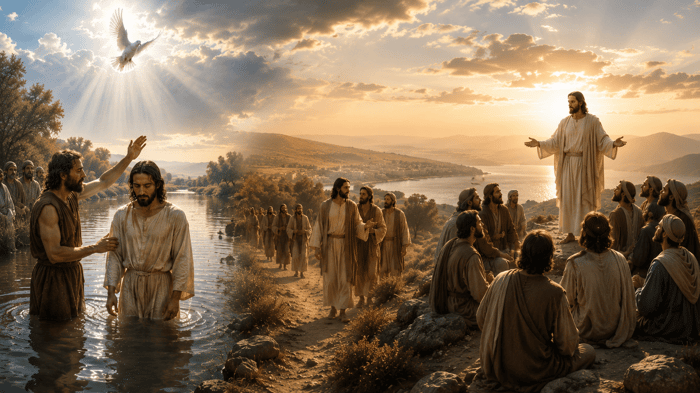
One of the clearest pictures of the Trinity in the New Testament appears at the baptism of Jesus.
Jesus stands in the water. The Holy Spirit descends upon Him. The Father's voice speaks from heaven.
"Behold, a voice out of the heavens said, 'This is my beloved Son, with whom I am well pleased.'"
Matthew 3:17 (WEB)
Luke also records the Spirit's presence.
"The Holy Spirit descended in a bodily form as a dove on him; and a voice came out of the sky, saying, 'You are my beloved Son. In you I am well pleased.'"
Luke 3:22 (WEB)
The Father is not the Son in this scene. The Son is not the Spirit. All three appear at the same time.
This matters because it shows that the Trinity is not one person changing from one role into another. The Father speaks to the Son while the Spirit descends upon the Son.
Jesus' baptism gives us a visible New Testament picture of three distinct persons acting together.
Jesus Reveals His Relationship With the Father
Much of the New Testament Trinity teaching comes from Jesus' own words.
Jesus repeatedly speaks about His Father. He does not describe the Father as another name for Himself. He speaks to the Father, obeys the Father, is sent by the Father, and returns to the Father.
At the same time, Jesus claims a unique unity with Him.
"I and the Father are one."
John 10:30 (WEB)
Jesus does not say, "I am the Father." He distinguishes Himself from the Father while claiming a unity that shocked His listeners.
John's Gospel begins by showing the same relationship.
"In the beginning was the Word, and the Word was with God, and the Word was God."
John 1:1 (WEB)
The Word was "with God," showing distinction. Yet the Word "was God," showing deity.
John later identifies this Word with Jesus Christ.
"The Word became flesh and lived among us. We saw his glory, glory as of the one and only Son of the Father, full of grace and truth."
John 1:14 (WEB)
The Trinity in the New Testament becomes clearer through Jesus because the eternal Son entered human history. Through Him, people could see God's character, hear God's truth, and witness God's saving work.
Jesus Promises the Holy Spirit
Jesus also reveals the Trinity by teaching His disciples about the Holy Spirit.
On the night before His crucifixion, Jesus promised that the Father would give His followers another Helper.
"I will pray to the Father, and he will give you another Counselor, that he may be with you forever: the Spirit of truth."
John 14:16-17 (WEB)
All three persons appear in Jesus' statement.
Jesus, the Son, asks the Father. The Father sends the Spirit.
The Holy Spirit is not described as an impersonal power. He teaches, guides, speaks, reminds, and bears witness to Christ.
Jesus says:
"But when the Counselor has come, whom I will send to you from the Father, the Spirit of truth, who proceeds from the Father, he will testify about me."
John 15:26 (WEB)
The Father, Son, and Spirit work together without losing their personal distinction.
The Spirit does not draw attention away from Jesus. He testifies about Christ and helps believers understand the truth Jesus has revealed.
The Trinity Is Revealed in God's Work of Salvation
The Trinity in the New Testament is not only a truth about God's nature. It is also seen in the way God saves sinners.
The Father plans and sends. The Son comes into the world, dies for sin, and rises again. The Holy Spirit brings God's saving work into the lives of believers.
Paul describes this pattern in Ephesians.
"Blessed be the God and Father of our Lord Jesus Christ, who has blessed us with every spiritual blessing in the heavenly places in Christ."
Ephesians 1:3 (WEB)
Later in the same passage, Paul explains that believers are sealed with the promised Holy Spirit.
"In him you also, having heard the word of the truth, the Good News of your salvation—in whom, having also believed, you were sealed with the promised Holy Spirit."
Ephesians 1:13 (WEB)
God's work of redemption has a Trinitarian shape.
| Person | New Testament emphasis in salvation |
|---|---|
| The Father | Plans, chooses, sends, loves, and adopts |
| The Son | Becomes human, dies for sin, rises, and redeems |
| The Holy Spirit | Gives new life, indwells, seals, teaches, and transforms |
These roles do not divide God into separate beings. They show how the one God works through the Father, Son, and Holy Spirit to bring sinners into fellowship with Him.
The Trinity Appears in the Apostles' Teaching
The apostles did not leave the Trinitarian pattern behind after Jesus returned to heaven.
Their letters continue to speak naturally about the Father, Son, and Holy Spirit together.
Paul ends 2 Corinthians with a blessing:
"The grace of the Lord Jesus Christ, God's love, and the fellowship of the Holy Spirit be with you all. Amen."
2 Corinthians 13:14 (WEB)
Grace is connected with Jesus Christ, love with God, and fellowship with the Holy Spirit. Yet these are not three separate sources of spiritual life. They are united in the experience of God's people.
Peter uses a similar pattern when describing Christians.
"According to the foreknowledge of God the Father, in sanctification of the Spirit, to obedience and sprinkling of the blood of Jesus Christ: Grace to you and peace be multiplied."
1 Peter 1:2 (WEB)
The Father, Spirit, and Jesus Christ appear together in one description of salvation.
These Trinity Scriptures show that Trinitarian language was part of normal Christian teaching from the earliest New Testament churches.
The New Testament Shows One God, Not Three Gods
Because the New Testament speaks about three divine persons, someone might wonder whether Christianity teaches three gods.
It does not.
The apostles remained committed to the truth that there is one God.
Paul writes:
"Yet to us there is one God, the Father, of whom are all things, and we for him; and one Lord, Jesus Christ, through whom are all things, and we live through him."
1 Corinthians 8:6 (WEB)
Paul does not replace belief in one God with belief in many gods. Instead, he includes Jesus within his explanation of the one true God while distinguishing Jesus from the Father.
This is one reason the Trinity in the New Testament cannot be reduced to three independent divine beings.
The Father is God. The Son is divine. The Spirit is divine. Yet God remains one.
The New Testament holds these truths together even when it does not stop to give a philosophical explanation of how they fit together.
The Holy Spirit Is More Than God's Power
The New Testament also reveals the Holy Spirit as a divine person, not merely a force God uses.
In Acts, Peter confronts Ananias about lying to the Holy Spirit.
"But Peter said, 'Ananias, why has Satan filled your heart to lie to the Holy Spirit and to keep back part of the price of the land? ... You haven't lied to men, but to God.'"
Acts 5:3-4 (WEB)
Peter first says Ananias lied to the Holy Spirit. He then says Ananias lied to God.
Elsewhere, the Spirit speaks, teaches, gives gifts, guides believers, and can be grieved.
This strengthens the New Testament Trinity picture. The Holy Spirit is not simply the Father's influence or Jesus' power. He acts personally and is spoken of in divine terms.
The Father, Son, and Spirit Work Together in Christian Life
The Trinity in the New Testament continues beyond conversion. Christian life is lived in relationship with the Father, through the Son, and by the Holy Spirit.
Paul explains:
"For through him we both have our access in one Spirit to the Father."
Ephesians 2:18 (WEB)
This one verse gives a beautiful picture of Christian fellowship with God.
Through Christ, believers have access to the Father in the Holy Spirit.
The Christian life is therefore Trinitarian at its core. We pray to the Father, trust in the Son, and depend upon the Spirit.
Paul gives another example when writing about spiritual gifts.
"Now there are various kinds of gifts, but the same Spirit. There are various kinds of service, and the same Lord. There are various kinds of workings, but the same God, who works all things in all."
1 Corinthians 12:4-6 (WEB)
The Spirit, Lord, and God work together in the life of the church.
Different ministries and gifts come from the same divine source.
Why the Trinity in the New Testament Matters
The Trinity is more than a doctrine to memorize. It helps us understand who God is and how He relates to His people.
The Trinity in the New Testament shows that God's work of salvation flows from who God eternally is.
The Father loves and sends the Son. The Son willingly comes to accomplish redemption. The Holy Spirit makes Christ known and gives spiritual life.
This changes how Christians understand salvation.
We are not saved by a distant God who simply issues a command from heaven. God acts personally for our redemption.
The Father sends His Son.
The Son gives Himself for sinners.
The Spirit brings sinners to life and joins them to Christ.
Jesus explains the Father's love through the gift of the Son:
"For God so loved the world, that he gave his one and only Son, that whoever believes in him should not perish, but have eternal life."
John 3:16 (WEB)
Humanity's deepest problem is sin, which separates us from the holy God who created us. We cannot repair that separation through good works.
God Himself provides the answer.
The Father gives the Son. Jesus bears sin and rises from the dead. The Holy Spirit gives new life to those who trust in Christ.
The New Testament Trinity therefore points us directly toward the Gospel.
A Pattern Found Across the New Testament
No single verse contains every detail Christians believe about the Trinity.
Instead, the teaching develops from the New Testament as a whole.
Again and again, we find the same pattern:
- There is one God.
- The Father is God.
- Jesus Christ shares the divine identity while remaining distinct from the Father.
- The Holy Spirit is spoken of and acts as divine.
- The Father, Son, and Spirit relate personally to one another.
- All three work together in creation, redemption, Christian life, and the mission of the church.
That is why studying individual Trinity New Testament verses is helpful, but it is not enough to look at only one passage.
The strength of the doctrine comes from the combined witness of the New Testament.
From Jesus' baptism to the Great Commission, from John's Gospel to Paul's letters, the Father, Son, and Holy Spirit appear again and again.
The Trinity in the New Testament is not an isolated idea hidden in one difficult verse. It is woven through the story of Jesus, the Gospel message, the apostles' teaching, and the life of the early church.
The New Testament invites us not only to understand this truth but to know the God it reveals: the Father who loves, the Son who saves, and the Holy Spirit who gives life and leads God's people in truth.
FAQs
What does the Trinity in the New Testament mean?
The Trinity in the New Testament means that the New Testament reveals one God as the Father, the Son, and the Holy Spirit. These three are personally distinct, yet Scripture does not present them as three gods. Jesus brings the three together in His command to make disciples and baptize them in one name.
"Go and make disciples of all nations, baptizing them in the name of the Father and of the Son and of the Holy Spirit."
Matthew 28:19 (WEB)
Where are the Father, Son, and Holy Spirit revealed together in the New Testament?
One of the clearest scenes is Jesus' baptism. The Son is in the water, the Holy Spirit descends upon Him, and the Father's voice comes from heaven. The scene shows all three at the same time while keeping them personally distinct.
"The Holy Spirit descended in a bodily form as a dove on him; and a voice came out of the sky, saying, 'You are my beloved Son. In you I am well pleased.'"
Luke 3:22 (WEB)
How does Jesus reveal His relationship with the Father?
Jesus speaks to and about the Father as someone distinct from Himself. At the same time, He claims a unique unity with the Father. The New Testament therefore presents the Father and Son as distinct persons without separating them into different gods.
"I and the Father are one."
John 10:30 (WEB)
How does Jesus reveal the Holy Spirit in the New Testament?
Jesus describes the Holy Spirit as the Counselor and Spirit of truth. Jesus asks the Father, the Father gives the Spirit, and the Spirit remains with believers. This shows the Father, Son, and Holy Spirit working together while remaining personally distinct.
"I will pray to the Father, and he will give you another Counselor, that he may be with you forever: the Spirit of truth."
John 14:16-17 (WEB)
Does the Trinity in the New Testament mean Christians believe in three gods?
No. The New Testament continues to teach that there is one God while also revealing the Father, Son, and Holy Spirit. Paul speaks of one God, the Father, and one Lord, Jesus Christ, while describing both in relation to all things and to believers.
"Yet to us there is one God, the Father, of whom are all things, and we for him; and one Lord, Jesus Christ, through whom are all things, and we live through him."
1 Corinthians 8:6 (WEB)
How do the Father, Son, and Holy Spirit work together in salvation?
The New Testament shows a Trinitarian pattern in salvation. The Father plans, loves, and sends; the Son comes into the world and accomplishes redemption; and the Holy Spirit gives life, indwells believers, and seals those who trust in Christ. Salvation is the work of the one God revealed as Father, Son, and Holy Spirit.
"In him you also, having heard the word of the truth, the Good News of your salvation—in whom, having also believed, you were sealed with the promised Holy Spirit."
Ephesians 1:13 (WEB)
How does the Trinity in the New Testament point to the Gospel and salvation?
The Trinity in the New Testament shows that God Himself acts to rescue sinners who cannot restore their broken relationship with Him through good works. The Father gives His Son, Jesus bears sin and rises from the dead, and the Holy Spirit gives new life to those who believe. The Trinitarian pattern therefore points directly to faith in Jesus Christ as God's provision for sinners.
"For God so loved the world, that he gave his one and only Son, that whoever believes in him should not perish, but have eternal life."
John 3:16 (WEB)
How does the Trinity shape the Christian life?
The Christian life continues in relationship with the Father, Son, and Holy Spirit. Believers have access to the Father through Christ and in the Holy Spirit. The Trinity is therefore not only a doctrine about God's nature but also part of how Christians understand fellowship with God.
"For through him we both have our access in one Spirit to the Father."
Ephesians 2:18 (WEB)