Table of Contents
- How the Trinity in the Gospels Is Revealed
- The Father, Son, and Holy Spirit at Jesus' Baptism
- The Holy Spirit Is Active in Jesus' Ministry
- Jesus Reveals the Father
- The Father Sends the Son
- The Father and Son Share a Unique Relationship
- Jesus Promises the Holy Spirit
- The Holy Spirit Continues Jesus' Teaching
- The Spirit Testifies About Jesus
- Jesus' Prayer Shows the Distinction Between Father and Son
- The Great Commission Brings the Trinity Together
- How Each Gospel Contributes to the Trinitarian Picture
- The Trinity and the Gospel Message
- Why the Trinity in the Gospels Matters
- FAQs
The Trinity in the Gospels is revealed through the life, words, and ministry of Jesus Christ. Matthew, Mark, Luke, and John do not present a formal definition of the Trinity. Instead, they show the Father, Son, and Holy Spirit acting together while remaining distinct from one another.
Jesus speaks to the Father, obeys the Father, and is sent by the Father. The Holy Spirit comes upon Jesus, leads Him, and is later promised to His disciples. At key moments in Jesus' life, all three appear together.
When the four Gospels are read as a whole, they provide a strong biblical foundation for understanding one God revealed as Father, Son, and Holy Spirit.
How the Trinity in the Gospels Is Revealed
The Trinity in the Gospels is not revealed through one isolated verse. It appears through repeated patterns across Jesus' life and teaching.
The Gospels show several truths at the same time:
- The Father is distinct from the Son.
- Jesus shares a unique unity with the Father.
- The Holy Spirit is distinct from both the Father and Son.
- The Father, Son, and Holy Spirit act together.
- Jesus places the Father, Son, and Holy Spirit together in the mission of His disciples.
These truths become clearer as the Gospel story unfolds.
The Trinity is not a theory placed on top of the Gospels. It grows from the way Jesus speaks about God and from what happens during His ministry.
The Father, Son, and Holy Spirit at Jesus' Baptism
Jesus' baptism is one of the clearest Trinity Gospel verses because all three persons are present at the same time.
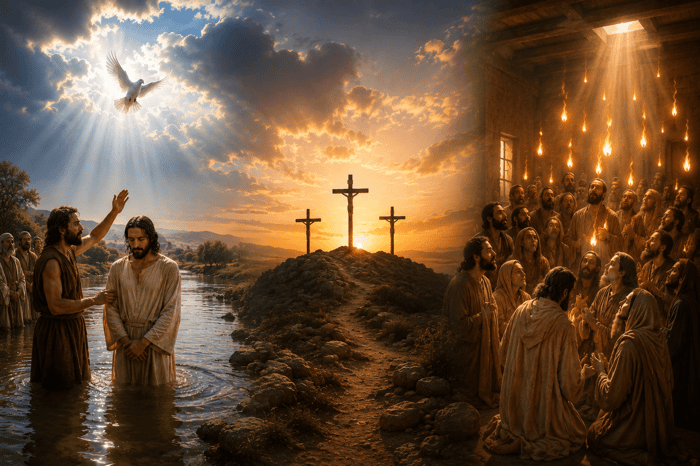
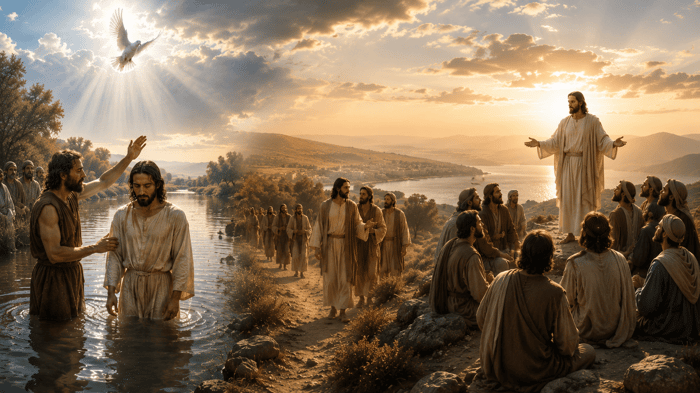
Matthew records Jesus coming up from the water while the Spirit descends and the Father speaks.
"Behold, the heavens were opened to him. He saw the Spirit of God descending as a dove and coming on him. Behold, a voice out of the heavens said, 'This is my beloved Son, with whom I am well pleased.'"
Matthew 3:16-17 (WEB)
The Son is being baptized. The Spirit descends upon Him. The Father's voice comes from heaven.
Luke gives the same basic picture.
"The Holy Spirit descended in a bodily form as a dove on him; and a voice came out of the sky, saying, 'You are my beloved Son. In you I am well pleased.'"
Luke 3:22 (WEB)
This scene matters because it shows that the Father, Son, and Holy Spirit are not merely three names for one person.
The Father speaks to the Son while the Spirit descends upon the Son.
Jesus' baptism provides one of the strongest pictures of the Trinity in the Gospels.
The Holy Spirit Is Active in Jesus' Ministry
The Holy Spirit is not introduced only at the end of Jesus' ministry. The Spirit is active from the beginning.
Luke records that Jesus returned from the Jordan full of the Holy Spirit.
"Jesus, full of the Holy Spirit, returned from the Jordan and was led by the Spirit into the wilderness."
Luke 4:1 (WEB)
The Spirit leads Jesus into the wilderness before His temptation.
Soon afterward, Jesus enters the synagogue in Nazareth and applies Isaiah's prophecy to Himself.
"The Spirit of the Lord is on me, because he has anointed me to preach good news to the poor."
Luke 4:18 (WEB)
Jesus' ministry takes place in the power and presence of the Holy Spirit.
This does not mean Jesus is less than divine. Instead, the Gospels reveal the Son carrying out His mission in perfect obedience to the Father and through the Spirit.
Jesus and the Trinity cannot be separated from one another in the Gospel story. The Father's purpose, the Son's mission, and the Spirit's work appear together.
Jesus Reveals the Father
A major theme in the Gospels is Jesus' relationship with the Father.
Jesus does not speak as though He is the Father. He prays to the Father, obeys Him, and says He was sent by Him.
Yet Jesus also claims a unique relationship with the Father that goes beyond that of an ordinary prophet.
John records one of Jesus' clearest statements:
"I and the Father are one."
John 10:30 (WEB)
Jesus does not say that He is the Father. He remains distinct from the Father while claiming unity with Him.
Later, Jesus tells Philip that seeing Him means seeing the Father.
"Jesus said to him, 'Have I been with you such a long time, and do you not know me, Philip? He who has seen me has seen the Father. How do you say, "Show us the Father"?'"
John 14:9 (WEB)
Jesus reveals the Father's character perfectly.
The Trinity in Matthew Mark Luke John becomes especially clear when Jesus' relationship with the Father is viewed alongside His teaching about the Holy Spirit.
The Father Sends the Son
The Gospels also reveal a repeated pattern of the Father sending the Son into the world.
Jesus does not present His mission as something He invented for Himself. He comes according to the Father's will.
John records Jesus saying:
"For I have come down from heaven, not to do my own will, but the will of him who sent me."
John 6:38 (WEB)
The Father sends. The Son comes.
This distinction is important for understanding the Trinity in the Gospels. The Father and Son are not the same person, yet they act with complete unity of purpose.
Jesus' obedience reaches its highest point in His death.
He came to accomplish the Father's saving purpose.
The Father and Son Share a Unique Relationship
The Gospels show more than simple cooperation between God and a human servant.
Jesus describes Himself as having a unique knowledge of the Father.
Matthew records:
"All things have been delivered to me by my Father. No one knows the Son except the Father; neither does anyone know the Father except the Son and he to whom the Son desires to reveal him."
Matthew 11:27 (WEB)
This is an extraordinary claim.
Jesus places His knowledge of the Father on a level unlike anyone else. The Father knows the Son, and the Son knows the Father in a unique way.
Jesus also says that He reveals the Father to others.
This unique relationship between the Father and Son is central to understanding the Trinity in the Gospels.
Jesus Promises the Holy Spirit
Near the end of His earthly ministry, Jesus begins teaching His disciples more directly about the Holy Spirit.
John gives some of the clearest Trinity Gospel verses in Jesus' farewell teaching.
Jesus says:
"I will pray to the Father, and he will give you another Counselor, that he may be with you forever: the Spirit of truth."
John 14:16-17 (WEB)
This verse includes all three persons.
The Son asks the Father.
The Father gives the Spirit.
The Spirit comes to remain with Jesus' followers.
The distinctions are clear, yet the three work together for the good of God's people.
The Holy Spirit Continues Jesus' Teaching
Jesus also explains that the Holy Spirit will continue His work among the disciples.
"But the Counselor, the Holy Spirit, whom the Father will send in my name, he will teach you all things and will remind you of all that I said to you."
John 14:26 (WEB)
Again, the Father, Son, and Holy Spirit appear together.
The Father sends the Spirit.
The Spirit comes in Jesus' name.
The Spirit reminds the disciples of Jesus' words.
This shows that the Holy Spirit does not compete with Jesus. His work points people back to Christ and helps them understand what Jesus taught.
The Spirit Testifies About Jesus
Jesus develops this teaching further in John 15.
"When the Counselor has come, whom I will send to you from the Father, the Spirit of truth, who proceeds from the Father, he will testify about me."
John 15:26 (WEB)
This passage shows a deep relationship between all three persons.
Jesus sends the Spirit from the Father. The Spirit proceeds from the Father and testifies about the Son.
The Spirit's mission is Christ-centered.
This gives the Trinity in the Gospels a strong missionary and redemptive focus. The Father sends the Son, and the Spirit reveals and testifies about the Son.
Jesus' Prayer Shows the Distinction Between Father and Son
Jesus' prayers are another important part of the Gospel witness.
In John 17, Jesus speaks directly to the Father.
"Jesus said these things, and lifting up his eyes to heaven, he said, 'Father, the time has come. Glorify your Son, that your Son may also glorify you.'"
John 17:1 (WEB)
The Father and Son are clearly distinct.
Jesus is not speaking to Himself. The Son speaks to the Father and asks the Father to glorify Him.
At the same time, Jesus speaks of a glory shared with the Father before the world existed.
"Now, Father, glorify me with your own self with the glory which I had with you before the world existed."
John 17:5 (WEB)
This goes beyond the relationship between God and an ordinary human being.
Jesus claims a preexistent glory shared with the Father.
The Great Commission Brings the Trinity Together
The Gospel of Matthew ends with one of the strongest Trinitarian statements in Scripture.
After His resurrection, Jesus commands His disciples:
"Go and make disciples of all nations, baptizing them in the name of the Father and of the Son and of the Holy Spirit."
Matthew 28:19 (WEB)
Jesus uses the singular word "name" while naming three persons.
The Father, Son, and Holy Spirit are placed together in the identity of Christian baptism.
This is not a passing reference. It comes in Jesus' final commission to His followers.
The church is sent into the world under the authority of the risen Christ, making disciples in the name of the Father, Son, and Holy Spirit.
How Each Gospel Contributes to the Trinitarian Picture
Each Gospel emphasizes different parts of Jesus' life and teaching, yet together they form a united picture.
| Gospel | Trinitarian Emphasis |
|---|---|
| Matthew | Jesus' baptism, His unique relationship with the Father, and the Great Commission |
| Mark | The Father's voice and the Spirit's presence at Jesus' baptism and ministry |
| Luke | The Holy Spirit's active role in Jesus' birth, baptism, temptation, and ministry |
| John | Jesus' unity with the Father and His detailed teaching about the Holy Spirit |
No single Gospel contains the entire doctrine in one place.
Together, Matthew, Mark, Luke, and John reveal a consistent picture of the Trinity in the Gospels.
The Father sends and speaks.
The Son reveals, obeys, saves, and returns to the Father.
The Holy Spirit descends, leads, teaches, and testifies about Jesus.
The Trinity and the Gospel Message
The Trinity in the Gospels is closely tied to salvation.
The Father sends the Son because humanity needs rescue from sin.
Jesus comes into the world to give His life for sinners.
The Holy Spirit reveals the truth about Christ and continues His work among God's people.
Jesus explains the Father's saving love:
"For God so loved the world, that he gave his one and only Son, that whoever believes in him should not perish, but have eternal life."
John 3:16 (WEB)
The Father gives the Son.
The Son comes so that sinners may receive eternal life through faith in Him.
The Gospel story shows God personally acting to save.
Salvation is not humanity climbing upward toward God. God comes to us.
The Father sends. The Son gives Himself. The Spirit reveals and applies the truth.
Why the Trinity in the Gospels Matters
The Trinity is not merely a difficult doctrine for theologians to study.
It tells us who God is.
The Gospels show that God is not distant or uninvolved. The Father sends the Son in love. The Son willingly obeys and gives Himself. The Spirit comes to reveal Christ and remain with God's people.
This also helps Christians understand Jesus more clearly.
Jesus is not merely a teacher pointing people toward God from a distance. He reveals the Father in a unique way and shares divine glory with Him.
The Holy Spirit is not merely an impersonal force. He teaches, leads, and bears witness to Christ.
When the Gospels are read together, their testimony is consistent.
The Trinity in the Gospels is woven through Jesus' baptism, ministry, prayers, teaching, death, resurrection, and Great Commission. The Father, Son, and Holy Spirit remain distinct, yet they work together in perfect unity.
The Gospels invite us to know the Father through the Son and to receive the truth made known by the Holy Spirit. That Trinitarian pattern stands at the heart of Jesus' life, teaching, and saving mission.
FAQs
How is the Trinity in the Gospels revealed?
The Trinity in the Gospels is revealed through repeated patterns in Jesus' life and teaching rather than through one formal definition. The Father speaks and sends, the Son reveals and obeys the Father, and the Holy Spirit descends, leads, teaches, and testifies about Jesus. Jesus also places all three together in the Great Commission.
"Go and make disciples of all nations, baptizing them in the name of the Father and of the Son and of the Holy Spirit."
Matthew 28:19 (WEB)
How does Jesus' baptism reveal the Father, Son, and Holy Spirit?
At Jesus' baptism, the Son is in the water, the Holy Spirit descends upon Him, and the Father's voice comes from heaven. All three are present at the same time, showing that the Father, Son, and Holy Spirit are personally distinct while acting together.
"Behold, the heavens were opened to him. He saw the Spirit of God descending as a dove and coming on him. Behold, a voice out of the heavens said, 'This is my beloved Son, with whom I am well pleased.'"
Matthew 3:16-17 (WEB)
What do the Gospels teach about Jesus' relationship with the Father?
The Gospels show that Jesus is distinct from the Father while sharing a unique unity with Him. Jesus prays to the Father, obeys Him, and says He was sent by Him. Yet Jesus also declares that He and the Father are one.
"I and the Father are one."
John 10:30 (WEB)
How is the Holy Spirit connected to Jesus' ministry in the Gospels?
The Holy Spirit is active throughout Jesus' ministry. After Jesus' baptism, the Spirit leads Him into the wilderness. Jesus later describes His ministry as taking place under the Spirit's anointing, showing the Father's purpose, the Son's mission, and the Spirit's work together.
"Jesus, full of the Holy Spirit, returned from the Jordan and was led by the Spirit into the wilderness."
Luke 4:1 (WEB)
What did Jesus teach His disciples about the Holy Spirit?
Jesus taught that the Holy Spirit would come from the Father to remain with His followers. The Son asks the Father, the Father gives the Spirit, and the Spirit continues God's work among Jesus' disciples. This teaching clearly distinguishes the Father, Son, and Holy Spirit.
"I will pray to the Father, and he will give you another Counselor, that he may be with you forever: the Spirit of truth."
John 14:16-17 (WEB)
Why is the Great Commission important for understanding the Trinity?
The Great Commission places the Father, Son, and Holy Spirit together in Jesus' command to make disciples. Jesus speaks of one "name" while naming three distinct persons. This makes Matthew 28:19 one of the clearest Trinitarian statements in the Gospels.
"Go and make disciples of all nations, baptizing them in the name of the Father and of the Son and of the Holy Spirit."
Matthew 28:19 (WEB)
How does the Trinity in the Gospels point to the Gospel and salvation?
The Trinity in the Gospels shows God acting personally to rescue sinners who cannot save themselves. The Father sends and gives the Son, Jesus comes to give Himself so sinners may receive eternal life, and the Holy Spirit reveals and testifies about Christ. This Trinitarian pattern points people toward faith in Jesus as God's provision for salvation.
"For God so loved the world, that he gave his one and only Son, that whoever believes in him should not perish, but have eternal life."
John 3:16 (WEB)
Do all four Gospels contribute to our understanding of the Trinity?
Yes. Matthew emphasizes Jesus' baptism and the Great Commission. Mark records the Father's voice and the Spirit at Jesus' baptism. Luke highlights the Spirit's activity throughout Jesus' ministry. John gives detailed teaching about Jesus' relationship with the Father and His promise of the Holy Spirit. Together, the four Gospels reveal a consistent Trinitarian pattern.
"But the Counselor, the Holy Spirit, whom the Father will send in my name, he will teach you all things and will remind you of all that I said to you."
John 14:26 (WEB)