Table of Contents
- Is the Trinity a Contradiction?
- The Bible Teaches That God Is One
- The Father Is God
- The Son Is God
- The Holy Spirit Is God
- The Three Persons Are Distinct
- Why the Trinity Is a Mystery but Not a Contradiction
- Does "One God in Three Persons" Make Sense?
- The Trinity Appears in Christian Baptism
- Why the Trinity Matters for Salvation
- Common Claims About a Trinity Contradiction
- How to Approach Understanding the Trinity
- The Trinity Calls Us to Worship
- FAQs
A Trinity contradiction is one of the most common objections raised against Christianity. Christians say there is one God, yet they also say the Father is God, the Son is God, and the Holy Spirit is God. At first, this may sound like saying God is both one and three in the same way.
But that is not what the Bible teaches.
The doctrine of the Trinity does not say that God is one person and three persons. It says that God is one Being who eternally exists as three distinct Persons: the Father, the Son, and the Holy Spirit.
That claim is deep, but depth is not the same as contradiction. Understanding the Trinity begins by allowing Scripture to define the truth. The Bible presents one God, three divine Persons, and clear personal distinctions between them.
Is the Trinity a Contradiction?
A contradiction occurs when two claims cannot both be true at the same time and in the same sense. For example, it would be a contradiction to say, "God is one person," and then say, "God is three persons."
The Bible does not make those two claims, which is why the Trinity contradiction objection does not accurately describe what Scripture teaches.
Instead, Scripture teaches:
- There is only one God.
- The Father is God.
- The Son is God.
- The Holy Spirit is God.
- The Father, Son, and Holy Spirit are personally distinct.
A supposed Trinity contradiction often comes from using the words "being" and "person" as though they mean the same thing. They do not.
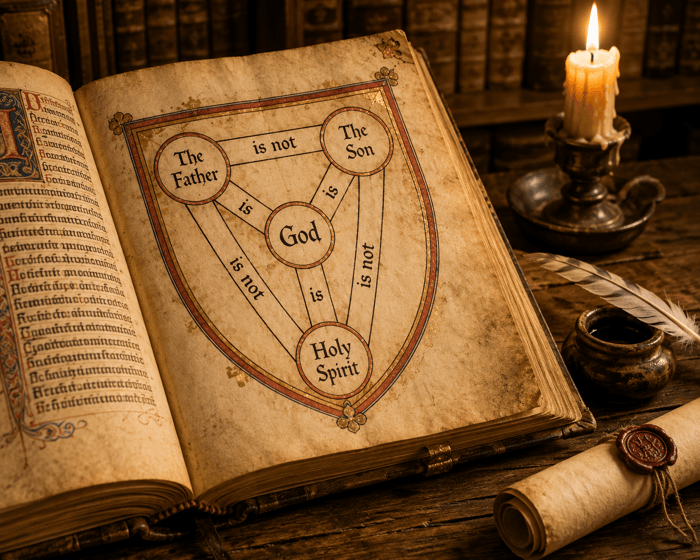
God is one in being and three in person. He is not one God and three gods. He is not one person wearing three masks. The doctrine is not "one equals three." It is one divine Being existing eternally as three Persons.
The Bible Teaches That God Is One
Any sound understanding of the Trinity must begin with the Bible's clear teaching that there is only one true God.
Hear, Israel: Yahweh is our God. Yahweh is one.
Deuteronomy 6:4 (WEB)
This statement stood at the heart of Israel's faith. God's people were surrounded by nations that worshiped many gods, but Israel was commanded to worship Yahweh alone.
The New Testament repeats the same truth.
We know that an idol is nothing in the world, and that there is no other God but one.
1 Corinthians 8:4 (WEB)
Christians do not believe in three gods. The Trinity is not a form of polytheism, and this is why the Trinity contradiction claim misunderstands biblical teaching. The Father, Son, and Holy Spirit do not form a committee of separate divine beings.
There is one God.
This truth also matters for salvation. The gospel is not a story of several gods working together. It is the work of the one true God to rescue sinners, restore them to Himself, and transform those who trust in Christ.
Humanity was separated from God by sin, but God provided restoration through His Son. Salvation brings believers into a new relationship with the Father and a new life through the Holy Spirit.
The Father Is God
The Bible directly identifies the Father as God. Jesus often prayed to the Father and spoke of Him as God.
Jesus said to her, "Don't hold me, for I haven't yet ascended to my Father; but go to my brothers and tell them, 'I am ascending to my Father and your Father, to my God and your God.'"
John 20:17 (WEB)
Paul also speaks of the Father as God.
Yet to us there is one God, the Father, of whom are all things, and we for him; and one Lord, Jesus Christ, through whom are all things, and we live through him.
1 Corinthians 8:6 (WEB)
No Christian explanation of the Trinity denies the full deity of the Father. The Father is not one-third of God. He is fully God.
Yet the Father is not the Son, and the Father is not the Holy Spirit. The Persons are distinct without being divided into separate gods.
The Son Is God
The Bible also teaches that Jesus Christ, the Son, is fully divine.
John begins his Gospel by calling the Word God. He then explains that the Word became flesh.
In the beginning was the Word, and the Word was with God, and the Word was God.
John 1:1 (WEB)
This verse contains two important truths. The Word was "with God," which shows personal distinction. The Word also "was God," which shows His divine nature.
John later identifies the Word as the Son who became human.
The Word became flesh and lived among us. We saw his glory, glory as of the one and only Son of the Father, full of grace and truth.
John 1:14 (WEB)
These verses show both unity and distinction. The Word was God, but the Word was also with God. Jesus is not the Father, yet Jesus fully shares the divine nature.
Thomas also addressed the risen Jesus with a direct confession.
Thomas answered him, "My Lord and my God!"
John 20:28 (WEB)
Jesus did not correct Thomas for calling Him God. He accepted Thomas's confession.
A Trinity contradiction would exist if Christians claimed that Jesus is the Father while also saying He is not the Father. Scripture does not teach that. It teaches that the Son is God and that the Son is personally distinct from the Father.
The Holy Spirit Is God
The Holy Spirit is not an impersonal force or a symbol of God's power. He speaks, teaches, leads, can be grieved, and acts according to His will.
In Acts, Peter tells Ananias that lying to the Holy Spirit was lying to God.
But Peter said, "Ananias, why has Satan filled your heart to lie to the Holy Spirit and to keep back part of the price of the land? While you kept it, didn't it remain your own? After it was sold, wasn't it in your power? How is it that you have conceived this thing in your heart? You haven't lied to men, but to God."
Acts 5:3-4 (WEB)
Peter first says Ananias lied to the Holy Spirit. He then says Ananias lied to God. The passage connects the Holy Spirit with God without teaching that the Spirit is the Father or the Son.
The Spirit is also described as knowing the deep things of God.
But to us, God revealed them through the Spirit. For the Spirit searches all things, yes, the deep things of God.
1 Corinthians 2:10 (WEB)
The Holy Spirit is fully God, not a lesser divine being. Yet He is not the Father or the Son.
The deity of the Holy Spirit is essential to answering the Trinity contradiction objection. The Christian belief is not that two divine Persons and one created spirit work together. All three Persons are fully divine.
The Three Persons Are Distinct
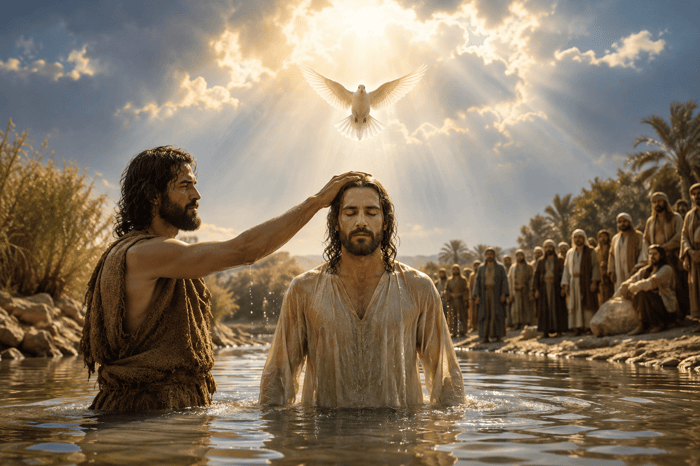
The baptism of Jesus gives one of the clearest pictures of the three Persons acting at the same time.
Jesus, when he was baptized, went up directly from the water: and behold, the heavens were opened to him. He saw the Spirit of God descending as a dove and coming on him. Behold, a voice out of the heavens said, "This is my beloved Son, with whom I am well pleased."
Matthew 3:16-17 (WEB)
The Son is baptized. The Spirit descends. The Father speaks from heaven.
This passage rules out the idea that God is one Person who simply appears in three different roles. The Father is not being baptized. The Son is not speaking from heaven. The Spirit is not calling Jesus "my beloved Son."
The Persons relate to one another. They love, send, speak to, and glorify one another.
This does not create a Trinity contradiction. Personal distinction does not require separation into three beings. The Father, Son, and Holy Spirit remain the one true God.
Why the Trinity Is a Mystery but Not a Contradiction
The Trinity is beyond full human understanding, but it is not against reason.
A mystery is a truth that we cannot fully explain. A contradiction is a statement that cancels itself out. Those are not the same.
A Trinity paradox may feel difficult because nothing in creation is exactly like God. Every illustration used to explain Him breaks down at some point.
| Common Illustration | What It Tries to Show | Why It Falls Short |
|---|---|---|
| Water as ice, liquid, and steam | Three forms of one substance | Suggests one Person changing between three modes |
| An egg with shell, white, and yolk | Three parts in one whole | Makes each Person only one part of God |
| One man as father, son, and worker | One person with three roles | Denies the three personal distinctions |
| A three-leaf clover | Three parts forming one object | Suggests each Person is one-third of God |
These illustrations may seem helpful at first, but none can define God. Creation cannot provide a perfect model of the Creator.
Water can change from one form to another, but the Father does not turn into the Son. An egg has three parts, but the Son is not one-third of God. One person may have several roles, but the Father, Son, and Spirit relate to one another as distinct Persons.
The safest path is to use the language Scripture gives us. There is one God. The Father, Son, and Holy Spirit are each fully God. They are distinct Persons who share the one divine being.
Does "One God in Three Persons" Make Sense?
It makes sense once the terms are kept clear.
"Being" answers the question, "What is God?"
"Person" answers the question, "Who is God?"
God is one divine Being. The Father, Son, and Holy Spirit are the three Persons who eternally share that one divine nature.
This does not mean each Person possesses one-third of the divine nature. The Father is fully God. The Son is fully God. The Spirit is fully God. Yet there are not three divine beings.
The Trinity contradiction claim often assumes that every person must also be a separate being. That is true of human beings, but it does not follow that God must exist in the same way.
Each human person is also a separate human being. In us, one person equals one being. God is not a larger or stronger version of a human. His way of existing is unique.
The difficulty of understanding the Trinity should not surprise us. If God is eternal, uncreated, and infinite, we should expect some truths about Him to exceed our experience.
For my thoughts are not your thoughts,
neither are your ways my ways, declares the Lord.
For as the heavens are higher than the earth,
so are my ways higher than your ways
and my thoughts than your thoughts.
Isaiah 55:8-9 (ESV)
This does not mean Christians should believe nonsense. It means the Creator is greater than the human mind. We can know what God has revealed without knowing everything that could be known about Him.
The Trinity Appears in Christian Baptism
Jesus commanded His followers to baptize disciples in one name, yet He named three Persons.
Go and make disciples of all nations, baptizing them in the name of the Father and of the Son and of the Holy Spirit.
Matthew 28:19 (WEB)
Notice that Jesus did not say "in the names." He used the singular word "name." He then identified the Father, Son, and Holy Spirit.
This verse does not give a full theological definition of the Trinity. However, it brings unity and distinction together in one sentence.
The three Persons share one divine name and authority. This truth also answers the Trinity contradiction objection by showing unity without erasing the distinction between the Persons. At the same time, the Father is distinguished from the Son, and the Son is distinguished from the Holy Spirit.
The same pattern appears in the Christian blessing Paul gave the church.
The grace of the Lord Jesus Christ, God's love, and the fellowship of the Holy Spirit be with you all. Amen.
2 Corinthians 13:14 (WEB)
The three Persons are not placed together by accident. They act in perfect unity while remaining personally distinct.
These passages do not present a Trinity contradiction. They show how naturally the first Christians spoke about the Father, Son, and Holy Spirit while continuing to believe in one God.
Why the Trinity Matters for Salvation
The Trinity is not a puzzle added to Christianity. It stands at the center of the gospel.
The Father sends the Son. The Son takes on human flesh, dies for sins, and rises again. The Holy Spirit gives new life, indwells believers, and applies Christ's saving work to them.
But when the fullness of the time came, God sent out his Son, born to a woman, born under the law, that he might redeem those who were under the law, that we might receive the adoption of children. And because you are children, God sent out the Spirit of his Son into your hearts, crying, "Abba, Father!"
Galatians 4:4-6 (WEB)
This passage shows the Father, the Son, and the Spirit working in salvation.
The Father plans and sends. The Son enters the world and redeems. The Spirit brings believers into the lived experience of being God's children.
Their works are not divided as though each Person acts alone. The one God saves, yet Scripture reveals the personal work of the Father, Son, and Holy Spirit.
The Trinity also shows the depth of God's love. The Father did not send an unrelated creature to save humanity. He sent His beloved Son. The Son willingly gave Himself, and the Spirit brings the life of Christ to those who believe.
A Trinity contradiction would make the gospel confused and uncertain. Instead, the Trinity helps us understand salvation as the united work of the one true God.
Common Claims About a Trinity Contradiction
Several objections appear again and again. Each one can be answered by keeping the Bible's teaching clear.
"The Word Trinity Is Not in the Bible"
The word "Trinity" is not found in the Bible, but the truth summarized by the word is found throughout Scripture.
A theological word is useful when it accurately summarizes biblical teaching. The word "Trinity" helps Christians describe three truths that must be held together:
- God is one.
- The Father, Son, and Holy Spirit are fully divine.
- The Father, Son, and Holy Spirit are personally distinct.
The doctrine does not come from the word itself. It comes from the combined witness of Scripture.
"Jesus Prayed to God, So He Cannot Be God"
Jesus prayed to the Father because the Son is distinct from the Father. His prayers do not disprove His deity. They reveal the real relationship between the Father and the Son.
They also show that the eternal Son truly became human. As the incarnate Son, Jesus lived in humble obedience and prayerful dependence on the Father.
If Jesus were the same Person as the Father, His prayers would be hard to explain. The Trinity explains why the divine Son can speak to the divine Father without producing two gods.
"Jesus Said the Father Is Greater Than He Is"
Jesus said the Father was greater than He was during His earthly mission.
You heard how I told you, "I go away, and I come to you." If you loved me, you would have rejoiced because I said "I am going to my Father;" for the Father is greater than I.
John 14:28 (WEB)
This does not mean Jesus has a lesser divine nature. It refers to His humbled position during the incarnation. The Son took the role of a servant without ceasing to be divine.
A king may take the position of a servant without losing his royal identity. In a far greater way, the eternal Son humbled Himself and accepted a servant's role.
"Three Persons Must Mean Three Gods"
This conclusion assumes each divine Person must be a separate being. Scripture does not make that assumption.
The three Persons do not merely agree with one another. They share the one divine nature. God is one in essence, power, glory, and being.
There are three "whos," but only one divine "what."
This distinction answers the Trinity logical contradiction claim. Christianity does not teach that three divine beings are one divine being. It teaches that one divine Being exists as three distinct Persons.
How to Approach Understanding the Trinity
Understanding the Trinity requires humility. No one can reduce God to a diagram, formula, or simple object lesson.
A wise approach includes several steps:
- Begin with the plain statements of Scripture.
- Hold together God's oneness and the deity of all three Persons.
- Keep the Persons distinct without separating them into three gods.
- Avoid illustrations that replace biblical truth.
- Accept mystery without calling it nonsense.
- Let the Trinity deepen worship instead of feeding endless debate.
The goal is not to explain every detail of God's inner life. Instead of trying to solve a supposed Trinity contradiction, the goal is to confess faithfully what God has revealed.
We should also avoid trying to solve the Trinity contradiction objection by weakening one part of the doctrine. Denying the Son's deity, treating the Spirit as a force, or turning the three Persons into three roles may make the doctrine seem simpler. However, each solution rejects part of Scripture's teaching.
Faithfulness means accepting all that the Bible says, even when the truth is greater than our ability to picture it.
The Trinity Calls Us to Worship
The Trinity is not a Trinity logical contradiction. It is the Bible's way of showing us the living God as He has made Himself known.
The Father is God. The Son is God. The Holy Spirit is God. Yet there is one God, not three.
This truth stretches the mind, but it does not break the rules of reason. Rather than proving a Trinity contradiction, it calls us to speak with care, reject false shortcuts, and bow before the greatness of God.
The Trinity paradox reminds us that God is greater than creation, yet He has come near. The Father sent the Son for our salvation, and the Holy Spirit brings believers into fellowship with God.
We may not fully understand the Trinity, but we can truly know the triune God through Jesus Christ. The answer to the Trinity contradiction objection is not to remove the mystery. It is to state the Bible's teaching accurately: one God, eternally existing as Father, Son, and Holy Spirit.
FAQs
Is the Trinity a contradiction?
No. The Bible does not teach that God is one Person and three Persons. It teaches that God is one Being who eternally exists as the Father, the Son, and the Holy Spirit.
Hear, Israel: Yahweh is our God. Yahweh is one.
Deuteronomy 6:4 (WEB)
Why isn't the Trinity a logical contradiction?
A contradiction says something is true and false in the same way. The Trinity teaches that God is one in Being and three in Persons, not one and three in the same sense.
In the beginning was the Word, and the Word was with God, and the Word was God.
John 1:1 (WEB)
Does the Bible teach that Jesus is God?
Yes. Scripture identifies Jesus as fully God while also showing that He is distinct from the Father.
Thomas answered him, "My Lord and my God!"
John 20:28 (WEB)
Is the Holy Spirit really God?
Yes. The Holy Spirit is a divine Person, not merely a force. The Bible equates lying to the Holy Spirit with lying to God.
But Peter said, "Ananias, why has Satan filled your heart to lie to the Holy Spirit?... You haven't lied to men, but to God."
Acts 5:3-4 (WEB)
Why does the Trinity matter for salvation?
Answering the Trinity contradiction question points us to the Gospel. Our sin separated us from God, yet the Father sent His Son to redeem us, and the Holy Spirit applies that saving work to everyone who believes in Christ. The Trinity reveals the united work of the one true God in salvation.
But when the fullness of the time came, God sent out his Son, born to a woman, born under the law, that he might redeem those who were under the law, that we might receive the adoption of children.
Galatians 4:4-5 (WEB)
Can we fully understand the Trinity?
No. We can truly know what God has revealed in Scripture, even though we cannot fully comprehend His infinite nature.
"For my thoughts are not your thoughts, and your ways are not my ways," says Yahweh.
Isaiah 55:8 (WEB)
Where do we see all three Persons of the Trinity together in the Bible?
At Jesus' baptism, the Son is baptized, the Holy Spirit descends like a dove, and the Father speaks from heaven, showing three distinct Persons acting together.
Jesus, when he was baptized, went up directly from the water... Behold, a voice out of the heavens said, "This is my beloved Son, with whom I am well pleased."
Matthew 3:16-17 (WEB)