
Table of Contents
- The Trinity Explained From the Bible
- The Father, Son, and Holy Spirit Are Distinct
- Why Christians Use Trinity Examples
- The Water Illustration
- The Egg Illustration
- The Sun, Light, and Heat Illustration
- The One Person With Three Roles Illustration
- The Three-Leaf Clover Illustration
- What Is the Best Trinity Illustration?
- Why the Trinity Matters for Salvation
- How to Use Trinity Examples Wisely
- We Know God Truly, but Not Completely
- Trust Scripture More Than the Illustration
- FAQs
The Trinity explained in simple words can help us understand what Christians mean when they say God is one Being in three Persons. Yet every human example has limits. God is not part of creation, so no picture from nature can fully describe who He is.
The Bible teaches that there is one God. It also reveals the Father, the Son, and the Holy Spirit as distinct Persons who are each fully divine. This is not a puzzle Christians invented. It is a truth drawn from the whole witness of Scripture.
Examples can give us a starting point for understanding the Trinity. They can also mislead us when we press them too far. The safest path is to use illustrations as small teaching tools while letting Scripture set the boundaries.
The Trinity Explained From the Bible
Before looking at Trinity examples, we need a clear biblical foundation. The doctrine of the Trinity can be stated in three simple truths:
- There is only one God.
- The Father, the Son, and the Holy Spirit are each fully God.
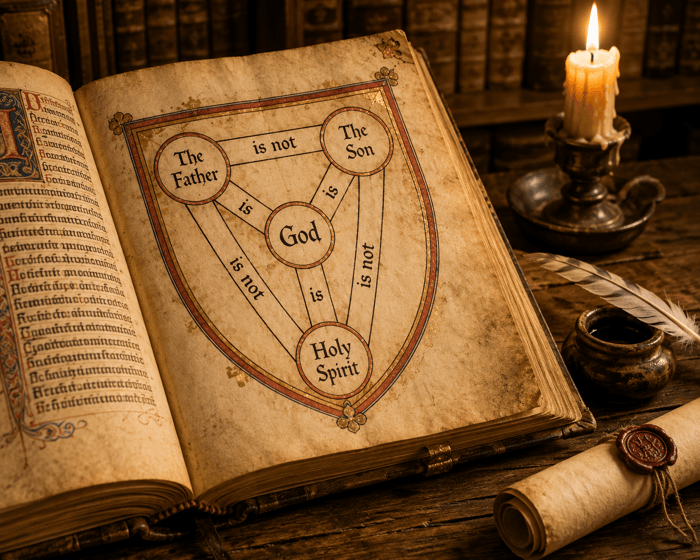
- The Father, the Son, and the Holy Spirit are distinct Persons.
The Bible begins with the truth that God is one.
“Hear, O Israel: The Lord our God, the Lord is one.
Deuteronomy 6:4 (ESV)
Jesus repeated this same truth when He named the greatest commandment.
Jesus answered, "The greatest is, 'Hear, Israel, the Lord our God, the Lord is one.'"
Mark 12:29 (WEB)
The Trinity explained in a biblical way never means that Christians worship three gods. Christianity is firmly monotheistic. There is one God, not three separate divine beings.
At the same time, Scripture identifies the Father as God, the Son as God, and the Holy Spirit as God. It also shows them relating to one another.
The Father sends the Son. The Son prays to the Father. The Father and the Son send the Holy Spirit. These are not three names for the same Person.
The Father, Son, and Holy Spirit Are Distinct
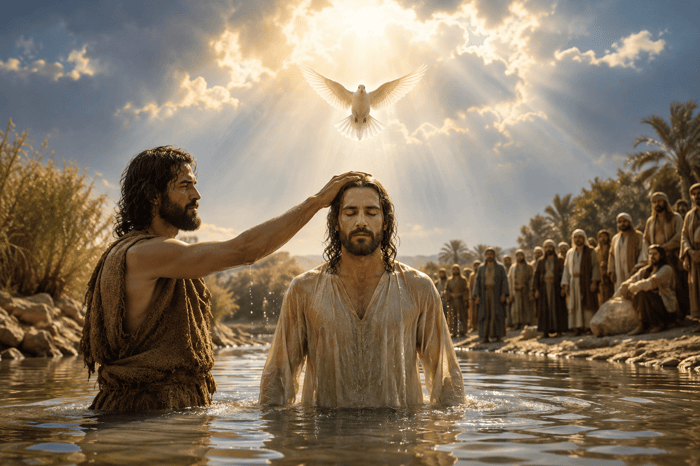
One of the clearest scenes for understanding the Trinity is the baptism of Jesus. The Son is in the water, the Spirit descends like a dove, and the Father's voice speaks from heaven.
Behold, a voice out of the heavens said, "This is my beloved Son, with whom I am well pleased."
Matthew 3:17 (WEB)
This moment shows distinction without division. The Father is not the Son. The Son is not the Spirit. The Spirit is not the Father. Yet all three act together in perfect unity.
Jesus also commanded His followers to baptize disciples in one name while naming three Persons.
Go and make disciples of all nations, baptizing them in the name of the Father and of the Son and of the Holy Spirit.
Matthew 28:19 (WEB)
Notice that Jesus said "name," not "names." The wording points to one divine identity shared by the Father, Son, and Holy Spirit.
Paul used the same threefold pattern when he blessed the church.
The grace of the Lord Jesus Christ, God's love, and the fellowship of the Holy Spirit be with you all. Amen.
2 Corinthians 13:14 (WEB)
The Trinity explained from these passages is not an abstract math problem. It is a truth about the living God who saves, loves, speaks, sends, and dwells with His people.
Why Christians Use Trinity Examples
The Bible does not use the word "Trinity," but it gives us the truths that the word summarizes. Christians often look for the Trinity explained through a simple Trinity illustration because the doctrine can feel difficult at first.
A good illustration may help explain one part of the doctrine, such as unity or distinction. The danger comes when an example is treated as a full picture of God.
| Illustration | What It Tries to Show | Where It Falls Short |
|---|---|---|
| Water as ice, liquid, and steam | One substance in three forms | Suggests God changes modes instead of existing as three Persons |
| An egg with shell, white, and yolk | One object with three parts | Suggests each Person is only one-third of God |
| The sun, light, and heat | One source with related effects | Can make the Son and Spirit seem created or less divine |
| One person as father, son, and worker | One person with three roles | Confuses three Persons with one Person wearing three masks |
| A three-leaf clover | Three leaves joined as one plant | Suggests God is made of three separate parts |
These examples may open a conversation, but none can carry the full weight of the Trinity explained by Scripture.
The Water Illustration
The water illustration is one of the most common Trinity examples. Water can appear as liquid, ice, or vapor. The same substance can be seen in three forms.
This may sound helpful because it shows one substance connected with three expressions. Yet it creates a serious problem. Water usually changes from one form to another. It is not ice, liquid, and vapor in the same way at the same time.
That can lead to a false idea called modalism. Modalism teaches that God is one Person who appears in different modes or roles. In this view, God may act as Father at one time, Son at another time, and Spirit at another.
Scripture shows more than changing roles. Jesus speaks to the Father. The Father loves the Son. The Spirit descends upon the Son. The three Persons are present and active at the same time.
Now, Father, glorify me with your own self with the glory which I had with you before the world existed.
John 17:5 (WEB)
Jesus did not speak to Himself while wearing a different role. He spoke to the Father, with whom He shared glory before creation.
The Egg Illustration
Another Trinity illustration compares God to an egg. The shell, white, and yolk are three parts of one egg.
This example may show that three things can belong to one whole. Yet it also teaches the wrong idea if taken too far. The Father, Son, and Holy Spirit are not parts of God. Each Person is fully God.
The Son is not one-third of God. The Holy Spirit is not one-third of God. The Father is not the largest or most important part. God is not divided into pieces.
The Bible speaks of Jesus as fully divine.
For in him all the fullness of the Deity dwells bodily.
Colossians 2:9 (WEB)
The Trinity explained by the egg illustration becomes too small. God is one undivided divine Being, not a collection of divine parts.
The Sun, Light, and Heat Illustration
Some people compare the Trinity to the sun, its light, and its heat. The sun is the source, while light and heat come from it.
This illustration may help people think about unity and relationship. Yet it can also make the Son and the Holy Spirit seem like forces or effects rather than divine Persons.
The Son is not a created beam coming from God. He is eternal and fully divine. John says that the Word was with God and was God.
In the beginning was the Word, and the Word was with God, and the Word was God.
John 1:1 (WEB)
The Holy Spirit is also personal. He speaks, teaches, leads, and can be grieved. He is not divine energy.
But the Counselor, the Holy Spirit, whom the Father will send in my name, will teach you all things and will remind you of all that I said to you.
John 14:26 (WEB)
This Trinity example can point toward shared glory, but it must not reduce the Son or Spirit to something less than God.
The One Person With Three Roles Illustration
A person may be a father, a son, and an employee at the same time. Some use this fact to describe the Trinity explained through three roles.
The problem is that this is still one human person. The roles change based on the relationship or setting. That is not what the Bible teaches about God.
The Father, Son, and Holy Spirit are not three job titles held by one Person. They know, love, speak to, and glorify one another.
The Father loves the Son, and has given all things into his hand.
John 3:35 (WEB)
Love between the Father and the Son is a real personal relationship. It is not one person acting out both sides of a conversation.
The Three-Leaf Clover Illustration
The three-leaf clover is linked with early Christian teaching because its three leaves share one stem. It gives a simple picture of three-in-one.
Still, each leaf is only part of the clover. Remove one leaf, and much of the plant remains. That does not fit the biblical teaching about God.
The divine Persons are not detachable pieces. They share the one divine nature fully and eternally. The Trinity explained through a clover may help a child remember the number three, but it cannot explain God's being.
What Is the Best Trinity Illustration?
There is no perfect Trinity illustration in creation. Every example either divides God into parts, turns the three Persons into roles, or makes one Person less divine than the others.
The best approach is not to search for one flawless picture. It is to hold together the truths Scripture gives us.
A safer summary is:
- The Father is God.
- The Son is God.
- The Holy Spirit is God.
- The Father is not the Son.
- The Son is not the Holy Spirit.
- The Holy Spirit is not the Father.
- There is only one God.
These statements may stretch our minds, but they do not contradict one another. God is one in Being and three in Person.
"Being" answers what God is. "Person" answers who God is.
This does not mean three beings are one being. It means the one divine Being exists eternally as three distinct Persons.
Why the Trinity Matters for Salvation
Understanding the Trinity matters because salvation is the work of the triune God. The Father planned and sent. The Son came, died, and rose again. The Holy Spirit gives new life and lives in believers.
The Father sent the Son because of His love for the world.
For God so loved the world, that he gave his one and only Son, that whoever believes in him should not perish, but have eternal life.
John 3:16 (WEB)
The Son willingly gave His life for sinners. He did not come as a created helper. God the Son took on human nature so He could bear sin and defeat death.
The Holy Spirit opens hearts, gives new birth, and joins believers to Christ. Salvation is not the work of three competing gods. It is the united work of the one true God.
But when the fullness of the time came, God sent out his Son, born to a woman, born under the law, that he might redeem those who were under the law, that we might receive the adoption of children. And because you are children, God sent out the Spirit of his Son into your hearts, crying, "Abba, Father!"
Galatians 4:4-6 (WEB)
This passage brings the Father, Son, and Spirit together in the believer's salvation and adoption. The Trinity explained through the Gospel is not cold theory. It shows how God brings sinners into fellowship with Himself.
How to Use Trinity Examples Wisely
Trinity examples can still be useful when they are handled with care. They should serve Scripture, not replace it.
When using an illustration, follow three simple steps:
- State the biblical truth first.
- Explain the one point the illustration helps show.
- Name where the illustration breaks down.
For example, you might say that a clover has three leaves joined together, which can help someone remember "three and one." Then explain that God is not made of three parts, so the clover cannot describe His nature.
This honest approach keeps a simple teaching tool from becoming false teaching.
We Know God Truly, but Not Completely
The Trinity is mysterious, but mystery does not mean nonsense. Christians are not claiming to explain everything about God's inner life. They are seeking to speak faithfully about what God has revealed.
A child can truly know a parent without knowing everything about that parent. In a greater way, believers can truly know God while admitting that His being is beyond full human understanding.
For my thoughts are not your thoughts,
neither are your ways my ways, declares the Lord.
For as the heavens are higher than the earth,
so are my ways higher than your ways
and my thoughts than your thoughts.
Isaiah 55:8-9 (ESV)
The Trinity explained with humility leads us toward worship. God is not small enough to fit inside a picture, formula, or object lesson.
Trust Scripture More Than the Illustration
Simple Trinity examples can be useful doors into a hard subject. Water may help us think about one substance. A clover may help us remember three-in-one. The sun may help us picture shared glory. Yet every created example falls short.
The final authority is Scripture. It provides the Trinity explained by revealing one God, three distinct divine Persons, and their perfect unity.
The goal is not to master God as though He were a problem to solve. The goal is to know Him as He has made Himself known: Father, Son, and Holy Spirit, one God forever.
FAQs
What does the Trinity mean?
The Trinity means there is one God who exists eternally as three distinct Persons: the Father, the Son, and the Holy Spirit. Christians do not believe in three gods but one God revealed throughout Scripture.
Go and make disciples of all nations, baptizing them in the name of the Father and of the Son and of the Holy Spirit.
Matthew 28:19 (WEB)
Does the Bible use the word "Trinity"?
No. The word itself does not appear in the Bible, but the doctrine comes from passages that teach there is one God while revealing the Father, Son, and Holy Spirit as distinct and fully divine.
Hear, Israel: Yahweh is our God. Yahweh is one.
Deuteronomy 6:4 (WEB)
Why do Trinity examples always fall short?
Every illustration comes from creation, while God is the Creator. Examples may explain one aspect of the doctrine, but none perfectly describe God's nature.
"For my thoughts are not your thoughts, and your ways are not my ways," says Yahweh. "For as the heavens are higher than the earth, so are my ways higher than your ways, and my thoughts than your thoughts."
Isaiah 55:8-9 (WEB)
What is the clearest biblical picture of the Trinity?
Jesus' baptism clearly shows the Father speaking from heaven, the Son being baptized, and the Holy Spirit descending like a dove at the same time.
Behold, a voice out of the heavens said, "This is my beloved Son, with whom I am well pleased."
Matthew 3:17 (WEB)
How should Christians use Trinity illustrations?
Illustrations can be helpful teaching tools when they support Scripture instead of replacing it. They should always be presented with their limitations.
But the Counselor, the Holy Spirit, whom the Father will send in my name, will teach you all things and will remind you of all that I said to you.
John 14:26 (WEB)
How does the Trinity explained point to the Gospel?
Understanding the Trinity explained helps us see that salvation is the united work of the one true God. The Father sent His Son in love, the Son died and rose again to redeem sinners, and the Holy Spirit brings new life to those who trust in Christ. The doctrine points us to Jesus as the only Savior and invites us to place our faith in Him.
For God so loved the world, that he gave his one and only Son, that whoever believes in him should not perish, but have eternal life.
John 3:16 (WEB)