Table of Contents
- Matthew 28:19 in Its Biblical Context
- Matthew 28:19 Meaning and the Great Commission
- What Does "In the Name" Mean?
- The Trinity in Matthew 28
- The Father, Son, and Holy Spirit at Jesus' Baptism
- Why Is Jesus Included in the Divine Name?
- Why Is the Holy Spirit Included?
- Why Christians Baptize in the Triune Name
- Does Baptism Save a Person?
- What Matthew 28:19 Teaches About Christian Life
- A Simple Summary of Matthew 28:19 Meaning
- FAQs
The Matthew 28:19 meaning becomes clear when we read the verse as part of Jesus' final command to His disciples. Jesus told them to make disciples of all nations and baptize those disciples in the name of the Father, the Son, and the Holy Spirit. This command is known as the Great Commission.
Matthew 28:19 is also one of the clearest biblical foundations for the Trinity. The verse places the Father, Son, and Holy Spirit together under one divine name.
It does not teach that Christians worship three gods. It reveals one God who exists eternally as three distinct persons: Father, Son, and Holy Spirit.
Matthew 28:19 in Its Biblical Context
Matthew 28 takes place after Jesus rose from the dead. The women found His tomb empty, and Jesus appeared to His disciples.
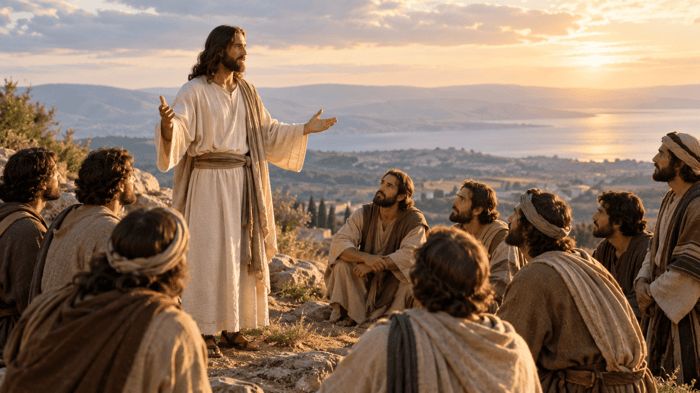
The disciples later met Jesus on a mountain in Galilee. There, the risen Christ gave them His final mission.
Jesus came to them and spoke to them, saying, "All authority has been given to me in heaven and on earth."
Matthew 28:18 (WEB)
Jesus began by declaring His authority. He did not speak as a teacher offering a suggestion. He spoke as the risen Lord who rules over heaven and earth.
"Go and make disciples of all nations, baptizing them in the name of the Father and of the Son and of the Holy Spirit."
Matthew 28:19 (WEB)
"teaching them to observe all things that I commanded you. Behold, I am with you always, even to the end of the age." Amen.
Matthew 28:20 (WEB)
The Matthew 28:19 meaning must be understood between these two promises. Jesus has all authority, and Jesus will remain with His people as they carry out His mission.
Matthew 28:19 Meaning and the Great Commission
The main command in this passage is to make disciples. Going, baptizing, and teaching are all parts of that mission.
The Great Commission includes four key actions:
- Go beyond familiar places and people.
- Make disciples from every nation.
- Baptize those who believe.
- Teach believers to obey Jesus.
A disciple is more than someone who knows facts about Jesus. A disciple trusts Jesus, learns from Him, obeys Him, and becomes more like Him.
The Matthew 28:19 meaning is therefore broader than baptism alone. Jesus was establishing the worldwide mission of His church.
The disciples were not supposed to keep the gospel in Jerusalem or within the nation of Israel. The good news of Jesus' death and resurrection was to be proclaimed among every nation and people group.
What Does "In the Name" Mean?
Jesus commanded baptism "in the name" of the Father, Son, and Holy Spirit. The word "name" is singular.
That detail is important.
Jesus did not say to baptize people in the "names" of the Father, Son, and Holy Spirit. He used one name while identifying three distinct persons.
The Matthew 28:19 meaning includes both God's unity and the personal distinction between the Father, Son, and Holy Spirit.
| Words in Matthew 28:19 | What They Reveal |
|---|---|
| "In the name" | There is one divine identity and authority |
| "Of the Father" | The Father is a distinct person |
| "Of the Son" | The Son is a distinct person |
| "Of the Holy Spirit" | The Holy Spirit is a distinct person |
In the Bible, a name often represents a person's identity, character, ownership, and authority. To be baptized in God's name means publicly identifying with Him and placing oneself under His authority.
Baptism in the name of the Father, Son, and Holy Spirit declares that the believer belongs to the triune God.
The Trinity in Matthew 28
The Trinity in Matthew 28 is not presented as a complicated formula. Jesus simply joins the Father, Son, and Holy Spirit together in the one divine name.
The Bible teaches that there is only one God.
“Hear, O Israel: The Lord our God, the Lord is one.
Deuteronomy 6:4 (ESV)
Jesus did not reject this truth. Instead, He revealed more about the identity of the one God.
The Father is not the Son. The Son is not the Holy Spirit. The Holy Spirit is not the Father. Yet all three share the one divine name.
The Matthew 28:19 meaning guards against two serious errors:
- God is not three separate gods.
- The Father, Son, and Holy Spirit are not one person changing between three roles.
God is one being who exists eternally as three persons. Each person is fully God, yet there is only one God.
This truth is beyond our full understanding, but it is not a contradiction. Christians do not claim that God is one person and three persons in the same way. God is one in being and three in person.
The Father, Son, and Holy Spirit at Jesus' Baptism
Matthew introduced the three persons of the Trinity earlier in his Gospel. All three were revealed at Jesus' baptism.
Jesus, when he was baptized, went up directly from the water: and behold, the heavens were opened to him. He saw the Spirit of God descending as a dove, and coming on him.
Matthew 3:16 (WEB)
Behold, a voice out of the heavens said, "This is my beloved Son, with whom I am well pleased."
Matthew 3:17 (WEB)
The Son was standing in the water. The Holy Spirit descended upon Him. The Father spoke from heaven.
This scene shows that the Father, Son, and Holy Spirit are personally distinct. Jesus was not speaking from heaven to Himself while also pretending to descend as the Spirit.
The three persons were present and active at the same time.
The Matthew 28:19 meaning agrees with this earlier event. At Jesus' baptism, the three persons were revealed. In the Great Commission, new disciples were commanded to be baptized in the name of those same three persons.
Why Is Jesus Included in the Divine Name?
Including the Son in the divine name makes a strong statement about Jesus' identity. Jesus is not merely a prophet, angel, or created teacher.
The risen Jesus had just declared that all authority in heaven and on earth belonged to Him. He then placed Himself alongside the Father and the Holy Spirit in the baptismal command.
John also described Jesus, the eternal Word, as being both with God and fully God.
In the beginning was the Word, and the Word was with God, and the Word was God.
John 1:1 (WEB)
The Word was "with God," showing personal distinction. The Word also "was God," showing His divine nature.
The Matthew 28:19 meaning supports this same truth. The Son is distinct from the Father, but He shares the divine identity of the one God.
Why Is the Holy Spirit Included?
The Holy Spirit is sometimes misunderstood as an impersonal force. Scripture presents Him as a divine person.
The Holy Spirit teaches, guides, speaks, gives gifts, and can be grieved. Jesus said that the Father would send the Spirit to teach His followers.
"But the Counselor, the Holy Spirit, whom the Father will send in my name, he will teach you all things, and will remind you of all that I said to you."
John 14:26 (WEB)
The Father sends the Holy Spirit in the Son's name. Once again, the three persons are distinct but united in their work.
Jesus would not place a created power inside the one divine name. The command to practice baptism in the name of the Father, Son, and Holy Spirit points to the Spirit's full deity.
The Matthew 28:19 meaning therefore reveals that the Holy Spirit is not less divine than the Father or the Son.
Why Christians Baptize in the Triune Name
Christian baptism is a public declaration of faith and belonging. A baptized believer identifies with Jesus' death, burial, and resurrection.
We were buried therefore with him through baptism into death, that just as Christ was raised from the dead through the glory of the Father, so we also might walk in newness of life.
Romans 6:4 (WEB)
Baptism pictures the end of an old life ruled by sin and the beginning of a new life under Christ's authority.
Baptism in the name of the Father, Son, and Holy Spirit also shows that salvation is the work of the triune God.
- The Father planned salvation and sent the Son.
- The Son died for sinners and rose from the dead.
- The Holy Spirit gives new life and lives within believers.
The Father, Son, and Holy Spirit do not work against one another. They work in perfect unity to save sinners and bring them into fellowship with God.
Does Baptism Save a Person?
Baptism is commanded by Jesus, but the act of baptism does not earn salvation. Water cannot remove guilt or change a sinful heart.
Salvation is God's gift. It is received through repentance and faith in Jesus Christ.
For God so loved the world, that he gave his one and only Son, that whoever believes in him should not perish, but have eternal life.
John 3:16 (WEB)
Human beings have sinned against God and cannot restore their relationship with Him through good works. Jesus, the Son of God, came into the world to save sinners.
He lived without sin, died on the cross in the place of sinners, and rose from the dead. Everyone who turns from sin and trusts in Him receives forgiveness and eternal life.
Baptism follows faith. It is the believer's public confession that Jesus is Lord and that he or she now belongs to the Father, Son, and Holy Spirit.
The Matthew 28:19 meaning does not support the idea that a religious ceremony can replace personal faith in Christ. Baptism is an act of obedience flowing from genuine faith.
What Matthew 28:19 Teaches About Christian Life
Matthew 28:19 is not only about the beginning of the Christian life. It is part of a command to make lifelong disciples.
Jesus connected baptism with teaching believers to obey everything He commanded. Baptism marks the beginning of a life of learning, obedience, worship, and spiritual growth.
A Christian's relationship with the triune God shapes every part of life:
- Believers pray to the Father.
- Believers come to the Father through the Son.
- Believers are guided and strengthened by the Holy Spirit.
- Believers follow Jesus and teach others to follow Him.
- Believers live under God's authority rather than their own.
Paul also joined the three persons together when blessing the church.
The grace of the Lord Jesus Christ, the love of God, and the fellowship of the Holy Spirit be with you all. Amen.
2 Corinthians 13:14 (WEB)
Christians depend on the grace of the Son, the love of the Father, and the fellowship of the Holy Spirit. The Christian life is a relationship with the one true and triune God.
A Simple Summary of Matthew 28:19 Meaning
The Matthew 28:19 meaning can be summarized through six truths:
- Jesus has authority over heaven and earth.
- His followers must make disciples among all nations.
- Those who trust Christ should be baptized.
- Baptism identifies believers with the triune God.
- The Father, Son, and Holy Spirit are personally distinct.
- The three persons share the one divine name.
Matthew 28:19 is one of the strongest biblical foundations for the Trinity. It does not explain every question about God's nature, but it gives clear boundaries for Christian belief.
There is one God, not three gods. The Father is God, the Son is God, and the Holy Spirit is God. The three persons are distinct, yet they share one divine identity.
The Matthew 28:19 meaning also connects the Trinity to the gospel and the mission of the church. The Father sent the Son to save sinners. The Son died and rose again. The Holy Spirit gives new life to those who believe.
Christians are baptized in the name of this living God: the Father who planned salvation, the Son who accomplished salvation, and the Holy Spirit who applies salvation to God's people.
FAQs
What is the meaning of Matthew 28:19?
Matthew 28:19 records Jesus' command to make disciples of all nations and baptize them in the name of the Father, the Son, and the Holy Spirit. It reveals both the mission of the church and the unity and distinction of the three persons of the Trinity.
"Go and make disciples of all nations, baptizing them in the name of the Father and of the Son and of the Holy Spirit."
Matthew 28:19 (WEB)
Why is the word "name" singular in Matthew 28:19?
Jesus used the singular word "name" to show the unity of God while naming the Father, Son, and Holy Spirit as distinct persons. This verse is one of the clearest biblical foundations for the Trinity.
Hear, Israel: Yahweh is our God. Yahweh is one.
Deuteronomy 6:4 (WEB)
How does Matthew 28:19 support the doctrine of the Trinity?
Matthew 28:19 places the Father, Son, and Holy Spirit together under one divine name. It teaches that the three persons are distinct yet fully united as the one true God.
The grace of the Lord Jesus Christ, the love of God, and the fellowship of the Holy Spirit be with you all. Amen.
2 Corinthians 13:14 (WEB)
Does baptism save a person?
No. Baptism is an act of obedience that follows genuine faith in Jesus Christ. It publicly identifies a believer with Christ but does not earn forgiveness or eternal life.
For God so loved the world, that he gave his one and only Son, that whoever believes in him should not perish, but have eternal life.
John 3:16 (WEB)
How does the Matthew 28:19 meaning point to the Gospel?
The Matthew 28:19 meaning shows that salvation is the work of the triune God. The Father sent the Son, the Son died and rose again for sinners, and the Holy Spirit gives new life to those who trust Christ. Jesus commands believers to be baptized because they have become His disciples through faith, not because baptism itself saves.
For God so loved the world, that he gave his one and only Son, that whoever believes in him should not perish, but have eternal life.
John 3:16 (WEB)
Why is the Great Commission still important today?
The Great Commission remains Christ's command for every generation. Christians are called to make disciples, baptize new believers, and teach them to obey everything Jesus commanded.
Jesus came to them and spoke to them, saying, "All authority has been given to me in heaven and on earth."
Matthew 28:18 (WEB)