Table of Contents
- Luke 1:35 Meaning in Its Immediate Context
- What Does "The Holy Spirit Will Come Upon You" Mean?
- What Is the "Power of the Most High"?
- Why Is Jesus Called the Son of God?
- Luke 1:35 Meaning and the Trinity
- The Trinity in Luke Appears Again at Jesus' Baptism
- Why the Virgin Birth Matters
- Why Does Gabriel Call Jesus "The Holy One"?
- Luke 1:35 Points Forward to the Gospel
- Did Jesus Begin to Exist at His Birth?
- What Luke 1:35 Does Not Mean
- What Luke 1:35 Teaches Us About God's Work
- Why Luke 1:35 Matters for Understanding the Trinity
- FAQs
Luke 1:35 meaning becomes clearer when we read the verse in the setting of the angel Gabriel's announcement to Mary. In one sentence, Luke brings together the Holy Spirit, the Most High, and the Son of God.
Mary had asked how she could give birth to a son when she was a virgin. Gabriel's answer explained more than the miracle itself. His words revealed who would bring about the birth of Jesus and who this child truly would be.
Luke 1:35 does not give a complete explanation of the Trinity. Yet it gives strong biblical evidence that the Father, Son, and Holy Spirit are distinct while acting together in God's plan of redemption.
Luke 1:35 Meaning in Its Immediate Context
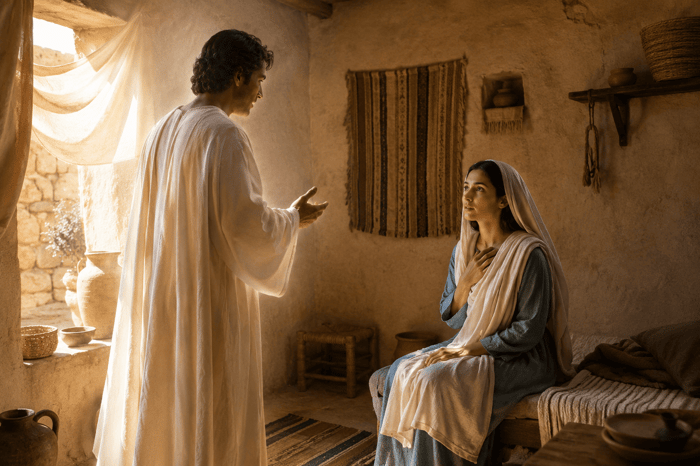
To understand Luke 1:35 meaning, we first need to look at Gabriel's announcement. The angel told Mary that she would conceive and give birth to Jesus.
"Behold, you will conceive in your womb and give birth to a son, and will call his name 'Jesus.' He will be great and will be called the Son of the Most High. The Lord God will give him the throne of his father David, and he will reign over the house of Jacob forever. There will be no end to his Kingdom."
Luke 1:31-33 (WEB)
Mary understood what pregnancy normally required. Since she was a virgin, she asked how Gabriel's promise could happen.
"Mary said to the angel, 'How can this be, seeing I am a virgin?'"
Luke 1:34 (WEB)
Gabriel answered by pointing to God's direct action.
"The angel answered her, 'The Holy Spirit will come on you, and the power of the Most High will overshadow you. Therefore also the holy one who is born from you will be called the Son of God.'"
Luke 1:35 (WEB)
Three statements stand out in Luke 1:35 meaning:
- The Holy Spirit will come upon you.
- The power of the Most High will overshadow Mary.
- The child will be called the Son of God.
Luke brings these truths together in one event. That makes the verse an important part of the biblical foundation for understanding the Trinity.
What Does "The Holy Spirit Will Come Upon You" Mean?
The phrase "Holy Spirit will come upon you" describes God's miraculous work in the conception of Jesus.
Jesus would not be conceived through an earthly father. His conception would take place through the supernatural work of the Holy Spirit.
This does not mean the Holy Spirit became Jesus' biological father in the normal human sense. Gabriel is describing divine action, not human reproduction.
Scripture often shows the Spirit of God acting to accomplish God's purposes. The Spirit is present even in the opening chapter of Genesis.
"The earth was formless and empty. Darkness was on the surface of the deep and God's Spirit was hovering over the surface of the waters."
Genesis 1:2 (WEB)
At creation, the Spirit is active as God brings forth the created world. In Luke 1:35 meaning, the Spirit is again active in a unique work of God: the miraculous conception of the Messiah.
The words also show that the Holy Spirit is not simply another name for Jesus. The Spirit comes upon Mary, while the Son is the child who will be born.
What Is the "Power of the Most High"?
Gabriel also says that the power of the Most High will overshadow Mary.
"Most High" is a title for God. Just a few verses earlier, Gabriel says Jesus will be called the "Son of the Most High."
The word "overshadow" points to God's powerful presence. It does not describe any type of physical relationship between God and Mary.
The wording recalls places in Scripture where God's presence comes upon a person or place. When the tabernacle was completed, for example, God's glory filled it.
"Then the cloud covered the Tent of Meeting, and Yahweh's glory filled the tabernacle."
Exodus 40:34 (WEB)
Luke does not say these events are identical. Still, the language helps us understand Luke 1:35 meaning. The conception of Jesus would happen because God Himself acted in power.
Mary could not make Gabriel's promise happen. Joseph could not make it happen. The miracle depended upon God.
Why Is Jesus Called the Son of God?
Gabriel says that the child "will be called the Son of God." This is central to understanding Luke 1:35 meaning.
Jesus is not presented as an ordinary child who later receives a special title. From the announcement of His birth, He is identified as God's Son.
Gabriel had already said:
"He will be great and will be called the Son of the Most High."
Luke 1:32 (WEB)
Jesus' identity as the Son of God continues throughout the New Testament.
When Jesus later asked His disciples who they believed He was, Peter answered:
"Simon Peter answered, 'You are the Christ, the Son of the living God.'"
Matthew 16:16 (WEB)
The title Son of God points to Jesus' unique relationship with the Father. It also helps reveal His divine identity.
Luke wants readers to understand from the beginning that the child born to Mary is no ordinary child.
Luke 1:35 Meaning and the Trinity
The word "Trinity" does not appear in Luke 1:35. Yet Luke 1:35 meaning contributes important evidence to the biblical doctrine of the Trinity.
The doctrine of the Trinity comes from bringing together everything Scripture teaches about God. The Bible teaches that there is one God while also revealing the Father, the Son, and the Holy Spirit as distinct.
All three can be seen in Luke 1:35.
| Person | Description in Luke 1:35 | What Happens |
|---|---|---|
| Holy Spirit | "The Holy Spirit" | Comes upon Mary |
| Father | "The Most High" | His power overshadows Mary |
| Son | "The Son of God" | Is born as the holy child |
Luke does not confuse the three.
The Holy Spirit is not the Son who is born. The Most High is not the child in Mary's womb. The Son is distinct from both the Father and the Spirit.
At the same time, all three are connected to one divine work.
This is one reason Luke 1:35 meaning is important when studying the biblical foundation for the Trinity.
The Trinity in Luke Appears Again at Jesus' Baptism
Luke's Gospel does not mention the Father, Son, and Holy Spirit together only once. The pattern appears again when Jesus is baptized.
"Now when all the people were baptized, Jesus also had been baptized and was praying. The sky was opened, and the Holy Spirit descended in a bodily form like a dove on him; and a voice came out of the sky, saying, 'You are my beloved Son. In you I am well pleased.'"
Luke 3:21-22 (WEB)
The Son is being baptized. The Holy Spirit descends upon Him. The Father's voice comes from heaven.
This helps us understand the Trinity in Luke. Luke presents the three as distinct, yet each participates in God's work.
At Jesus' conception, the Holy Spirit comes upon Mary, the power of the Most High overshadows her, and the Son of God is born.
At Jesus' baptism, the Son stands in the water, the Spirit descends, and the Father speaks.
These events form part of the biblical evidence from which Christians understand God as Father, Son, and Holy Spirit.
Why the Virgin Birth Matters
Luke 1:35 meaning also helps explain why the virgin birth matters.
The virgin birth shows that Jesus' entrance into the world was God's work from the beginning. His conception was miraculous, His identity was unique, and His mission came from God.
Matthew describes the same miracle from another perspective.
"Behold, the virgin shall be with child, and shall give birth to a son. They shall call his name Immanuel, which is, being interpreted, 'God with us.'"
Matthew 1:23 (WEB)
Jesus entered real human life through Mary. He was truly born as a human child. He grew, became hungry, experienced sorrow, suffered, and died.
Yet His conception was unlike that of every other human being.
The birth of Jesus therefore points to both His true humanity and His unique divine identity.
Why Does Gabriel Call Jesus "The Holy One"?
Gabriel says that "the holy one" who would be born would be called the Son of God.
That description matters.
Jesus is not introduced as a sinful person who later becomes righteous. From His birth, He is described as holy.
The rest of Scripture confirms that Jesus lived without sin.
"For we don't have a high priest who can't be touched with the feeling of our infirmities, but one who has been in all points tempted like we are, yet without sin."
Hebrews 4:15 (WEB)
Jesus shared in true human life, yet He did not share in humanity's sin.
This becomes essential to the Gospel. We need more than a teacher who tells us how to become better people. We need a Savior who is Himself without sin.
Luke 1:35 Points Forward to the Gospel
The importance of Luke 1:35 meaning reaches beyond the question of how Jesus was conceived. The verse points toward why the Son of God entered the world.
Jesus came to save sinners.
Later in Luke's Gospel, Jesus describes His mission:
"For the Son of Man came to seek and to save that which was lost."
Luke 19:10 (WEB)
Humanity's deepest problem is sin. We have rebelled against God and cannot repair our broken relationship with Him through our own goodness.
The child announced in Luke 1 would become the Savior sinners need.
Jesus would live without sin, give His life for sinners, and rise from the dead.
"Christ died for our sins according to the Scriptures, that he was buried, that he was raised on the third day according to the Scriptures."
1 Corinthians 15:3-4 (WEB)
The Gospel depends upon the identity of Jesus. If Jesus were only an ordinary human being, He could not be the Savior Scripture reveals.
Luke 1:35 meaning prepares us to understand that Jesus is the holy Son of God. His coming was according to the Father's purpose and accomplished through the work of the Holy Spirit.
Faith in Christ is therefore not faith in a good teacher alone. It is trust in the Son God sent to save sinners.
Did Jesus Begin to Exist at His Birth?
Luke focuses on Jesus entering human life through Mary. That does not mean the Son of God first began to exist when Mary became pregnant.
Other passages explain that the Son existed before His human birth.
John calls Jesus "the Word" and says:
"In the beginning was the Word, and the Word was with God, and the Word was God."
John 1:1 (WEB)
John then explains what happened when Jesus entered the world.
"The Word became flesh and lived among us. We saw his glory, glory as of the one and only Son of the Father, full of grace and truth."
John 1:14 (WEB)
Jesus' conception was the beginning of His human life in Mary's womb. It was not the beginning of the eternal Son's existence.
This distinction keeps Luke 1:35 meaning from being misunderstood. The eternal Son did not come into existence. He came into the world.
What Luke 1:35 Does Not Mean
Because Luke 1:35 describes a unique miracle, several misunderstandings should be avoided.
- It does not mean the Holy Spirit is the Father.
- It does not mean Jesus began to exist when He was conceived.
- It does not describe a physical union between God and Mary.
- It does not teach that there are three gods.
- It does not present Jesus as merely a specially chosen human child.
- It does not give a complete definition of the Trinity by itself.
Instead, Luke 1:35 meaning shows three distinct persons involved in one divine work: the Holy Spirit, the Most High, and the Son of God.
This fits the larger testimony of Scripture about the Father, Son, and Holy Spirit.
What Luke 1:35 Teaches Us About God's Work
Luke 1:35 shows remarkable unity in God's work.
The Father purposes and provides. The Holy Spirit acts. The Son enters the world.
There is no competition between them. Each is distinct, yet God's saving work is perfectly united.
This pattern continues throughout the New Testament. The Father sends the Son. The Son accomplishes redemption. The Holy Spirit works in God's people and applies the benefits of Christ's work to them.
Luke 1:35 does not explain every part of those truths. Its focus is the miraculous conception of Jesus.
Yet the pattern is already visible at the beginning of Jesus' earthly life.
Why Luke 1:35 Matters for Understanding the Trinity
Luke 1:35 meaning matters because the verse places the Father, Son, and Holy Spirit together at one of the most important moments in God's plan of redemption.
The Holy Spirit comes upon Mary. The power of the Most High overshadows her. The holy child is called the Son of God.
Luke does not give readers an abstract theological formula. He shows the Father, Son, and Holy Spirit through the unfolding events surrounding Jesus.
That is an important distinction. Christian belief in the Trinity is not built upon one isolated word or one later theological idea. It comes from taking seriously everything Scripture says about the one God and about the Father, Son, and Holy Spirit.
Luke 1:35 contributes a key piece of that biblical testimony.
The verse therefore answers much more than Mary's question about how the birth of Jesus could happen. It reveals God's miraculous power, identifies Jesus as the holy Son of God, and shows the Father, Son, and Holy Spirit working together as God's plan of salvation moves forward.
FAQs
What does Luke 1:35 mean?
Luke 1:35 explains how Jesus would be conceived and identifies the divine persons involved in this miraculous event. The Holy Spirit would come upon Mary, the power of the Most High would overshadow her, and the holy child would be called the Son of God. The verse does not give a complete definition of the Trinity, but it shows the Father, Son, and Holy Spirit as distinct while acting together in God's work.
"The angel answered her, 'The Holy Spirit will come on you, and the power of the Most High will overshadow you. Therefore also the holy one who is born from you will be called the Son of God.'"
Luke 1:35 (WEB)
What does "the Holy Spirit will come upon you" mean in Luke 1:35?
The phrase describes the Holy Spirit's supernatural work in the conception of Jesus. Jesus would not be conceived through an earthly father. Gabriel was describing divine action, not a physical relationship between God and Mary. Scripture also shows the Spirit active in God's work at creation.
"The earth was formless and empty. Darkness was on the surface of the deep and God's Spirit was hovering over the surface of the waters."
Genesis 1:2 (WEB)
What does "the power of the Most High will overshadow you" mean?
The phrase points to God's powerful presence and action. "Most High" is a title for God, and "overshadow" describes His divine work in bringing about the miraculous conception of Jesus. Mary could not make Gabriel's promise happen through human effort. The miracle depended upon God.
"Then the cloud covered the Tent of Meeting, and Yahweh's glory filled the tabernacle."
Exodus 40:34 (WEB)
Why is Jesus called the Son of God in Luke 1:35?
Jesus is called the Son of God because He has a unique relationship with the Father and a divine identity. Gabriel does not present Jesus as an ordinary child who later receives a special title. Even before His birth, He is identified as the Son of the Most High.
"He will be great and will be called the Son of the Most High."
Luke 1:32 (WEB)
How does Luke 1:35 point to the Trinity?
Luke 1:35 brings together the Holy Spirit, the Most High, and the Son of God in one divine work. The Holy Spirit comes upon Mary, the Most High acts in power, and the Son is the holy child who will be born. The three are distinct rather than different names for the same person. Luke shows a similar pattern when the Son is baptized, the Spirit descends, and the Father's voice speaks from heaven.
"Now when all the people were baptized, Jesus also had been baptized and was praying. The sky was opened, and the Holy Spirit descended in a bodily form like a dove on him; and a voice came out of the sky, saying, 'You are my beloved Son. In you I am well pleased.'"
Luke 3:21-22 (WEB)
Why does the virgin birth matter in Luke 1:35?
The virgin birth shows that Jesus' entrance into the world was God's miraculous work. Jesus was truly born into human life through Mary, yet His conception was unlike that of every other person. His birth points to His true humanity and His unique divine identity.
"Behold, the virgin shall be with child, and shall give birth to a son. They shall call his name Immanuel, which is, being interpreted, 'God with us.'"
Matthew 1:23 (WEB)
Did Jesus begin to exist when He was conceived in Mary?
No. Luke 1:35 describes the beginning of Jesus' human life in Mary's womb, not the beginning of the Son's existence. Scripture teaches that the Son existed before His human birth. The eternal Word became flesh and entered human history.
"In the beginning was the Word, and the Word was with God, and the Word was God."
John 1:1 (WEB)
How does Luke 1:35 meaning point to the Gospel and salvation?
Luke 1:35 meaning points to the Gospel by revealing the identity of the Savior before His birth. Humanity's deepest problem is sin, and we cannot restore our relationship with God through our own goodness. Jesus entered the world as the holy Son of God to seek and save the lost. He would live without sin, die for sinners, and rise again. Understanding who Jesus is therefore points us toward trusting Him as the Savior God sent.
"For the Son of Man came to seek and to save that which was lost."
Luke 19:10 (WEB)