Table of Contents
- What Does John 20:28 Say?
- John 20:28 Meaning in Its Biblical Context
- Did Thomas Really Call Jesus God?
- "My Lord and My God" and the Deity of Christ
- Why Didn't Jesus Correct Thomas?
- Does John 20:28 Mean Jesus Is the Father?
- Why Is Thomas's Confession So Important?
- John 20:28 and the Purpose of John's Gospel
- What Does "My Lord" Mean?
- What Does "My God" Mean?
- From Doubt to Saving Faith
- What John 20:28 Teaches Us About Jesus
- FAQs
The John 20:28 meaning becomes clear when we look at Thomas's response after seeing the risen Jesus. Thomas had doubted the testimony of the other disciples. But when Jesus stood before him alive, Thomas answered with one of the strongest confessions about Christ found in the Gospel of John: "My Lord and my God!"
This was more than Thomas admitting that Jesus had risen from the dead. His words identified Jesus as his Lord and his God.
John does not correct Thomas for saying this. Jesus accepts his confession and speaks about the faith of those who will believe without seeing Him physically. This moment helps us understand the deity of Christ and gives important biblical support for understanding the relationship between the Father and the Son.
What Does John 20:28 Say?
Thomas was one of Jesus's twelve disciples. He was not present when Jesus first appeared to the disciples after His resurrection.
When the others told Thomas that they had seen the Lord, he refused to believe without physical evidence.
The other disciples therefore said to him, "We have seen the Lord!" But he said to them, "Unless I see in his hands the print of the nails, and put my hand into the print of the nails, and put my hand into his side, I will not believe."
John 20:25 (WEB)
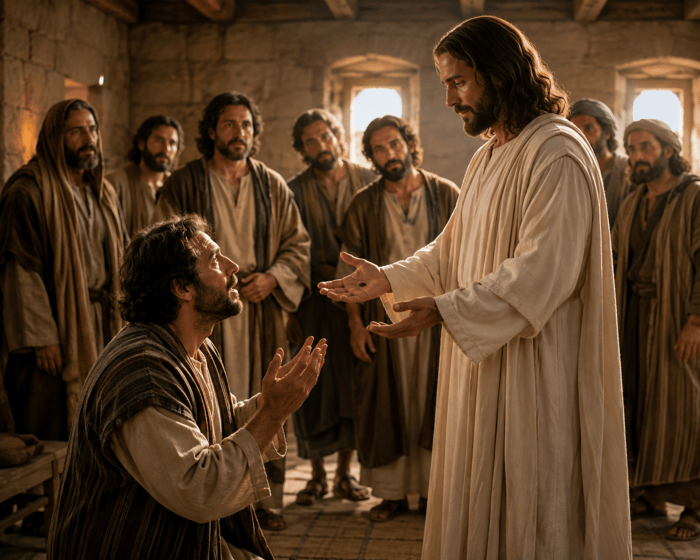
Eight days later, Jesus appeared again while Thomas was present.
Jesus knew exactly what Thomas had said. He invited Thomas to examine the evidence for himself.
Then he said to Thomas, "Reach here your finger, and see my hands. Reach here your hand, and put it into my side. Don't be unbelieving, but believing."
John 20:27 (WEB)
Thomas then gave his famous confession.
Thomas answered him, "My Lord and my God!"
John 20:28 (WEB)
The John 20:28 meaning becomes clearer when we see that these few words carry great theological weight.
Thomas did not merely say that he now believed Jesus was alive. He called Jesus both Lord and God.
John 20:28 Meaning in Its Biblical Context
The John 20:28 meaning is tied to everything Thomas had experienced during Jesus's ministry.
Thomas had traveled with Jesus. He had heard His teaching, watched His miracles, and seen the authority with which He spoke. He also saw Jesus arrested and knew that He had been crucified.
For Thomas, the crucifixion appeared to be the end.
Then the risen Christ stood in front of him.
Thomas could no longer dismiss what the other disciples had told him. The Jesus who had been crucified was alive.
But Thomas's confession goes beyond saying, "Jesus really rose from the dead." His response is personal and theological:
- "My Lord" recognizes Jesus's authority over him.
- "My God" recognizes who Jesus truly is.
- "My" shows personal faith rather than mere intellectual agreement.
Thomas's doubt gave way to worshipful faith.
That makes his confession one of the high points of John's Gospel.
Did Thomas Really Call Jesus God?
Some people have suggested that Thomas may have been expressing surprise rather than speaking directly to Jesus.
The text does not support that interpretation.
John says that Thomas "answered him." His words were directed toward Jesus.
Thomas answered him, "My Lord and my God!"
John 20:28 (WEB)
Thomas was not making a random religious exclamation. He was responding directly to the risen Christ.
This is important because Scripture consistently teaches that worship belongs to God. If Thomas wrongly called Jesus God, we would expect Jesus to correct him.
Jesus did not.
Instead, He responded to Thomas's faith.
Jesus said to him, "Because you have seen me, you have believed. Blessed are those who have not seen, and have believed."
John 20:29 (WEB)
Jesus treated the Thomas confession as belief, not blasphemy.
That response is a major part of the John 20:28 meaning. Thomas confessed Jesus as Lord and God, and Jesus accepted his confession.
"My Lord and My God" and the Deity of Christ
Thomas's words fit the message John has been building throughout his Gospel.
John begins by explaining who Jesus was before His birth in Bethlehem.
In the beginning was the Word, and the Word was with God, and the Word was God.
John 1:1 (WEB)
This verse teaches two truths at the same time.
The Word was with God, showing a distinction between the Word and God the Father. Yet the Word was God, showing the divine nature of the Word.
John then tells us that this eternal Word became human.
The Word became flesh, and lived among us. We saw his glory, glory as of the one and only Son of the Father, full of grace and truth.
John 1:14 (WEB)
John begins his Gospel by saying that the Word was God. Near the end of his Gospel, Thomas looks at Jesus and says, "My Lord and my God!"
These statements work together.
John is showing his readers who Jesus is.
| Passage | What It Reveals About Jesus |
|---|---|
| John 1:1 | The Word existed from the beginning and was God |
| John 1:14 | The divine Word became flesh |
| John 10:30 | Jesus declared His unity with the Father |
| John 20:28 | Thomas confessed Jesus as Lord and God |
| John 20:29 | Jesus accepted Thomas's confession as faith |
Thomas's confession is therefore not an isolated statement. The John 20:28 meaning fits within John's larger testimony concerning the deity of Christ.
Why Didn't Jesus Correct Thomas?
The way Jesus responds to Thomas matters.
Throughout Scripture, God's servants refuse worship that belongs to God. Yet Jesus does not tell Thomas, "Do not call me God."
Instead, He says that Thomas has believed.
That tells us that Thomas's confession was appropriate.
Jesus had already taught that the Son deserves honor alongside the Father.
that all may honor the Son, even as they honor the Father. He who doesn't honor the Son doesn't honor the Father who sent him.
John 5:23 (WEB)
Jesus did not teach that He was the Father. The Father and the Son are personally distinct.
Yet Jesus taught that the Son should receive the honor given to the Father.
This helps explain why Thomas's words were not rejected.
Calling Jesus "my Lord and my God" agreed with what Jesus had revealed about Himself.
Does John 20:28 Mean Jesus Is the Father?
No.
The John 20:28 meaning does not teach that Jesus and the Father are the same Person.
Jesus is God, but Jesus is not God the Father.
Earlier in John's Gospel, Jesus clearly distinguished Himself from the Father while also speaking of His unique unity with Him.
I and the Father are one.
John 10:30 (WEB)
Notice the wording.
Jesus says "I and the Father," showing distinction. Then He says they "are one," showing unity.
This is one reason the John 20:28 meaning is important when studying the biblical foundation for the Trinity.
The Bible does not teach that there are three gods. Nor does it teach that the Father, Son, and Holy Spirit are simply three names for one Person.
Instead, Scripture reveals one God while distinguishing the Father, Son, and Holy Spirit.
Thomas's confession contributes an important part of that biblical picture because he openly identifies Jesus as God.
Why Is Thomas's Confession So Important?
Thomas is sometimes remembered only as "Doubting Thomas." But that description can cause us to miss what happened next.
Thomas moved from doubt to one of the clearest confessions of faith in the New Testament.
His story shows several important truths.
- Christianity rests on the reality of the risen Jesus.
- Biblical faith is centered on who Jesus truly is.
- Jesus is more than a teacher, prophet, or moral example.
- Jesus is Lord.
- Jesus is God.
- Faith in Christ requires a personal response.
Thomas did not say, "You are a Lord and a God."
He said, "My Lord and my God."
His confession became personal.
That distinction matters for every reader of John's Gospel.
John 20:28 and the Purpose of John's Gospel
The placement of Thomas's confession is also important.
Shortly after describing this event, John explains why he wrote his Gospel.
but these are written, that you may believe that Jesus is the Christ, the Son of God, and that believing you may have life in his name.
John 20:31 (WEB)
Thomas saw the risen Christ and believed.
John then turns toward his readers. We have not stood in the room with Thomas. We have not placed our fingers into Jesus's wounds.
But we have the testimony recorded in Scripture.
John wrote so that people who did not physically see the resurrection could still believe in Jesus and have life through His name.
That connects directly with what Jesus told Thomas.
Jesus said to him, "Because you have seen me, you have believed. Blessed are those who have not seen, and have believed."
John 20:29 (WEB)
The Gospel invites us to reach the same conclusion Thomas reached.
Jesus Christ is Lord.
Jesus Christ is God.
And we are called to believe in Him.
What Does "My Lord" Mean?
Calling Jesus Lord means more than speaking respectfully.
For Thomas, Jesus was his Master and rightful ruler.
The resurrection showed that death had not defeated Christ. Jesus had accomplished what He told His disciples would happen.
Thomas's confession therefore involved submission.
Jesus was not simply someone Thomas admired. Jesus had authority over his life.
The same truth applies to Christian faith today.
Believing in Jesus means more than agreeing that He existed. Biblical faith recognizes who He is and responds to Him as Lord.
What Does "My God" Mean?
The second half of Thomas's confession is even stronger.
He calls Jesus "my God."
This fits with other New Testament teaching about Christ.
For in him all the fullness of the Godhead dwells bodily,
Colossians 2:9 (WEB)
Jesus did not merely reflect certain qualities of God. The fullness of deity dwells in Him.
At the same time, Jesus became truly human. The eternal Son entered His creation, lived among us, died for sinners, and rose again.
That is why the John 20:28 meaning is so important. Thomas stood before the risen Jesus and confessed the truth that John's Gospel had been revealing from its opening chapter.
The Word who was God became flesh.
The crucified Jesus rose from the dead.
And Thomas called Him, "My Lord and my God."
From Doubt to Saving Faith
Thomas's story is also about the movement from unbelief to faith.
He first demanded proof. Jesus graciously confronted his unbelief and called him to believe.
Thomas responded with faith.
John's purpose in recording the event was not merely to preserve an interesting moment from Thomas's life. John wanted his readers to believe in Jesus.
That belief has eternal consequences.
Sin separates people from God, and no person can restore that relationship through good works or religious effort. Jesus came to save sinners. He died and rose again so that those who trust in Him can receive forgiveness and eternal life.
Thomas encountered the risen Savior and responded personally.
"My Lord and my God."
That same question stands before every person who reads John's account: Who is Jesus to you?
The Gospel does not leave Him as merely a wise teacher.
John presents Him as the eternal Word who became flesh, the Son sent by the Father, the crucified Savior, the risen Lord, and the One whom Thomas rightly called God.
What John 20:28 Teaches Us About Jesus
The John 20:28 meaning can be summarized in several simple truths.
First, Thomas's words were spoken directly to Jesus. He truly called Jesus his Lord and his God.
Second, Jesus accepted that confession rather than correcting it. He described Thomas's response as belief.
Third, Thomas's words fit the message of John's Gospel. John begins by saying that the Word was God and later records Thomas calling the risen Jesus God.
Fourth, the passage does not teach that Jesus is God the Father. Scripture distinguishes the Father from the Son while revealing their divine unity.
Finally, Thomas's confession calls for a personal response. Knowing facts about Jesus is not the same as trusting Him.
Thomas moved from unbelief to faith.
His final response was not simply, "Now I believe the resurrection happened."
It was personal:
"My Lord and my God."
That is the heart of John 20:28 Meaning. Thomas recognized the risen Jesus for who He truly is and placed his faith in Him. His confession remains one of Scripture's clearest testimonies that Jesus Christ is both Lord and God.
FAQs
What does John 20:28 mean?
John 20:28 records Thomas's response to the risen Jesus. His words, "My Lord and my God," confess that Jesus is both his Lord and truly God.
Thomas answered him, "My Lord and my God!"
John 20:28 (WEB)
Did Thomas really call Jesus God?
Yes. Thomas spoke directly to Jesus, and Jesus accepted his confession as an expression of genuine faith rather than correcting him.
Jesus said to him, "Because you have seen me, you have believed. Blessed are those who have not seen, and have believed."
John 20:29 (WEB)
How does John 20:28 support the deity of Christ?
Thomas's confession agrees with John's Gospel, which begins by declaring that the Word was God and later identifies Jesus as that eternal Word made flesh.
In the beginning was the Word, and the Word was with God, and the Word was God.
John 1:1 (WEB)
Does John 20:28 teach that Jesus is the Father?
No. The passage identifies Jesus as God while Scripture continues to distinguish the Son from the Father. They are distinct Persons who share the one divine nature.
I and the Father are one.
John 10:30 (WEB)
Why is Thomas's confession important for Christians today?
Thomas moved from doubt to personal faith. His confession reminds believers that Jesus is not only a teacher but the risen Lord worthy of trust and worship.
that all may honor the Son, even as they honor the Father. He who doesn't honor the Son doesn't honor the Father who sent him.
John 5:23 (WEB)
How does John 20:28 Meaning point to the Gospel?
The John 20:28 Meaning reveals that the crucified and risen Jesus is both Lord and God. Because our sin separates us from God, we need the Savior Thomas confessed. Everyone who believes in the risen Christ receives eternal life through His name.
but these are written, that you may believe that Jesus is the Christ, the Son of God, and that believing you may have life in his name.
John 20:31 (WEB)