Table of Contents
- What Does Jehovah Nissi Mean?
- Exodus 17 and the Battle With Amalek
- Moses' Hands and Israel's Victory
- Jehovah Nissi Meaning and God's Banner
- The Lord Is My Banner, Not My Own Strength
- Jehovah Nissi and Spiritual Battles
- How Jehovah Nissi Points to Jesus Christ
- Jehovah Nissi Does Not Mean Life Is Battle-Free
- What Jehovah Nissi Reveals About God
- How Should Christians Respond to Jehovah Nissi?
- Jehovah Nissi and the Hope of Final Victory
- FAQs
The Jehovah Nissi meaning is "The Lord Is My Banner." This name of God comes from Exodus 17, after the Lord gave Israel victory over Amalek in the wilderness.
Jehovah Nissi teaches us that God's people do not stand under their own strength. They stand under the Lord's rule, protection, and victory.
This name does not mean believers never face battles. It means the Lord is the banner over His people when the battle is real.
What Does Jehovah Nissi Mean?
The Jehovah Nissi meaning comes from the name Moses gave to an altar after Israel defeated Amalek. "Nissi" is connected to the idea of a banner, signal, or standard lifted up.
In ancient battle, a banner helped people know where they belonged. It marked identity, leadership, and hope. Soldiers could look to the banner and remember who they fought under.
Moses named the altar Jehovah Nissi because Israel's victory came from the Lord.
Moses built an altar, and called its name "Yahweh our Banner."
Exodus 17:15 (WEB)
This name shows that God Himself is the banner over His people. He is not only the one who helps from a distance. He is the one His people gather under, trust in, and follow.
Exodus 17 and the Battle With Amalek
To understand the Jehovah Nissi meaning, we need to look at Exodus 17. Israel had already been rescued from Egypt. God had parted the Red Sea, provided water, and fed them with manna.
Yet the wilderness was not easy. God's people still faced danger.
Amalek came and fought against Israel at Rephidim.
Then Amalek came and fought with Israel in Rephidim.
Exodus 17:8 (WEB)
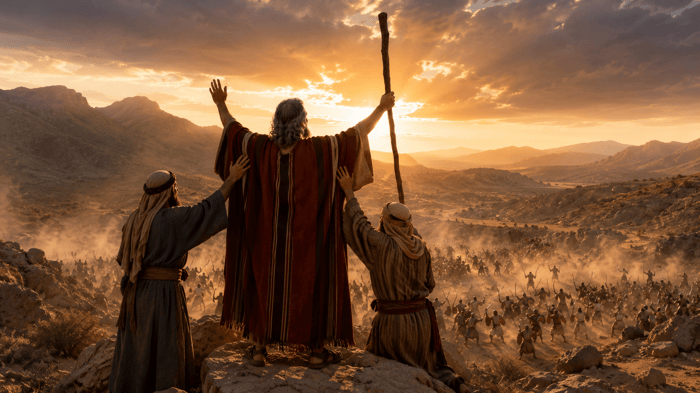
Moses told Joshua to choose men and go fight. Moses would stand on top of the hill with the staff of God in his hand.
Moses said to Joshua, "Choose men for us, and go out, fight with Amalek. Tomorrow I will stand on the top of the hill with God's rod in my hand."
Exodus 17:9 (WEB)
This battle had two scenes. Joshua fought in the valley. Moses prayed on the hill. Both mattered, but the victory belonged to God.
Moses' Hands and Israel's Victory
As the battle continued, something unusual happened. When Moses held up his hand, Israel prevailed. When his hand lowered, Amalek prevailed.
When Moses held up his hand, Israel prevailed. When he let down his hand, Amalek prevailed.
Exodus 17:11 (WEB)
This was not magic. Moses' raised hands showed dependence on God. Israel needed more than weapons, courage, and strategy. They needed the Lord.
Moses grew tired, so Aaron and Hur helped him. They gave him a stone to sit on and held up his hands until sunset.
But Moses' hands were heavy; so they took a stone, and put it under him, and he sat on it. Aaron and Hur held up his hands, one on one side, and the other on the other side. His hands were steady until sunset.
Exodus 17:12 (WEB)
Then Joshua defeated Amalek.
Joshua defeated Amalek and his people with the edge of the sword.
Exodus 17:13 (WEB)
The story teaches that victory in God does not come from human strength alone. God's people must act, but they must also depend on the Lord.
Jehovah Nissi Meaning and God's Banner
The Jehovah Nissi meaning shows that the Lord is the banner lifted over His people. A banner is not hidden. It is raised where people can see it.
God's banner declares who His people belong to. Israel belonged to Yahweh, not Egypt, not fear, and not the enemy.
This name also reminds us that the Lord is not ashamed to identify Himself with His people. He leads them, guards them, and fights for them according to His will.
| Picture in Exodus 17 | What It Teaches |
|---|---|
| Amalek attacked Israel | God's people face real opposition |
| Joshua fought in the valley | Faithful action matters |
| Moses stood on the hill | Dependence on God matters |
| Aaron and Hur helped Moses | God's people need one another |
| Israel prevailed when Moses' hands were raised | Victory belongs to the Lord |
| Moses built an altar | God's victory should be remembered |
Jehovah Nissi is a name of hope for people who feel weak in the battle. The Lord is not only present after the fight. He is present in the middle of it.
The Lord Is My Banner, Not My Own Strength
One of the clearest lessons of Exodus 17 is that Israel could not boast in itself.
Joshua fought. Moses prayed. Aaron and Hur helped. Yet Moses did not name the altar after Joshua's courage, his own leadership, or Israel's skill.
He named it "Yahweh our Banner."
The Jehovah Nissi meaning reminds us that faith gives glory to God. We may use wisdom, effort, planning, and courage, but our confidence must rest in the Lord.
Some trust in chariots and some in horses,
but we trust in the name of the Lord our God.
Psalm 20:7 (ESV)
This verse gives the same truth in another way. God's people must not place final trust in human power.
Chariots and horses were signs of military strength. Today, people may trust money, status, control, talent, or plans. But the believer's banner is the Lord.
Jehovah Nissi and Spiritual Battles
The battle in Exodus 17 was physical, but it also teaches a spiritual lesson. God's people live in a world filled with temptation, fear, weariness, and opposition.
Christians are not called to fight people as enemies. The New Testament points us to a deeper battle against sin, lies, and spiritual darkness.
For our wrestling is not against flesh and blood, but against the principalities, against the powers, against the world's rulers of the darkness of this age, and against the spiritual forces of wickedness in the heavenly places.
Ephesians 6:12 (WEB)
This is why the Jehovah Nissi meaning still matters. Believers need the Lord's strength for battles they cannot win alone.
We need God's truth when lies feel strong. We need God's grace when sin feels near. We need God's peace when fear rises. We need God's people when our hands grow tired. The Jehovah Nissi meaning reminds believers that victory comes from standing under the Lord's banner, not from personal strength.
How Jehovah Nissi Points to Jesus Christ
Jehovah Nissi points us to Jesus Christ, who gives His people the greatest victory.
Israel needed victory over Amalek. We need victory over sin, death, and judgment. No human strength can win that battle.
Jesus came to save sinners by His death and resurrection. At the cross, He did not look like a worldly conqueror. Yet through His sacrifice, He defeated the powers of sin and death.
Having stripped the principalities and the powers, he made a show of them openly, triumphing over them in it.
Colossians 2:15 (WEB)
The cross is where Christ won the victory His people could never win. He bore sin. He satisfied justice. He rose from the dead.
Because of Jesus, believers do not fight for salvation. They stand under the victory He has already won.
But thanks be to God, who gives us the victory through our Lord Jesus Christ.
1 Corinthians 15:57 (WEB)
This is the Gospel hope behind Jehovah Nissi. The Lord is our banner because Christ is our victorious Savior.
Jehovah Nissi Does Not Mean Life Is Battle-Free
Some people may think victory in God means life will become easy. Exodus 17 teaches the opposite.
Israel had been delivered from Egypt, but they still faced Amalek. God had saved them, but they still needed to trust Him in battle.
The Jehovah Nissi meaning does not promise that believers will avoid hardship. It teaches that God is faithful when hardship comes.
Jesus told His disciples they would have trouble in the world, but He also gave them courage.
I have told you these things, that in me you may have peace. In the world you have oppression; but cheer up! I have overcome the world.
John 16:33 (WEB)
Christian victory is not pretending the battle is small. It is trusting that Christ is greater.
What Jehovah Nissi Reveals About God
Jehovah Nissi reveals God's character in a clear and comforting way.
He is the God who leads. He does not leave His people without direction.
He is the God who protects. He guards His people according to His purpose.
He is the God who gives victory. He does what human strength cannot do.
He is the God who receives glory. His people remember and worship Him for what He has done.
The Lord is my strength and my shield;
in him my heart trusts, and I am helped;
my heart exults,
and with my song I give thanks to him.
Psalm 28:7 (ESV)
The Jehovah Nissi meaning invites believers to lift their eyes from the size of the battle to the greatness of the Lord.
How Should Christians Respond to Jehovah Nissi?
The right response to Jehovah Nissi is faith-filled dependence. We should fight sin, resist fear, obey God, and serve others, but never as if the victory depends on us alone.
Here are simple ways to respond:
- Pray before and during the battle.
- Trust God's power more than your own strength.
- Remember past victories God has given.
- Stand with other believers when they are weak.
- Use God's Word when temptation comes.
- Give God the glory when help comes.
- Rest in Christ's finished victory.
Finally, be strong in the Lord, and in the strength of his might.
Ephesians 6:10 (WEB)
This verse keeps our confidence in the right place. We are called to be strong, but not in ourselves. We are called to be strong in the Lord.
Jehovah Nissi and the Hope of Final Victory
The battles believers face now will not last forever. The Lord who is our banner will bring His people into final victory.
Sin will not win. Death will not win. Satan will not win. Christ has already risen, and His kingdom will not fail.
They will war against the Lamb, and the Lamb will overcome them, for he is Lord of lords and King of kings. Those who are with him are called, chosen, and faithful.
Revelation 17:14 (WEB)
This gives hope to weary believers. The outcome does not depend on the strength of God's people. It rests on the power and promise of Christ.
Jehovah Nissi reminds us that we do not stand under fear, shame, or defeat. We stand under the Lord.
The Lord is our banner. He leads His people. He sustains them in battle. He gives victory through Jesus Christ.
FAQs
What is the Jehovah Nissi meaning?
The Jehovah Nissi meaning is "The Lord Is My Banner." Moses gave God this name after Israel defeated Amalek because the victory came from the Lord, not from Israel's own strength. The name reminds believers that God leads, protects, and gives victory to His people.
"Moses built an altar, and called its name 'Yahweh our Banner.'"
Exodus 17:15 (WEB)
Where does Jehovah Nissi appear in the Bible?
Jehovah Nissi appears in Exodus 17 after the battle between Israel and Amalek. While Joshua fought in the valley, Moses stood on the hill with the staff of God raised, showing Israel's dependence on the Lord.
"When Moses held up his hand, Israel prevailed. When he let down his hand, Amalek prevailed."
Exodus 17:11 (WEB)
What does "the Lord is my banner" mean?
In ancient times, a banner identified an army and united its soldiers under one leader. Calling God "the Lord is my banner" means believers belong to Him, trust His leadership, and look to Him for victory rather than relying on themselves.
"Some trust in chariots, and some in horses, but we trust in the name of Yahweh our God."
Psalm 20:7 (WEB)
How does Jehovah Nissi point to Jesus Christ and the Gospel?
The Jehovah Nissi meaning ultimately points to Jesus Christ, who won the greatest victory through His death and resurrection. Humanity's greatest enemy is not another nation but sin, death, and God's righteous judgment. We cannot overcome these enemies ourselves. Through the cross, Jesus defeated sin and death, and everyone who repents and trusts in Him shares in His victory and receives eternal life. Jehovah Nissi reminds us that salvation is found under Christ's banner, not through our own efforts.
"But thanks be to God, who gives us the victory through our Lord Jesus Christ."
1 Corinthians 15:57 (WEB)
"Having stripped the principalities and the powers, he made a show of them openly, triumphing over them in it."
Colossians 2:15 (WEB)
Does Jehovah Nissi mean Christians will never face battles?
No. Exodus 17 teaches that God's people still face battles after being redeemed. Jehovah Nissi does not promise an easy life. Instead, it assures believers that God is with them and gives strength to endure and overcome according to His will.
"I have told you these things, that in me you may have peace. In the world you have oppression; but cheer up! I have overcome the world."
John 16:33 (WEB)
How should Christians live under the Lord's banner?
Believers should trust God's strength instead of their own, pray faithfully, obey His Word, encourage one another, and remember that every victory belongs to Him. Living under God's banner means following Christ with humility and confidence.
"Finally, be strong in the Lord, and in the strength of his might."
Ephesians 6:10 (WEB)
What encouragement does Jehovah Nissi give during difficult times?
Jehovah Nissi reminds believers that the outcome of every battle does not depend on human strength alone. God remains faithful, fights for His people, and will one day bring His final victory when Christ returns.
"They will war against the Lamb, and the Lamb will overcome them, for he is Lord of lords and King of kings. Those who are with him are called, chosen, and faithful."
Revelation 17:14 (WEB)