.svg)
.png)





Trinity Misunderstandings: Common Errors, Questions, and Biblical Answers
Trinity Misunderstandings often arise when one biblical truth is separated from the others. Scripture teaches one God, the full deity of the Father, Son, and Spirit, and their personal distinctions.
This study addresses common questions and explanations that lose part of that picture. Use the reading guide to understand an unfamiliar term, test an illustration, or explore a question about Jesus and the Spirit.
The grace of the Lord Jesus Christ, the love of God, and the fellowship of the Holy Spirit be with you all. Amen.
2 Corinthians 13:14 (WEB)
Recognizing Trinity Misunderstandings
Faithful explanations preserve both God’s oneness and the distinction between the three Persons. The Father, Son, and Spirit each share the full divine nature. Their distinct roles in salvation do not make one less divine than another.
Common errors change one of these truths. Modalism treats the three Persons as roles of one Person. Partialism treats them as parts of God. Tritheism divides them into three gods. Learning the terms helps us recognize what an explanation is claiming and compare it with Scripture.
Choose Where to Begin
- Common Trinity Errors — Get an overview before exploring individual questions.
- Modalism Explained — Understand why the Father, Son, and Spirit are distinct Persons.
- Arianism Explained — Explore why Christians confess the Son as eternal God.
- Trinity and Monotheism — See how belief in three Persons agrees with worship of one God.
- Trinity Analogies — Learn where common comparisons can distort the biblical teaching.
The articles below also examine partialism, tritheism, the Spirit’s personhood, Jesus as God and Son of God, and questions about church history.
Put This Study Into Practice
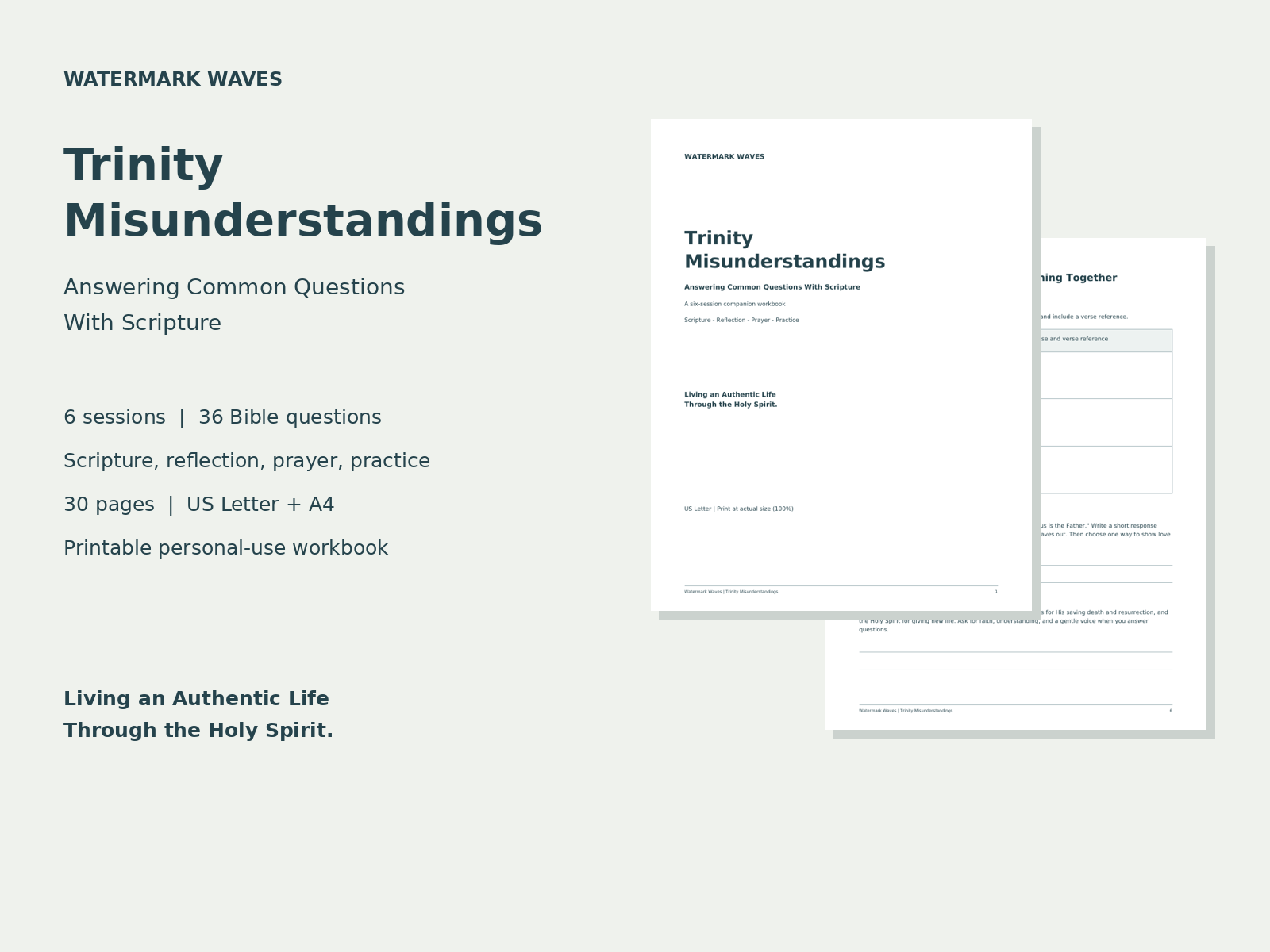
Explore Trinity Misunderstandings, a six-session printable companion workbook. Follow the free Articles with Scripture questions, reflection, prayer, and practical steps. Answer common questions about one God in three Persons and learn to explain your faith with care. Includes a final review, space to put the Bible’s teaching into your own words, next steps for growing in faith, and US Letter and A4 versions.
Digital download · Personal use · 30 pages · Both paper sizes included
Workbook purchases will open soon. You can preview Session 1 and read the free Articles below.
FAQs
Common Trinity misunderstandings include saying that the Father, Son, and Holy Spirit are the same Person, treating them as three separate gods, describing each Person as one-third of God, making the Son less divine than the Father, or treating the Holy Spirit as an impersonal force. Biblical teaching holds God's oneness, the full deity of each Person, and their personal distinction together.
Go and make disciples of all nations, baptizing them in the name of the Father and of the Son and of the Holy Spirit,
Matthew 28:19 (WEB)
No. Christianity teaches that there is one God, not three separate divine beings. The Father, Son, and Holy Spirit are distinct Persons, but this distinction does not divide God into three gods. Tritheism is therefore a misunderstanding of the Trinity rather than biblical Trinitarian belief.
Hear, Israel: Yahweh is our God. Yahweh is one.
Deuteronomy 6:4 (WEB)
No. Jesus is fully divine, but He is not the Father. Scripture presents a real relationship between the Father and the Son. Jesus speaks to the Father, is sent by the Father, and returns to the Father. Treating Father and Son as the same Person removes a distinction Scripture clearly presents.
I came out from the Father, and have come into the world. Again, I leave the world, and go to the Father.
John 16:28 (WEB)
The Holy Spirit is a Person, not merely an impersonal force or divine power. Scripture describes Him as speaking, teaching, guiding, choosing, interceding, and being grieved. Jesus also distinguishes the Holy Spirit from both Himself and the Father.
I will pray to the Father, and he will give you another Counselor, that he may be with you forever.
John 14:16 (WEB)
Trinity analogies can become misleading when a created object is treated as a complete picture of God's nature. Examples such as water, eggs, shamrocks, or one person filling three roles may emphasize one idea while suggesting an error such as Modalism or Partialism. Scripture should define what Christians believe about God rather than an illustration controlling the doctrine.
To whom then will you liken God? Or what likeness will you compare to him?
Isaiah 40:18 (WEB)
No. The Council of Nicaea addressed an existing dispute about whether the Son was created. Biblical teaching about the Father, Son, and Holy Spirit existed long before AD 325. The council used precise language to defend what its bishops believed Scripture already taught about the identity and deity of Jesus Christ.
In the beginning was the Word, and the Word was with God, and the Word was God.
John 1:1 (WEB)
Ask whether the explanation preserves the truths Scripture teaches together. Does it confess one God? Does it preserve the full deity of the Father, Son, and Holy Spirit? Does it preserve their personal distinction? An explanation that turns them into three gods, three parts of God, or one Person changing roles has lost part of the biblical picture.
I and the Father are one.
John 10:30 (WEB)
Trinity misunderstandings matter for the Gospel because they can distort the identity of the God who saves. The Father sends the Son because of His love for sinners, the Son comes to give eternal life to those who believe in Him, and the Holy Spirit works in God's people. Understanding these distinctions helps us see that salvation is the work of the one God revealed as Father, Son, and Holy Spirit and points us to faith in the Son whom the Father gave.
For God so loved the world, that he gave his one and only Son, that whoever believes in him should not perish, but have eternal life.
John 3:16 (WEB)
Test an Explanation Against Scripture
Begin with Common Trinity Errors. When you hear an illustration, ask whether it preserves one God, three distinct Persons, and the full deity of each.
If you discuss the subject with someone, listen to their question and explain one biblical truth with patience. Learning about God should deepen worship and help us speak about Him with care.
Return to the Trinity guide to explore the other studies.