.svg)
.png)





Messianic Identity: Understanding Jesus as the Promised Messiah
The Messianic Identity of Jesus connects His coming with God's promises in the Old Testament. He is the Christ, the promised Deliverer through whom God brings salvation.
This Study introduces the meaning of Messiah, the prophetic passages that point to Him, and the ways the New Testament presents their fulfillment. It helps you follow the story of God's promises rather than reading prophecy as a list of isolated predictions.
Simon Peter answered, "You are the Christ, the Son of the living God."
Matthew 16:16 (WEB)
Understanding Messianic Identity
Read a prophecy in its original setting before following how the New Testament connects it with Jesus. Notice its place in God's promises, the kind of hope it offers, and the way the Gospel writers use it.
Jesus' mission includes suffering, death, resurrection, and royal authority. Seeing these themes together helps us understand why His work went beyond the expectations of those who wanted an earthly deliverer alone.
Choose Where to Begin
- Learn what Messiah means. Messiah Meaning in the Bible Begin with the term and the hope it expresses.
- Explore the prophetic foundation. What Are the Messianic Prophecies? Get an overview before studying individual passages.
- Read Isaiah's witness. The Messiah in Isaiah Follow the themes of the promised Christ within Isaiah.
- Explore the Psalms. The Messiah in the Psalms Study how these prayers and songs point toward Him.
- Connect promise and fulfillment. How Did Jesus Fulfill Old Testament Prophecies? Consider the New Testament's witness to His life and saving work.
FAQs
The Messianic Identity refers to the biblical truth that Jesus is the promised Messiah foretold in the Old Testament. The Messiah was expected to be God’s anointed king, deliverer, and Savior who would restore God’s people and establish His kingdom.
The New Testament reveals that Jesus fulfills these promises.
He found first his own brother, Simon, and said to him, “We have found the Messiah!” (which is, being interpreted, Christ).
— John 1:41 (WEB)
Simon Peter answered, “You are the Christ, the Son of the living God.”
— Matthew 16:16 (WEB)
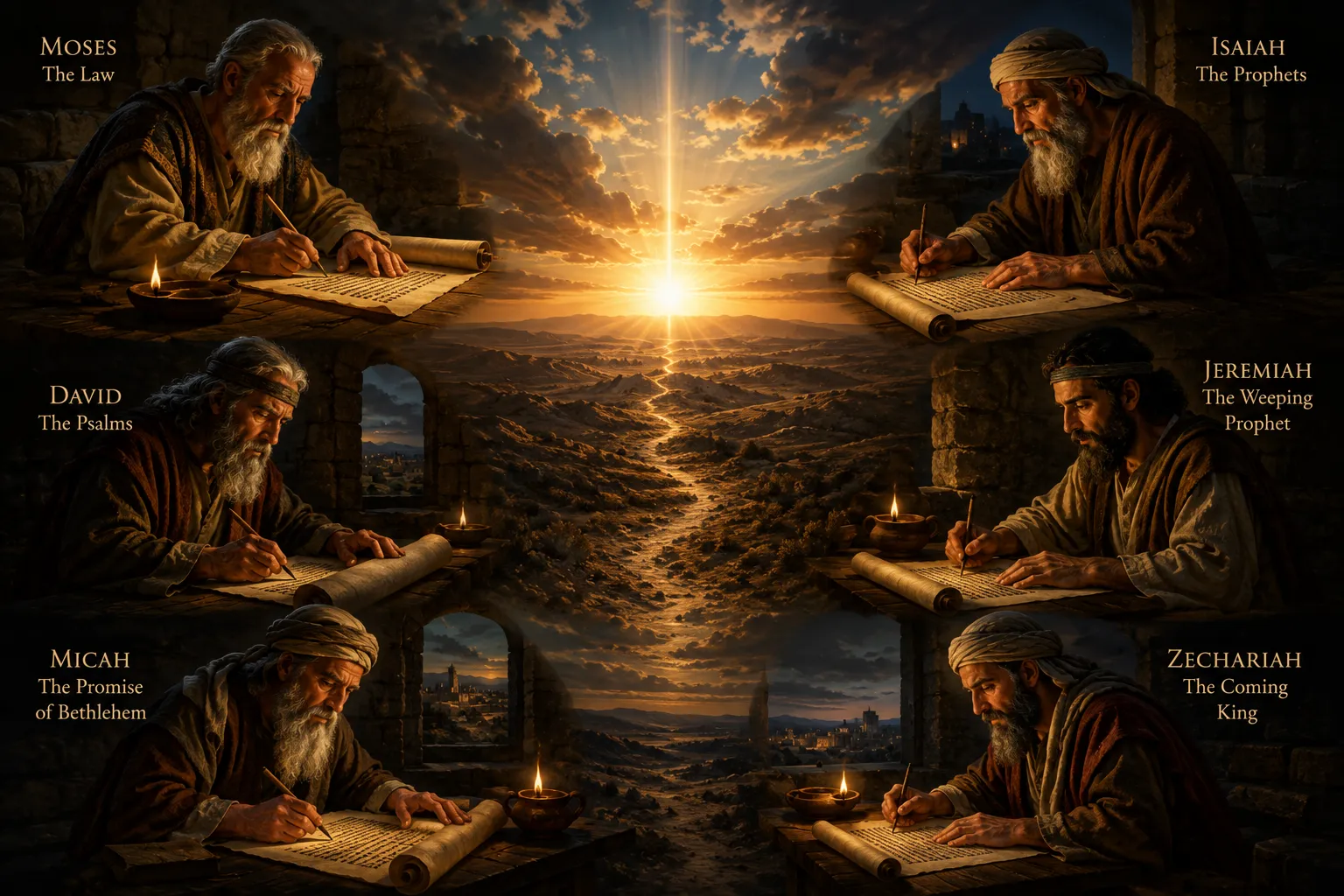
He said to them, “These are my words which I spoke to you while I was still with you, that all things which are written in the law of Moses, the Prophets, and the Psalms concerning me must be fulfilled.”
— Luke 24:44 (WEB)
Understanding the Messianic Identity of Christ helps believers see how the entire Bible points to Him.
The word Messiah comes from a Hebrew term meaning “anointed one.” In ancient Israel, kings and priests were anointed with oil as a sign that God had chosen them for a special role.
The Bible reveals that Jesus fulfills the ultimate role of the Messiah.
The woman said to him, “I know that Messiah comes,” he who is called Christ. “When he has come, he will declare to us all things.”
Jesus said to her, “I am he, the one who speaks to you.”
— John 4:25–26 (WEB)
Even Jesus of Nazareth, how God anointed him with the Holy Spirit and with power, who went about doing good and healing all who were oppressed by the devil, for God was with him.
— Acts 10:38 (WEB)
The kings of the earth take a stand, and the rulers take counsel together, against Yahweh, and against his Anointed, saying,
— Psalm 2:2 (WEB)
The Greek word Christ carries the same meaning, which is why Jesus is often called Jesus Christ, meaning “Jesus the Messiah.”
The Old Testament contains many prophecies describing the coming Messiah’s birth, mission, and kingdom. These prophecies were written centuries before Jesus was born.
Some well-known examples include:
I will put hostility between you and the woman, and between your offspring and her offspring. He will bruise your head, and you will bruise his heel.
— Genesis 3:15 (WEB)
For to us a child is born. To us a son is given; and the government will be on his shoulders. His name will be called Wonderful Counselor, Mighty God, Everlasting Father, Prince of Peace.
— Isaiah 9:6 (WEB)
But you, Bethlehem Ephrathah, being small among the clans of Judah, out of you one will come out to me that is to be ruler in Israel; whose goings out are from of old, from ancient times.
— Micah 5:2 (WEB)
But he was pierced for our transgressions. He was crushed for our iniquities. The punishment that brought our peace was on him; and by his wounds we are healed.
— Isaiah 53:5 (WEB)
These passages describe a future Savior who would rule with righteousness and suffer to bring redemption.
Jesus fulfilled many Old Testament prophecies through His life, ministry, death, and resurrection. These fulfillments confirm His true Messianic Identity.
Examples include:
| Prophecy | Fulfillment |
|---|---|
| Born in Bethlehem (Micah 5:2) | Matthew 2:1 |
| From David’s royal line (Jeremiah 23:5) | Luke 3:31 |
| Suffering servant (Isaiah 53) | Luke 23 |
| Resurrection foretold (Psalm 16:10) | Acts 2:31 |
Now when Jesus was born in Bethlehem of Judea in the days of King Herod, behold, wise men from the east came to Jerusalem, saying,
— Matthew 2:1 (WEB)
The son of Melea, the son of Menan, the son of Mattatha, the son of Nathan, the son of David,
— Luke 3:31 (WEB)
When they came to the place that is called The Skull, they crucified him there with the criminals, one on the right and the other on the left.
— Luke 23:33 (WEB)
He foreseeing this spoke about the resurrection of the Christ, that neither was his soul left in Hades, nor did his flesh see decay.
— Acts 2:31 (WEB)
These fulfillments reveal that Jesus is the Messiah promised throughout Scripture.
Many people in Jesus’ time expected a political leader who would overthrow Roman rule and restore Israel’s national power.
Instead, Jesus came first as a suffering servant who would bring salvation through His sacrifice.
He was despised,
and rejected by men;
a man of suffering,
and acquainted with disease.
He was despised as one from whom men hide their face;
and we didn’t respect him.
— Isaiah 53:3 (WEB)
He came to his own, and those who were his own didn’t receive him.
— John 1:11 (WEB)
He said to them, “Foolish men, and slow of heart to believe in all that the prophets have spoken! Didn’t the Christ have to suffer these things and to enter into his glory?”
Beginning from Moses and from all the prophets, he explained to them in all the Scriptures the things concerning himself.
— Luke 24:25–27 (WEB)
Because His mission did not match their expectations, some failed to recognize His Messianic Identity.
Recognizing Jesus as the Messiah is central to the message of the gospel. The Messiah came to save humanity from sin and restore the broken relationship between God and mankind.
For God so loved the world, that he gave his one and only Son, that whoever believes in him should not perish, but have eternal life.
— John 3:16 (WEB)
For the Son of Man came to seek and to save that which was lost.
— Luke 19:10 (WEB)
There is salvation in no one else, for there is no other name under heaven that is given among men by which we must be saved!
— Acts 4:12 (WEB)
Through faith in Jesus the Messiah, people receive forgiveness of sins and eternal life.
The Bible uses many titles to describe the Messiah and reveal His mission.
Some important titles include:
- Christ – the anointed Savior
- Son of David – rightful king of Israel
- Son of Man – divine ruler foretold in prophecy
- Lamb of God – sacrifice for sin
- King of Kings – eternal ruler
These titles together show the full scope of Christ’s Messianic Identity.
The next day, he saw Jesus coming to him, and said, “Behold, the Lamb of God, who takes away the sin of the world!
— John 1:29 (WEB)
The multitudes who went before him, and who followed kept shouting, “Hosanna to the son of David! Blessed is he who comes in the name of the Lord! Hosanna in the highest!”
— Matthew 21:9 (WEB)
He has on his garment and on his thigh a name written, “KING OF KINGS, AND LORD OF LORDS.”
— Revelation 19:16 (WEB)
The Bible calls people to believe in Jesus, trust Him as Savior, and follow Him as Lord. Faith in the Messiah begins a restored relationship with God.
But as many as received him, to them he gave the right to become God’s children, to those who believe in his name:
— John 1:12 (WEB)
That if you will confess with your mouth that Jesus is Lord, and believe in your heart that God raised him from the dead, you will be saved.
— Romans 10:9 (WEB)
Therefore if anyone is in Christ, he is a new creation. The old things have passed away. Behold, all things have become new.
— 2 Corinthians 5:17 (WEB)
Through faith in Christ, believers become part of God’s family and begin a new life transformed by Him.
Follow God's Promises Toward Faith in Christ
Start with Messiah Meaning in the Bible.
Begin with the meaning of Messiah, then read one prophetic passage alongside its New Testament connection. Ask how it deepens your understanding of Jesus' death, resurrection, or reign. Let God's faithfulness lead you to trust the Savior He promised.
Return to the Who Is Jesus Christ Topic when you are ready to explore another aspect of His identity and work.