Table of Contents
- What Does Redemptive History Mean?
- How Redemptive History Differs From a Bible Timeline
- Creation Begins the History of Redemption
- The Fall Creates the Need for Redemption
- God's Covenants Advance His Unfolding Plan
- The Exodus Shows What Redemption Looks Like
- The Law, Sacrifices, and Kingdom Point Forward
- The Prophets Keep Hope Alive
- Jesus Is the Center of Redemptive History
- How Biblical Theology Uses Redemptive History
- Redemptive History and the Gospel
- Redemptive History Is Still Moving Toward Completion
- Why Redemptive History Matters for Reading the Bible
- FAQs
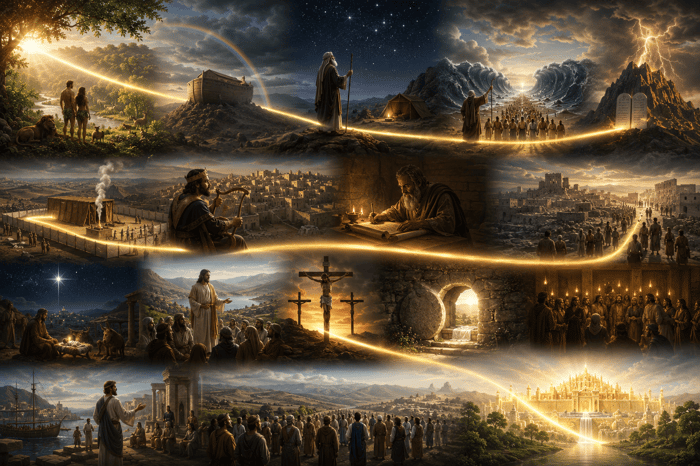
Redemptive history is the Bible's account of how God works through real events to rescue sinners and restore what sin has broken. It shows that Scripture is not a collection of disconnected stories. From Genesis to Revelation, the Bible reveals one saving plan centered on Jesus Christ.
This way of reading Scripture helps us see God's unfolding plan across creation, covenant, promise, sacrifice, kingdom, exile, the coming of Christ, and the final renewal of all things. It also helps explain how biblical theology connects the whole Bible without forcing every passage to say the same thing.
Redemptive history does not ignore the details of individual books. Instead, it places those details within the larger history of redemption. Each part of Scripture adds something important to the full picture of what God has done, is doing, and will do through His Son.
What Does Redemptive History Mean?
Redemptive history means the true story of God's saving work within human history. God acts through people, nations, promises, judgments, covenants, and miracles to bring His purpose to completion.
The word "redemptive" points to rescue through a price being paid. In the Bible, redemption often includes freedom from slavery, forgiveness of sin, restoration to God, and deliverance from judgment.
The word "history" matters too. Christianity is based on real events. God created the world. Israel left Egypt. David ruled as king. Jesus was born, crucified, buried, and raised from the dead. The Christian faith depends on what God has done in time and space.
Paul summarized the heart of the Gospel as historical truth:
For I delivered to you first of all that which I also received: that Christ died for our sins according to the Scriptures, that he was buried, that he was raised on the third day according to the Scriptures,
1 Corinthians 15:3-4 (WEB)
Redemptive history is therefore more than a theme. It is the record of God's actions that make salvation possible.
How Redemptive History Differs From a Bible Timeline
A Bible timeline usually asks, "What happened next?" Redemptive history asks, "How did this event move God's saving purpose forward?"
Both questions are useful, but they are not the same.
| Bible Timeline | Redemptive History |
|---|---|
| Arranges events in order | Explains their place in God's saving plan |
| Focuses on dates, rulers, and events | Focuses on promise, covenant, fulfillment, and redemption |
| Helps readers follow chronology | Helps readers understand theological meaning |
| Shows when events happened | Shows why events matter in the history of redemption |
For example, the Exodus is an important historical event in Israel's past. But within God's unfolding plan, it also reveals redemption through blood, deliverance from slavery, covenant relationship, and God's presence among His people.
The goal is not to turn every Old Testament detail into a hidden symbol. The goal is to understand each passage in its own setting and then see how it contributes to the Bible's full message.
Creation Begins the History of Redemption
The history of redemption begins with creation because redemption restores what God intended from the start.
God made humanity in His image. People were created to know Him, reflect His character, and live under His good rule.
God created man in his own image. In God's image he created him; male and female he created them.
Genesis 1:27 (WEB)
Sin did not improve God's creation. It damaged human fellowship with God, brought death into the world, and placed creation under corruption.
Redemptive history begins with the goodness of creation because salvation is not an escape from God's purpose. It is God's work to defeat sin, reconcile people to Himself, and bring creation to its promised renewal.
The Fall Creates the Need for Redemption
Adam and Eve rebelled against God's command. Their sin brought guilt, shame, separation, and death.
Yet God did not abandon His purpose. In the same chapter that records judgment, He also gave the first promise of a coming victory over the serpent.
I will put hostility between you and the woman, and between your offspring and her offspring. He will bruise your head, and you will bruise his heel.
Genesis 3:15 (WEB)
This promise does not reveal every detail at once. It begins a pattern that continues through the whole Bible. God gives a promise, protects the line through which it will be fulfilled, and reveals more as history moves forward.
The rest of redemptive history answers a central question: How will God defeat evil while remaining just, and how will He restore sinful people to fellowship with Himself?
God's Covenants Advance His Unfolding Plan
God's covenants form a major structure within biblical theology. Through them, God reveals His promises and moves His saving purpose forward.
The covenant with Noah preserved the world and ensured that human history would continue. The covenant with Abraham promised land, descendants, and blessing for all nations.
I will bless those who bless you, and I will curse him who treats you with contempt. All the families of the earth will be blessed through you.
Genesis 12:3 (WEB)
The covenant at Sinai formed Israel as God's nation. The covenant with David promised an enduring kingdom and a royal Son whose throne would last forever.
Your house and your kingdom will be made sure forever before you. Your throne will be established forever.
2 Samuel 7:16 (WEB)
The prophets later spoke of a new covenant in which God would forgive sin and write His law on His people's hearts.
“Behold, the days are coming, declares the Lord, when I will make a new covenant with the house of Israel and the house of Judah,
Jeremiah 31:31 (ESV)
These covenants are not competing plans. They build upon one another and find their fulfillment in Jesus Christ.
The Exodus Shows What Redemption Looks Like
The Exodus gives one of the clearest Old Testament pictures of redemption. Israel was enslaved in Egypt and could not free itself. God acted in power, judged Egypt, protected His people through the Passover blood, and brought them out of bondage.
God described His work in the language of redemption:
Say therefore to the people of Israel, ‘I am the Lord, and I will bring you out from under the burdens of the Egyptians, and I will deliver you from slavery to them, and I will redeem you with an outstretched arm and with great acts of judgment.
Exodus 6:6 (ESV)
This event becomes a pattern for later biblical teaching. Redemption includes rescue from slavery, protection from judgment, belonging to God, and a new life under His rule.
Yet the Exodus was not the final answer. Israel was freed from Egypt, but the deeper slavery of sin remained. The history of redemption had to move toward a greater Deliverer.
The Law, Sacrifices, and Kingdom Point Forward
The Law revealed God's holiness and showed Israel how to live as His covenant people. It also exposed sin and demonstrated that sinners need cleansing and forgiveness.
The sacrificial system taught that sin brings death and that atonement requires a substitute. Priests, sacrifices, the tabernacle, and the Day of Atonement all prepared God's people to understand the work of Christ.
The kingdom under David and Solomon also pointed beyond itself. Even Israel's best kings were flawed. The nation needed a faithful King who would rule with perfect justice and righteousness.
Redemptive history helps us see why these institutions matter without treating them as the final goal. The Law, sacrifices, priesthood, and kingdom prepared the way for Jesus, who fulfills them in Himself.
The Prophets Keep Hope Alive
When Israel and Judah turned from God, judgment came through exile. The temple was destroyed, the kingly line appeared broken, and the people were scattered.
Still, God continued to speak through the prophets. They announced judgment, but they also promised restoration, forgiveness, a new heart, a righteous King, and the coming Servant of the Lord.
The prophets teach an important truth about God's unfolding plan: human unfaithfulness cannot cancel God's faithfulness.
God's promises continued even when His people failed. The history of redemption depends on God's character, not human strength.
Jesus Is the Center of Redemptive History
Jesus did not enter the story as an unrelated religious teacher. He came as the fulfillment of God's promises.
The Son of God was born from Abraham's family and David's royal line. He obeyed where Adam failed, fulfilled the Law, announced God's kingdom, offered Himself as the true sacrifice, and established the new covenant through His blood.
Paul described the timing of Christ's coming:
But when the fullness of the time came, God sent out his Son, born to a woman, born under the law, that he might redeem those who were under the law, that we might receive the adoption of children.
Galatians 4:4-5 (WEB)
Jesus also taught His disciples to read Scripture as a unified story that pointed to Him.
Beginning from Moses and from all the prophets, he explained to them in all the Scriptures the things concerning himself.
Luke 24:27 (WEB)
This does not mean every verse is a direct prediction of Jesus. It means the whole Bible moves toward Him. Its promises, patterns, offices, sacrifices, and hopes reach their fulfillment in His person and work.
How Biblical Theology Uses Redemptive History
Biblical theology studies how God's truth unfolds across the Bible over time. It pays attention to each book's setting while tracing major themes through Scripture.
Some of these themes include:
- Kingdom
- Covenant
- Temple
- Sacrifice
- Priesthood
- Sonship
- God's presence
- Promise and fulfillment
- Creation and new creation
Redemptive history gives these themes a shared direction. They do not float as separate ideas. They develop through real events and reach their center in Christ.
For example, God's presence begins in Eden, appears in the tabernacle and temple, comes near in Jesus Christ, dwells in believers through the Holy Spirit, and fills the new creation.
This is one reason biblical theology is useful. It helps readers see both the unity and the progress of Scripture.
Redemptive History and the Gospel
Redemptive history reveals why the Gospel is necessary and why Jesus alone can save.
Humanity's problem is not lack of education, weak government, or poor circumstances. The deepest problem is sin against God. From Adam onward, every person enters a fallen world and shares in human rebellion.
The long history of promises, sacrifices, covenants, priests, kings, and prophets shows that mankind could not repair the break. God Himself had to provide the Savior.
Jesus lived without sin, died in the place of sinners, and rose from the dead. His death satisfied God's justice, and His resurrection proved His victory over sin and death.
The proper response is repentance and faith. A person is not saved by knowing the stages of redemptive history. A person is saved by trusting the Christ to whom that history points.
This matches the central Gospel truth that God created mankind, sin brought separation, and God provided restoration through His Son, Jesus Christ.
Redemptive History Is Still Moving Toward Completion
Christ's death and resurrection are the decisive center of God's plan, but the story is not finished.
The Gospel is now going to the nations. Christ is building His church. Believers wait for His return, the resurrection of the dead, final judgment, and the renewal of creation.
The Bible ends where God's purpose has always been moving: God dwelling with His redeemed people in a world made new.
He who sits on the throne said, "Behold, I am making all things new." He said, "Write, for these words of God are faithful and true."
Revelation 21:5 (WEB)
Redemptive history gives believers hope because the God who fulfilled His promises in Christ will also complete what He has begun.
Why Redemptive History Matters for Reading the Bible
Understanding redemptive history changes how we read Scripture.
It helps us avoid treating the Bible as a book of isolated moral lessons. David and Goliath is not merely about facing personal fears. The story takes place within God's work through His chosen king and moves the royal promise toward Christ.
It also protects us from reading ourselves as the center of every passage. The Bible speaks to us, but it is first about God, His glory, His covenant faithfulness, and His saving work.
Redemptive history also strengthens faith. We see that God keeps His word across centuries. What seems delayed is never forgotten. What appears threatened is never outside His control.
The Bible's many books, authors, covenants, and events tell one grand story. God creates, mankind rebels, God promises, Christ redeems, the Spirit gathers a people, and the Lord will renew all things.
That is the meaning of redemptive history. It is the true account of God's unfolding plan to save sinners and bring all things under the rule of Jesus Christ.
FAQs
What is redemptive history?
Redemptive history is the true story of how God works throughout history to save sinners and fulfill His promises through Jesus Christ. Rather than presenting isolated events, the Bible reveals one unified account of God's unfolding plan from creation to the new creation.
"Declaring the end from the beginning, and from ancient times things that are not yet done; saying, 'My counsel will stand, and I will do all my pleasure.'"
Isaiah 46:10 (WEB)
How is redemptive history different from a Bible timeline?
A Bible timeline arranges events in chronological order, while redemptive history explains how those events fit into God's saving plan. It helps us understand why the events happened and how they point to Christ.
"Beginning from Moses and from all the prophets, he explained to them in all the Scriptures the things concerning himself."
Luke 24:27 (WEB)
Why is redemptive history important for understanding the Bible?
Redemptive history helps us read the Bible as one unified story instead of many unrelated stories. It shows how God's covenants, promises, sacrifices, kings, and prophets all work together to reveal His plan of redemption.
"For no matter how many are the promises of God, in him they are 'Yes.' Therefore also through him is the 'Amen,' to the glory of God through us."
2 Corinthians 1:20 (WEB)
What role does biblical theology play in redemptive history?
Biblical theology traces how God's revelation unfolds throughout Scripture. It follows major themes such as covenant, kingdom, sacrifice, and God's presence, showing how they develop through history and reach their fulfillment in Jesus Christ.
"All Scripture is God-breathed and profitable for teaching, for reproof, for correction, and for instruction in righteousness."
2 Timothy 3:16 (WEB)
Why is Jesus the center of redemptive history?
Everything in redemptive history ultimately points to Jesus. The promises made to Abraham, the sacrifices under the Law, the kingdom of David, and the words of the prophets all prepare for His coming. Through His death and resurrection, God's plan of redemption reaches its fulfillment.
"But when the fullness of the time came, God sent out his Son, born to a woman, born under the law, that he might redeem those who were under the law, that we might receive the adoption of children."
Galatians 4:4-5 (WEB)
How does redemptive history reveal the Gospel?
Redemptive history shows that humanity's greatest problem is sin and that God has been carrying out one plan of salvation from the beginning. The entire history of redemption leads to Jesus Christ, who died for our sins and rose again to reconcile sinners to God.
Understanding redemptive history helps us see that salvation is not an isolated event but the fulfillment of God's eternal purpose. Everyone who repents and trusts in Christ becomes part of the redeemed people God has been gathering throughout history.
"For the grace of God has appeared, bringing salvation to all men."
Titus 2:11 (WEB)
Is redemptive history finished?
The decisive victory has already been won through Christ's death and resurrection, but redemptive history has not yet reached its final chapter. Believers now await Christ's return, the resurrection of the dead, and the creation of the new heaven and new earth, where God's redeeming work will be fully completed.
"He who sits on the throne said, 'Behold, I am making all things new.' He said, 'Write, for these words of God are faithful and true.'"
Revelation 21:5 (WEB)