Table of Contents
- What Happens at the Baptism of Jesus?
- Jesus' Baptism and the Trinity in Matthew 3:16-17
- The Father Speaks From Heaven
- The Son Is Baptized in the Jordan
- The Holy Spirit Descends Upon Jesus
- Why This Scene Matters for the Trinity
- Does Jesus' Baptism Teach Three Gods?
- The Trinity Works Together in Jesus' Mission
- Why Did the Father Say He Was Pleased With Jesus?
- What Does Jesus' Baptism Reveal About Jesus?
- Jesus' Baptism and the Trinity Point Toward Salvation
- What Christians Can Learn From Jesus' Baptism
- FAQs
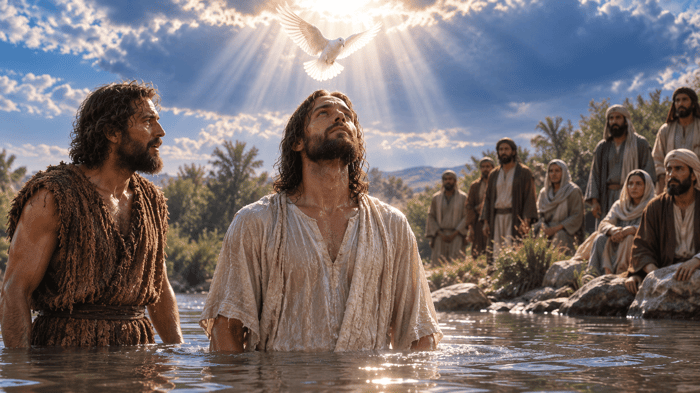
Jesus' Baptism and the Trinity come together in one of the clearest scenes in the New Testament. As Jesus comes up from the water, the Son is standing on earth, the Holy Spirit descends upon Him like a dove, and the Father's voice speaks from heaven. All three are present at the same moment.
Matthew 3:16-17 does not use the word "Trinity." Yet it gives strong biblical evidence for the doctrine because the Father, Son, and Holy Spirit are clearly distinguished from one another.
The baptism of Jesus also marks the beginning of His public ministry. The Father identifies Jesus as His beloved Son, while the Spirit comes upon Him. The scene reveals both who Jesus is and how the three Persons of the Trinity act together.
What Happens at the Baptism of Jesus?
Jesus came to John the Baptist at the Jordan River to be baptized. John was surprised because he understood that Jesus was greater than he was.
Jesus told John that His baptism was necessary to fulfill righteousness.
But Jesus, answering, said to him, "Allow it now, for this is the fitting way for us to fulfill all righteousness." Then he allowed him.
Matthew 3:15 (WEB)
Jesus was not baptized because He needed forgiveness for sin. Scripture presents Him as the sinless Son of God. His baptism identified Him with the people He came to save and marked the beginning of His public ministry.
Then something remarkable happened.
Jesus, when he was baptized, went up directly from the water: and behold, the heavens were opened to him. He saw the Spirit of God descending as a dove, and coming on him.
Matthew 3:16 (WEB)
The next verse records the Father's response.
Behold, a voice out of the heavens said, "This is my beloved Son, with whom I am well pleased."
Matthew 3:17 (WEB)
These two verses form the heart of Jesus' Baptism and the Trinity .
The Son is baptized. The Spirit descends. The Father speaks.
They are not presented as three names for the same Person. They appear and act distinctly at the same time.
Jesus' Baptism and the Trinity in Matthew 3:16-17
The baptism of Jesus gives us a vivid picture of the Father, Son, and Holy Spirit together.
| Person | What Happens at Jesus' Baptism |
|---|---|
| The Father | Speaks from heaven |
| The Son | Is baptized in the Jordan River |
| The Holy Spirit | Descends upon Jesus like a dove |
Each Person is clearly distinguishable.
Jesus is not speaking from heaven while also standing in the Jordan. The Holy Spirit is not the voice from heaven. The Father is not the One being baptized.
This matters when understanding Jesus' Baptism and the Trinity. The passage shows real personal distinction within the one God revealed throughout Scripture.
At the same time, nothing in the passage suggests three separate gods. Matthew assumes the Bible's consistent teaching that there is one God. The baptism scene helps reveal that within God's one being are the Father, Son, and Holy Spirit.
The Father Speaks From Heaven
At Jesus' baptism, the Father speaks directly about His Son.
Behold, a voice out of the heavens said, "This is my beloved Son, with whom I am well pleased."
Matthew 3:17 (WEB)
The Father's words reveal both relationship and approval.
Jesus is called "my beloved Son." The Father and Son are therefore personally distinct from one another. The Father speaks about the Son rather than speaking as though He were the Son.
The words "with whom I am well pleased" also show the Father's delight in Jesus.
This is important for understanding Jesus' Baptism and the Trinity because the relationship between the Father and Son is not symbolic language describing one Person playing different roles. The Father speaks to identify and honor the Son.
Mark records the same event with the Father's words directed toward Jesus.
A voice came out of the sky, "You are my beloved Son, in whom I am well pleased."
Mark 1:11 (WEB)
The Father is in heaven, while the Son is on earth. Their relationship is real and personal.
The Son Is Baptized in the Jordan
Jesus stands at the center of the scene.
He comes to John, enters the water, is baptized, and then begins His public ministry.
The Father's declaration identifies Him as the beloved Son. This statement helps answer the question of who Jesus is before He performs many of the public signs and teachings recorded later in the Gospels.
Jesus is not merely another prophet coming to John.
He is the Son.
Luke records the same scene:
Now when all the people were baptized, Jesus also had been baptized, and was praying. The sky was opened.
Luke 3:21 (WEB)
Jesus' baptism is therefore not just an example of baptism for Christians to study. It is also a moment of divine revelation.
In Jesus' Baptism and the Trinity, the identity of the Son is confirmed by the Father while the Spirit comes upon Him.
The Holy Spirit Descends Upon Jesus
Matthew says the Spirit of God descended like a dove and came upon Jesus.
Luke adds another important detail.
The Holy Spirit descended in a bodily form as a dove on him; and a voice came out of the sky, saying "You are my beloved Son. In you I am well pleased."
Luke 3:22 (WEB)
The Holy Spirit is distinct from both the Father and the Son.
The Father speaks.
The Son receives baptism.
The Holy Spirit descends.
The dove imagery does not mean the Holy Spirit is literally a dove. Luke says He descended "in a bodily form as a dove." The visible sign allowed those present to recognize what God was doing.
John the Baptist later testified about what he saw.
John testified, saying, "I have seen the Spirit descending like a dove out of heaven, and it remained on him."
John 1:32 (WEB)
The Spirit's descent was also part of God's confirmation of Jesus' identity.
John explains that God had told him to watch for this sign.
I didn't recognize him, but he who sent me to baptize in water said to me, "On whomever you will see the Spirit descending and remaining on him is he who baptizes in the Holy Spirit."
John 1:33 (WEB)
The Spirit therefore does more than appear in the scene. His descent helps identify Jesus as the One sent by God.
Why This Scene Matters for the Trinity
Jesus' Baptism and the Trinity are important because Matthew 3:16-17 shows all three Persons at once.
This is significant when evaluating the biblical foundation for the Trinity.
The passage shows:
- The Father is distinct from the Son.
- The Son is distinct from the Spirit.
- The Spirit is distinct from the Father.
- All three act together in one event.
- The three Persons are involved in revealing Jesus' identity and mission.
This scene makes it difficult to understand the Father, Son, and Holy Spirit as simply three temporary roles played by one Person.
If that were the case, the baptism scene would become difficult to explain. Jesus would have to be standing in the water, descending upon Himself, and speaking from heaven about Himself at the same moment.
Instead, Scripture naturally presents three distinct Persons.
That personal distinction is one of the essential truths behind the doctrine of the Trinity.
Does Jesus' Baptism Teach Three Gods?
No.
The baptism of Jesus distinguishes the Father, Son, and Holy Spirit, but it does not teach that there are three gods.
The Bible consistently teaches that God is one.
The Trinity brings several biblical truths together:
- There is one God.
- The Father is God.
- The Son is God.
- The Holy Spirit is God.
- The Father, Son, and Holy Spirit are personally distinct.
Matthew 3:16-17 especially helps establish the final point. It shows that the Father, Son, and Holy Spirit cannot simply be three different names for the same Person.
Later, Jesus places the same three Persons together when He gives the Great Commission.
Go and make disciples of all nations, baptizing them in the name of the Father and of the Son and of the Holy Spirit.
Matthew 28:19 (WEB)
Notice that Jesus says "name," not "names."
The Father, Son, and Holy Spirit are distinguished, yet they are brought together under one singular "name."
This strengthens the biblical foundation seen in Jesus' Baptism and the Trinity.
The Trinity Works Together in Jesus' Mission
The baptism of Jesus also shows that the Persons of the Trinity work together.
The Son comes to accomplish the work the Father has given Him. The Father publicly identifies and approves His Son. The Holy Spirit descends upon Jesus as His ministry begins.
This pattern continues throughout the New Testament.
Father, Son, and Holy Spirit do not compete with one another. Their actions are perfectly united.
Paul later places all three together in a blessing to the church.
The grace of the Lord Jesus Christ, God's love, and the fellowship of the Holy Spirit be with you all. Amen.
2 Corinthians 13:14 (WEB)
The verse distinguishes Jesus Christ, God the Father, and the Holy Spirit while showing their united relationship with God's people.
The same pattern is already visible at the Jordan River.
Jesus' Baptism and the Trinity therefore reveals both distinction and unity. The Father, Son, and Spirit act personally, yet their work belongs to one divine purpose.
Why Did the Father Say He Was Pleased With Jesus?
The Father's declaration tells us something important about Jesus.
He is the beloved Son in whom the Father is pleased.
This statement comes before Jesus' wilderness temptation and before much of His recorded public ministry. The Father's love for the Son is not something Jesus earns through later miracles or obedience.
The relationship already exists.
The Father's approval also stands in contrast to sinful humanity. People fail to obey God perfectly, but Jesus fulfills the Father's will.
This becomes important as Jesus moves toward the cross. The beloved Son will ultimately give His life for sinners.
His baptism begins a public road of obedience that leads toward His death and resurrection.
What Does Jesus' Baptism Reveal About Jesus?
The scene reveals several truths at once.
Jesus is:
- the Father's beloved Son,
- publicly approved by the Father,
- identified through the descent of the Holy Spirit,
- beginning His public ministry,
- and acting in willing obedience to God's purpose.
John the Baptist later gives his conclusion after witnessing the Spirit's descent.
I have seen, and have testified that this is the Son of God.
John 1:34 (WEB)
That is one of the main purposes of the event.
Jesus' baptism does not merely tell us something about baptism. It tells us something about Jesus.
He is the Son of God.
Jesus' Baptism and the Trinity Point Toward Salvation
Jesus' Baptism and the Trinity also fits within the larger story of salvation.
Jesus enters the water even though He has no sin to confess. He identifies Himself with sinful people and begins the public ministry that will eventually lead to the cross.
The Father declares His love for the Son. The Holy Spirit comes upon Him. The Son begins His mission.
That mission is necessary because humanity is separated from God by sin.
People cannot restore themselves to God through religious appearances, moral effort, or good works. We need the Savior God has provided.
The One standing in the Jordan is that Savior.
Jesus will live in perfect obedience, die for sinners, and rise from the dead. Those who trust in Him receive forgiveness and new life.
The baptism scene therefore points beyond the Jordan River. It introduces the Son who came to accomplish God's saving purpose.
What Christians Can Learn From Jesus' Baptism
The baptism of Jesus should lead Christians toward both understanding and worship.
It reveals that the Christian faith is centered on the Father, Son, and Holy Spirit.
It also shows that God's saving work is not disconnected from who He is. The Father sends and loves the Son. The Son willingly carries out His mission. The Holy Spirit comes upon the Son and works according to God's purpose.
Christians can therefore read Matthew 3:16-17 with confidence that the doctrine of the Trinity is not based on one isolated word or later human invention.
It grows from the way Scripture itself speaks about God.
Jesus' Baptism and the Trinity gives one of the most vivid examples. The Son stands in the Jordan. The Spirit descends upon Him. The Father speaks from heaven.
Three distinct Persons are present, yet Scripture continues to proclaim one God.
The scene invites us not only to study the Trinity but to recognize the glory of the God who has revealed Himself as Father, Son, and Holy Spirit and who acts in perfect unity to accomplish His saving purpose.
FAQs
What does Jesus' baptism reveal about the Trinity?
Jesus' baptism shows the Father, Son, and Holy Spirit present and acting at the same moment. Jesus the Son is in the Jordan, the Spirit of God descends upon Him like a dove, and the Father speaks from heaven. The scene clearly distinguishes the three Persons while remaining within Scripture's teaching that God is one.
Jesus, when he was baptized, went up directly from the water: and behold, the heavens were opened to him. He saw the Spirit of God descending as a dove, and coming on him.
Matthew 3:16 (WEB)
Where are the Father, Son, and Holy Spirit in Matthew 3:16-17?
The Son is Jesus standing in the Jordan after His baptism. The Holy Spirit descends upon Him like a dove. The Father speaks from heaven and identifies Jesus as His beloved Son. Their simultaneous actions make Matthew 3:16-17 an important biblical passage for understanding their personal distinction.
Behold, a voice out of the heavens said, "This is my beloved Son, with whom I am well pleased."
Matthew 3:17 (WEB)
Why did the Holy Spirit descend like a dove at Jesus' baptism?
The dove was a visible sign connected with the Holy Spirit's descent upon Jesus. It did not mean the Holy Spirit is literally a dove. John the Baptist had been told to watch for the Spirit descending and remaining upon someone, and this sign helped identify Jesus as the One sent by God.
John testified, saying, "I have seen the Spirit descending like a dove out of heaven, and it remained on him."
John 1:32 (WEB)
What did the Father say at Jesus' baptism?
The Father identified Jesus as His beloved Son and declared that He was pleased with Him. The statement reveals a real relationship between the Father and Son. The Father speaks about the Son rather than appearing as another role played by Jesus.
A voice came out of the sky, "You are my beloved Son, in whom I am well pleased."
Mark 1:11 (WEB)
Does Jesus' baptism teach that there are three gods?
No. Jesus' baptism distinguishes the Father, Son, and Holy Spirit, but the passage does not teach three gods. The scene contributes to the biblical foundation of the Trinity by showing three distinct Persons. Jesus later brings the same Father, Son, and Holy Spirit together under the singular word "name."
Go and make disciples of all nations, baptizing them in the name of the Father and of the Son and of the Holy Spirit.
Matthew 28:19 (WEB)
Why was Jesus baptized if He was without sin?
Jesus was not baptized because He needed forgiveness. He told John that His baptism was fitting to fulfill righteousness. His baptism identified Him with the people He came to save and marked the beginning of His public ministry.
But Jesus, answering, said to him, "Allow it now, for this is the fitting way for us to fulfill all righteousness." Then he allowed him.
Matthew 3:15 (WEB)
How does Jesus' baptism reveal who Jesus is?
Jesus' baptism publicly reveals Him as the Son of God. The Father identifies Him as His beloved Son, while the Spirit descends and remains upon Him. John the Baptist later testified that what he witnessed confirmed Jesus' identity.
I have seen, and have testified that this is the Son of God.
John 1:34 (WEB)
How do Jesus' Baptism and the Trinity point to the Gospel and salvation?
Jesus' Baptism and the Trinity show the Son beginning the public mission that leads toward His death and resurrection. Jesus enters the water even though He has no sin to confess, identifying with the sinful people He came to save. Humanity cannot overcome separation from God through moral effort or religious appearances. We need the Savior God provided. The Father identifies Jesus as His Son, the Spirit comes upon Him, and Jesus goes forward to accomplish the saving work that brings forgiveness and new life to those who trust in Him.
Behold, a voice out of the heavens said, "This is my beloved Son, with whom I am well pleased."
Matthew 3:17 (WEB)