Table of Contents
- The Context of Hebrews 1
- Hebrews 1:8 Meaning: Why Is the Son Called God?
- Why Hebrews 1 Compares Jesus With Angels
- What Does "Your Throne, O God" Mean?
- Why Psalm 45 Is Quoted in Hebrews 1:8
- The Father Speaks About the Son
- Does Hebrews 1:8 Teach That Jesus Is God?
- Hebrews 1:8 and the Deity of Christ
- How Hebrews 1:8 Supports the Trinity
- Why Christ's Righteous Rule Matters
- Why the Hebrews 1:8 Meaning Matters for Salvation
- What Hebrews 1:8 Does Not Mean
- What Hebrews 1:8 Means for Christians Today
- "Your Throne, O God" Reveals Who Jesus Is
- FAQs
The Hebrews 1:8 meaning centers on a striking statement about Jesus Christ: the Son is addressed as "God." In a chapter written to show that Jesus is greater than the angels, the writer of Hebrews quotes the Old Testament and applies the words, "Your throne, O God," directly to the Son.
This verse is important because it does more than say Jesus represents God or speaks for God. Hebrews presents the Son as sharing the divine identity while remaining distinct from the Father.
The verse comes from Psalm 45, but Hebrews uses it to reveal something deeper about Christ. The eternal Son rules with a righteous kingdom, receives honor that belongs to God, and stands far above every created being.
But of the Son he says, "Your throne, O God, is forever and ever. The scepter of uprightness is the scepter of your Kingdom."
Hebrews 1:8 (WEB)
Understanding this verse in its context helps explain the Hebrews 1:8 meaning and why Christians point to it as strong biblical evidence for the deity of Christ.
The Context of Hebrews 1
Hebrews begins by comparing God's earlier revelation through the prophets with His final revelation through His Son.
God, having in the past spoken to the fathers through the prophets at many times and in various ways, has at the end of these days spoken to us by his Son, whom he appointed heir of all things, through whom also he made the worlds.
Hebrews 1:1-2 (WEB)
The Son is not introduced as merely another prophet. The Hebrews 1:8 meaning begins with recognizing that He is the One through whom God made the worlds.
The next verse goes even further.
His Son is the radiance of his glory, the very image of his substance, and upholding all things by the word of his power, when he had by himself purified us of our sins, sat down on the right hand of the Majesty on high,
Hebrews 1:3 (WEB)
Before Hebrews reaches verse 8, the writer has already described Jesus in extraordinary terms.
The Son:
- made the worlds,
- reveals God's glory,
- bears the exact imprint of God's nature,
- upholds all things,
- purified people from sin,
- and sits at God's right hand.
The Hebrews 1:8 meaning must be understood within this larger argument. The writer is showing that Jesus cannot be placed in the same category as angels, prophets, or any other created servant.
He is the divine Son.
Hebrews 1:8 Meaning: Why Is the Son Called God?
The central statement is simple:
But of the Son he says, "Your throne, O God, is forever and ever. The scepter of uprightness is the scepter of your Kingdom."
Hebrews 1:8 (WEB)
The words "of the Son he says" identify the person being addressed.
The writer is speaking about the Son.
Then comes the declaration:
"Your throne, O God."
That wording is one reason Hebrews 1:8 has played an important role in Christian teaching about the identity of Jesus.
The Hebrews 1:8 meaning becomes unmistakable: the Son is called God.
This does not mean the Son is the Father. Hebrews distinguishes between them. The Father speaks concerning the Son.
Yet the Son receives a title that belongs to deity.
The verse therefore holds together two important truths:
- The Father and Son are personally distinct.
- The Son is truly divine.
These truths help form the biblical foundation for the Trinity.
Why Hebrews 1 Compares Jesus With Angels
One of the main purposes of Hebrews 1 is to show that Jesus is greater than angels.
Angels are powerful spiritual beings created by God. They serve Him and carry out His commands.
But the Son stands in a completely different position.
For to which of the angels did he say at any time, "You are my Son. Today I have become your father?" and again, "I will be to him a Father, and he will be to me a Son?"
Hebrews 1:5 (WEB)
No angel receives the unique identity given to Christ.
Hebrews then says that the angels worship the Son.
Again, when he brings in the firstborn into the world he says, "Let all the angels of God worship him."
Hebrews 1:6 (WEB)
That is a major distinction.
The angels worship.
The Son receives worship.
Then Hebrews 1:8 calls the Son God.
The argument becomes clear: Jesus is not the highest angel or the greatest created spiritual being. He belongs to a different category entirely.
He is the Son.
He is King.
He is addressed as God.
What Does "Your Throne, O God" Mean?
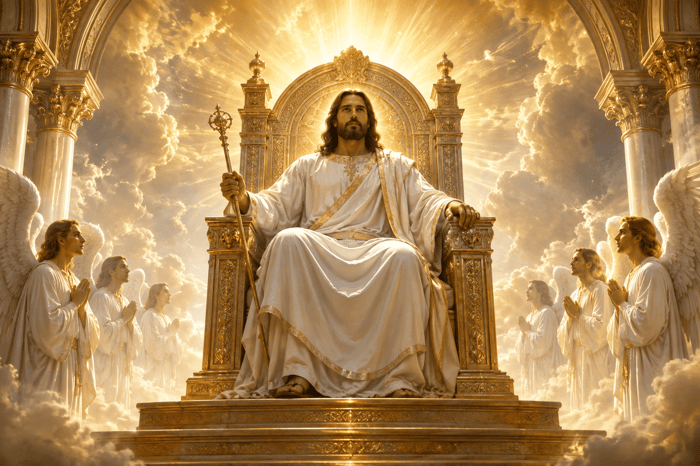
The phrase "Your throne, O God" points to Christ's eternal rule.
A throne represents authority, kingship, and the right to rule.
But Christ's throne is not temporary.
Hebrews says it is "forever and ever."
Human kings rule for a limited time. Kingdoms rise and fall. Every earthly ruler eventually loses power.
The Hebrews 1:8 meaning reminds us that Christ's reign is different.
His throne continues forever.
This matches other biblical descriptions of Jesus.
He will reign over the house of Jacob forever. There will be no end to his Kingdom.
Luke 1:33 (WEB)
The eternal nature of Christ's kingdom reinforces the Hebrews 1:8 meaning and supports the larger argument in Hebrews.
Jesus is not simply one ruler among many.
His authority does not expire.
His kingdom cannot be overthrown.
His throne is everlasting.
Why Psalm 45 Is Quoted in Hebrews 1:8
Hebrews 1:8 quotes Psalm 45.
Psalm 45 originally celebrates a royal king. It speaks about his throne, righteousness, and royal rule.
Your throne, God, is forever and ever. A scepter of equity is the scepter of your kingdom.
Psalm 45:6 (WEB)
Hebrews takes this royal language and applies it directly to Jesus.
This is significant because the writer sees the Old Testament king as pointing beyond himself toward the greater King.
Jesus fulfills the royal hope in its fullest sense.
The earthly kings of Israel were temporary.
Christ's throne is eternal.
Earthly kings could fail.
Christ rules in perfect righteousness.
Earthly kings were servants of God.
The Son is addressed as God.
So when Psalm 45 is quoted in Hebrews, the passage takes on its fullest meaning in Christ.
The Father Speaks About the Son
One of the most important details in the Hebrews 1:8 meaning is the relationship between the Father and Son.
Hebrews says:
"But of the Son he says..."
The Father is speaking about the Son.
That distinction matters.
Christian belief in the Trinity does not teach that the Father and Son are two names for the same Person.
The Father is not the Son.
The Son is not the Father.
Yet Hebrews does not solve that distinction by lowering Jesus to the level of a creature.
Instead, the Father addresses the Son as God.
The next verse continues the quotation:
You have loved righteousness and hated iniquity; therefore God, your God, has anointed you with the oil of gladness above your fellows.
Hebrews 1:9 (WEB)
This is an important biblical pattern.
The Son is called God.
Yet the Son also relates to the Father as "your God."
Rather than being a contradiction, this fits the biblical teaching of personal distinction within the one God.
The Father and Son are distinct Persons, yet the Son shares the divine identity.
Does Hebrews 1:8 Teach That Jesus Is God?
Yes. Hebrews 1:8 is one of the clearest passages where the Son is called God.
The verse does not merely imply that Jesus is important.
It directly applies divine language to Him.
That conclusion also fits the rest of Hebrews 1.
| What Hebrews says about the Son | What it reveals |
|---|---|
| God made the worlds through Him | Christ is involved in creation |
| He is the radiance of God's glory | Christ reveals God's divine glory |
| He is the exact image of God's substance | Christ shares God's nature |
| Angels worship Him | Christ receives worship |
| He is called God | Christ possesses divine identity |
| His throne is forever | Christ rules eternally |
Hebrews 1:8 is therefore not an isolated statement.
It is part of a carefully developed argument about who Jesus is.
Hebrews 1:8 and the Deity of Christ
The deity of Christ means that Jesus possesses the divine nature.
He did not become divine after His resurrection.
He is not a human being who was promoted into deity.
Hebrews begins with the Son already involved in creation.
That means His existence did not begin at Bethlehem.
The writer later applies another Old Testament passage to the Son:
And, "You, Lord, in the beginning, laid the foundation of the earth. The heavens are the works of your hands."
Hebrews 1:10 (WEB)
Creation is described as the work of the Son.
This strengthens the meaning of Hebrews 1:8.
The One called God is also the One through whom the world was made.
Jesus therefore stands on the Creator side of the distinction between Creator and creation.
How Hebrews 1:8 Supports the Trinity
Hebrews 1:8 does not explain every part of the doctrine of the Trinity.
It makes one particular contribution to the biblical case: it shows the deity of the Son while also distinguishing Him from the Father.
The larger biblical picture includes three truths:
- There is one God.
- The Father, Son, and Holy Spirit are personally distinct.
- Scripture identifies each with divine identity.
Hebrews 1:8 strongly supports the second and third truths as they relate to the Father and Son.
The Son is distinct from the Father because the Father speaks concerning Him.
Yet the Son is called God.
This fits with the Bible's clear teaching that God is one.
Hear, Israel: Yahweh is our God. Yahweh is one.
Deuteronomy 6:4 (WEB)
Christians do not reach the Trinity by abandoning biblical monotheism.
They reach it by taking seriously everything Scripture says about the one God, the Father, the Son, and the Holy Spirit.
Hebrews 1:8 is an important part of that evidence.
Why Christ's Righteous Rule Matters
Hebrews 1:8 does not only tell us that Christ is God.
It also tells us what His kingdom is like.
"the scepter of uprightness is the scepter of your Kingdom."
A scepter represents royal authority.
Jesus rules with righteousness.
Human rulers often misuse power. Even good rulers are imperfect.
Christ is different.
His authority is perfectly just because His character is perfectly righteous.
Hebrews continues:
You have loved righteousness and hated iniquity; therefore God, your God, has anointed you with the oil of gladness above your fellows.
Hebrews 1:9 (WEB)
Jesus does not merely possess power.
He loves righteousness.
He hates wickedness.
That means His eternal kingdom is not frightening for those who belong to Him. His rule is good, just, and holy.
Why the Hebrews 1:8 Meaning Matters for Salvation
The Hebrews 1:8 meaning also matters because the identity of Jesus is connected to the work He came to accomplish.
Hebrews 1 does not describe Christ's deity as an abstract theological idea.
The chapter connects who Jesus is with what He has done.
His Son is the radiance of his glory, the very image of his substance, and upholding all things by the word of his power, when he had by himself purified us of our sins, sat down on the right hand of the Majesty on high,
Hebrews 1:3 (WEB)
Humanity's problem is sin.
Sin separates people from the holy God, and we cannot remove our guilt through our own efforts.
We need someone who can truly deal with sin.
Hebrews tells us that the divine Son purified us from sins.
The One who saves is the One whose throne is eternal.
The One who died for sinners is not merely a religious teacher.
He is the Son whom Scripture calls God.
This makes the Gospel deeply personal.
God did not send a created messenger to solve humanity's greatest problem. The Son Himself came, took on human nature, gave His life for sinners, and rose again.
Those who trust in Jesus are not placing their hope in an ordinary man.
They are trusting the divine Son who is able to save.
What Hebrews 1:8 Does Not Mean
Several misunderstandings should be avoided.
First, Hebrews 1:8 does not mean Jesus is the Father.
The Father and Son are clearly distinguished.
Second, it does not mean there are two gods.
The Bible continues to affirm that God is one.
Third, it does not mean Jesus became God because He was given a throne.
Hebrews has already described the Son as Creator before discussing His throne.
Fourth, the verse does not place Jesus in the same category as angels.
The entire chapter argues the opposite.
Jesus is greater than the angels because He is the eternal Son.
These distinctions help us read the verse in harmony with the rest of Scripture.
What Hebrews 1:8 Means for Christians Today
The Hebrews 1:8 meaning gives believers strong confidence in Jesus Christ.
His throne is eternal.
His rule is righteous.
His divine identity is secure.
His authority does not depend on governments, cultures, or human approval.
Christians therefore have good reason to trust Him.
When life feels unstable, Christ's throne remains.
When injustice seems powerful, Christ still rules with righteousness.
When people question whether Jesus is truly God, Hebrews reminds us that Scripture itself addresses the Son as God.
And when sinners wonder whether Christ is able to save, Hebrews points us to the One who purified sins and now sits at the right hand of Majesty.
"Your Throne, O God" Reveals Who Jesus Is
The Hebrews 1:8 meaning is clear when the verse is read in its full context.
The Father speaks concerning the Son and says:
But of the Son he says, "Your throne, O God, is forever and ever. The scepter of uprightness is the scepter of your Kingdom."
Hebrews 1:8 (WEB)
The Son is distinct from the Father, yet He is addressed as God.
His throne is eternal.
His rule is righteous.
He stands above the angels and all creation.
Hebrews 1:8 therefore gives strong biblical support for the deity of Christ and helps explain why Christians confess Jesus as the divine Son within the one true God.
The One whose throne lasts forever is also the One who came to purify sinners from their sins.
That is why the identity of Jesus matters so much. The King who saves is no ordinary king.
He is the Son called God.
FAQs
What is the meaning of Hebrews 1:8?
The Hebrews 1:8 meaning is that the Father addresses the Son as "God," declaring His eternal kingship and divine identity. This verse shows that Jesus is distinct from the Father while fully sharing the divine nature, making it one of the clearest passages supporting the deity of Christ.
But of the Son he says, "Your throne, O God, is forever and ever. The scepter of uprightness is the scepter of your Kingdom."
Hebrews 1:8 (WEB)
Why does Hebrews 1:8 call the Son "God"?
Hebrews 1:8 calls the Son "God" because the writer is demonstrating that Jesus is far greater than the angels and possesses the divine identity. The Father speaks concerning the Son and gives Him a title that belongs to God.
His Son is the radiance of his glory, the very image of his substance, and upholding all things by the word of his power, when he had by himself purified us of our sins, sat down on the right hand of the Majesty on high,
Hebrews 1:3 (WEB)
Why does Hebrews quote Psalm 45 in Hebrews 1:8?
The writer of Hebrews quotes Psalm 45 because its description of the righteous King ultimately finds its fullest fulfillment in Jesus Christ. The eternal throne and righteous rule described in the psalm point beyond Israel's earthly kings to the Son.
Your throne, God, is forever and ever. A scepter of equity is the scepter of your kingdom.
Psalm 45:6 (WEB)
How does Hebrews 1:8 support the doctrine of the Trinity?
Hebrews 1:8 supports the Trinity by showing both the distinction between the Father and the Son and the full deity of the Son. The Father speaks to the Son, yet addresses Him as God, fitting the Bible's teaching that there is one God revealed as Father, Son, and Holy Spirit.
Hear, Israel: Yahweh is our God. Yahweh is one.
Deuteronomy 6:4 (WEB)
Does Hebrews 1:8 teach that Jesus is greater than the angels?
Yes. Hebrews 1 compares Jesus with the angels to show that He is infinitely greater. Angels worship Him, but the Son possesses an eternal throne and is called God, demonstrating that He is not a created being.
Again, when he brings in the firstborn into the world he says, "Let all the angels of God worship him."
Hebrews 1:6 (WEB)
How does the Hebrews 1:8 meaning point to the Gospel?
The Hebrews 1:8 meaning points directly to the Gospel by revealing the identity of the Savior. Humanity is separated from God because of sin and cannot save itself. The One who came to purify sinners is the eternal Son whom Scripture calls God. Because Jesus is fully God and truly man, His death and resurrection provide the perfect sacrifice for everyone who trusts in Him.
His Son is the radiance of his glory, the very image of his substance, and upholding all things by the word of his power, when he had by himself purified us of our sins, sat down on the right hand of the Majesty on high,
Hebrews 1:3 (WEB)
Why does Hebrews 1:8 still matter for Christians today?
Hebrews 1:8 reminds believers that Christ's throne is eternal and His rule is perfectly righteous. Because Jesus is the divine Son, Christians can trust His authority, worship Him with confidence, and find hope in His unchanging kingdom.
He will reign over the house of Jacob forever. There will be no end to his Kingdom.
Luke 1:33 (WEB)